
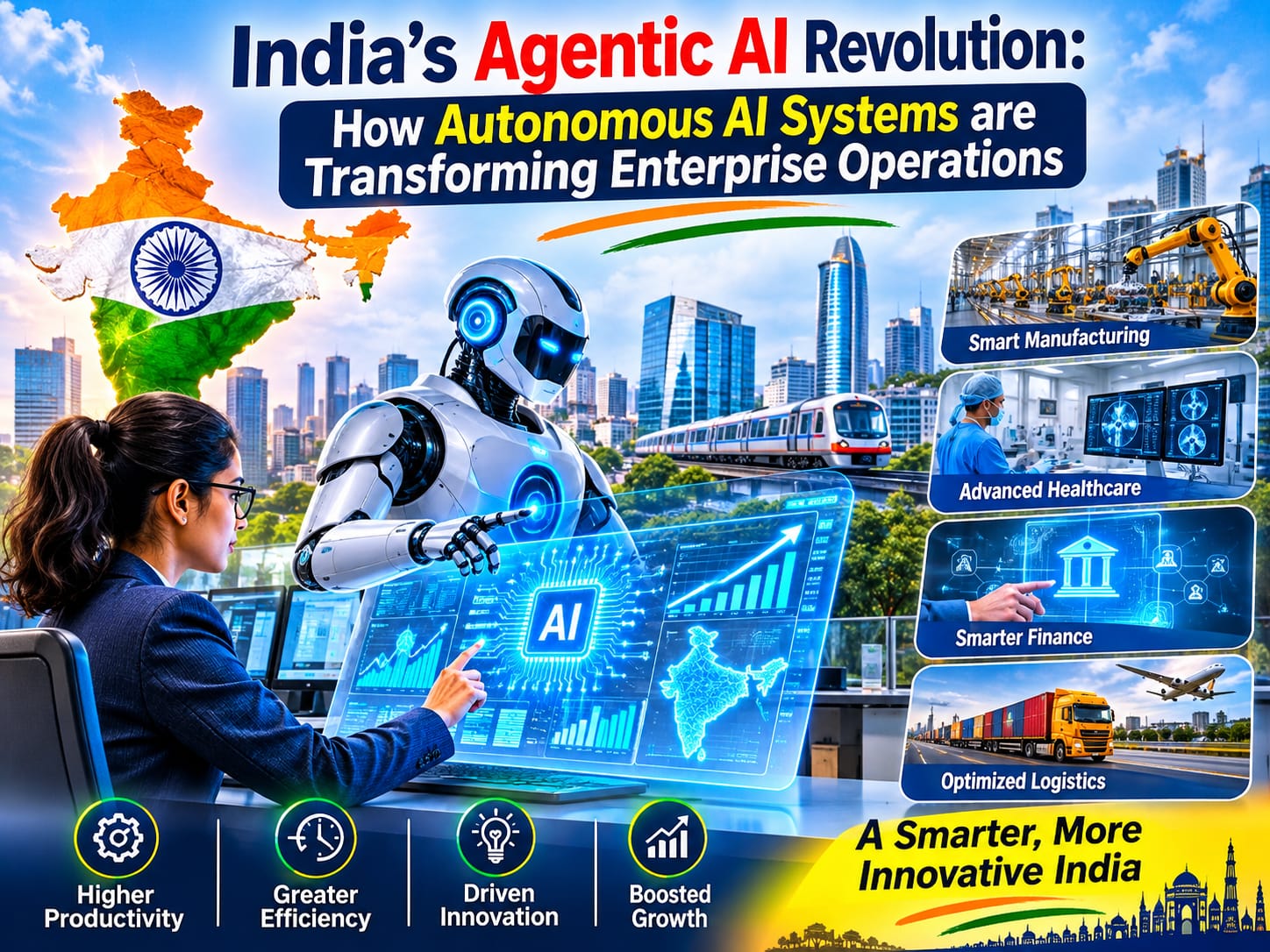
Nov 11: Artificial Intelligence (AI) is evolving beyond traditional automation and basic chatbots towards more intelligent and autonomous technologies. One of the key developments driving this transformation is Agentic AI, a form of artificial intelligence that enables systems to independently understand objectives, plan tasks, make decisions and execute actions with minimal human intervention.As Indian businesses increasingly adopt AI to improve efficiency, streamline operations and enhance customer experiences, Agentic AI is emerging as a significant force in enterprise transformation. It is opening new possibilities across industries by enabling businesses to automate complex workflows, coordinate multiple activities and make faster operational decisions.
The growing interest in this technology is also reflected in industry research. According to Deloitte’s State of GenAI Report (Fourth Wave): India Perspective, published in 2025, more than 80% of Indian organisations were exploring the development of autonomous AI agents. The report also found that 50% of organisations identified multi-agent workflows as a key focus area.
These findings highlight an important shift in India’s AI adoption journey. Businesses are gradually moving beyond using AI simply to generate content or answer queries towards exploring intelligent systems capable of independently managing interconnected tasks and business processes.
Agentic AI vs Traditional AI and Automation
Agentic AI represents a shift from simply generating responses to independently executing tasks and achieving specific objectives. Unlike Generative AI, which primarily creates content such as text, images and code based on human prompts, Agentic AI uses Large Language Models (LLMs) as reasoning engines to understand goals, plan workflows, interact with external tools and perform actions with minimal human intervention.
Understanding the Think–Act–Observe–Repeat Cycle
Agentic AI follows a continuous operational process that enables systems to understand situations, take action and improve their approach based on outcomes.
- Perceive: Collects information from databases, applications and connected sources.
- Think: Analyses the objective and plans the steps required.
- Act: Executes tasks using APIs, browsers and enterprise software.
- Observe: Evaluates the outcomes of completed actions.
- Adapt: Adjusts its approach based on new information or unexpected situations.
Unlike traditional AI, which focuses on analysing information, generating predictions or responding to prompts, and Robotic Process Automation (RPA), which performs repetitive, rule-based tasks, Agentic AI can manage interconnected workflows and make context-based decisions.
For example, while RPA can process invoices using predefined rules, an AI agent can review invoices, identify discrepancies, compare purchase orders, request missing information and forward exceptions for human approval.
Advanced Agentic AI systems can also use multiple specialised agents that collaborate through multi-agent orchestration, allowing them to manage different responsibilities while working towards a common business objective.
Agentic AI Transforming Business Operations in India
India’s expanding digital economy is encouraging businesses to adopt intelligent technologies to improve productivity, streamline operations and enhance decision-making. Agentic AI can support this transformation across several business functions by automating interconnected tasks and reducing manual intervention.
Key Business Applications of Agentic AI
1. Business Operations and Workflow Automation
AI agents can manage documentation, approvals, scheduling, reporting and data processing. For example, an AI agent in a procurement department can monitor inventory, identify purchasing requirements and compare approved suppliers before preparing purchase recommendations.
2. Customer Service and Experience
Agentic AI can understand customer requirements, retrieve relevant information, resolve eligible service requests and coordinate follow-ups. For instance, an e-commerce business can use AI agents to track orders, identify delivery delays and initiate return requests.
3. Banking and Financial Management
AI agents can assist with transaction monitoring, document verification, invoice reconciliation and risk assessment. An AI system can identify unusual transaction patterns and flag them for further investigation.
4. Supply Chain and Logistics
AI agents can monitor inventory, track shipments and identify potential supply disruptions. If a supplier delays a delivery, the system can evaluate alternative suppliers and recommend adjustments to procurement plans.
5. Human Resources and Recruitment
AI agents can assist with candidate screening, interview scheduling, onboarding documentation and employee queries. For example, an AI system can shortlist applications based on predefined job requirements and coordinate interview schedules.
6. Manufacturing and Industrial Operations
By analysing equipment data and sensor information, AI agents can identify unusual performance patterns, recommend preventive maintenance and coordinate technical support to minimise operational disruptions.
Real-World Applications of the Agentic AI Revolution
Agentic AI is creating opportunities beyond conventional automation by enabling systems to coordinate multiple activities and work towards specific business objectives.
Some practical applications include:
- Intelligent Recruitment: AI agents can identify suitable candidates, prepare screening questions, draft outreach messages and organise interview schedules.
- Technical Support: AI-powered systems can analyse technical issues, retrieve relevant documentation and recommend solutions before escalating complex cases to specialists.
- Insurance Claims Processing: AI agents can review claim documents, verify policy information, identify discrepancies and forward suspicious or complex cases for human assessment.
- Automated Customer Communication: AI agents can respond to customer enquiries, retrieve booking or service information and provide personalised updates.
- Enterprise Data Integration: AI agents can connect information across ERP, CRM and database systems to coordinate workflows and support faster business decisions.
These applications highlight the potential of Agentic AI to transform enterprise operations by connecting different business functions, improving coordination and enabling more efficient workflows.
However, human supervision remains essential for sensitive decisions, regulatory compliance and high-risk activities.
Key Benefits of Agentic AI for Indian Enterprises
The adoption of autonomous AI systems can offer businesses several operational and strategic advantages.
- Higher Operational Efficiency: Automating interconnected activities reduces repetitive manual work and improves workflow coordination.
- Faster Decision-Making: AI agents can analyse large volumes of information and provide relevant insights to support business decisions.
- Improved Employee Productivity: Employees can dedicate more time to strategic planning, problem-solving and customer relationships.
- Better Customer Experience: Intelligent systems can provide faster responses and coordinate customer requests across departments.
- Cost Optimisation: Businesses can identify process inefficiencies, minimise unnecessary manual effort and improve resource utilisation.
- Scalability: Enterprises can expand AI-supported workflows as business volumes and operational requirements increase.
- Improved Accuracy: Automated information processing and verification can reduce certain types of manual errors, although AI-generated outputs still require validation.
Challenges in Implementing Agentic AI in India
Despite its potential, implementing Agentic AI across enterprise environments involves several challenges. Businesses must address these concerns before deploying autonomous systems at scale.
Data Security and Privacy: AI agents may access sensitive business and customer information. Enterprises need strong data protection measures, secure integrations and appropriate access controls.
Integration with Existing Systems: Connecting autonomous AI agents with legacy software, databases and enterprise applications can be technically challenging.
Implementation Costs: Developing, integrating and maintaining AI infrastructure requires investment in technology, skilled professionals and continuous monitoring.
Accuracy and Reliability: AI agents can generate incorrect information or take inappropriate actions if their instructions, data or decision-making processes are inadequate.
Regulatory Compliance: Enterprises must ensure that their AI applications follow applicable Indian laws, industry regulations and data protection requirements.
Human Oversight: Autonomous systems should operate within clearly defined permissions, approval processes and accountability structures.
Addressing these challenges requires a structured implementation strategy that balances automation with transparency, security and human supervision.
The Role of Human Intelligence in an Agentic AI-Driven Workplace
The growing adoption of Agentic AI does not eliminate the importance of human involvement. Instead, it changes how employees interact with technology and manage organisational responsibilities.
AI agents can handle repetitive workflows, process information and coordinate routine activities. Human professionals remain essential for strategic decisions, complex problem-solving, ethical considerations, relationship management and accountability.
Enterprises must establish clear boundaries defining which activities AI agents can perform independently and which require human approval.
A human-in-the-loop approach allows organisations to maintain control over important business decisions while benefiting from the speed and efficiency of autonomous operations.
Ultimately, the objective is not to replace human intelligence but to combine it with AI capabilities to create more productive and responsive workplaces.
Preparing Indian Businesses for the Agentic AI Revolution
Successful Agentic AI adoption requires more than experimenting with individual AI tools. Enterprises need a structured approach that connects technology investments with measurable business objectives.
Identify Suitable Business Processes: Begin with repetitive and time-consuming workflows where automation can deliver measurable improvements.
Build Reliable Data Infrastructure: Ensure that business information is accurate, organised, secure and accessible to authorised AI systems.
Choose Appropriate AI Platforms: Select technologies that integrate with existing enterprise applications and meet specific operational requirements.
Establish Governance Frameworks: Define access permissions, decision-making boundaries, approval requirements and accountability mechanisms.
Train Employees: Help employees understand how to work alongside AI agents and manage AI-supported workflows.
Monitor Performance: Regularly evaluate accuracy, productivity, operational costs, security and business outcomes.
Starting with controlled pilot projects can help enterprises understand the practical value of Agentic AI before expanding its adoption across multiple departments.
The Future of Agentic AI in India’s Enterprise Ecosystem
India’s expanding digital infrastructure, growing technology talent pool, startup ecosystem and increasing enterprise adoption of artificial intelligence create significant opportunities for Agentic AI development.
In the coming years, businesses may increasingly move towards interconnected AI-agent ecosystems in which specialised agents collaborate across finance, marketing, customer service, operations, procurement and supply chain management.
For example, an enterprise could deploy separate AI agents for financial analysis, inventory monitoring, customer support and business reporting. These agents could exchange relevant information and coordinate activities to support broader organisational objectives.
The growing interest in multi-agent workflows, highlighted by Deloitte’s 2025 India findings, reflects the importance businesses are placing on this collaborative approach to automation.
The development of multi-agent systems, improved reasoning capabilities and secure enterprise integrations could further expand the scope of autonomous operations.
However, the pace of adoption will depend on technological maturity, data readiness, implementation costs, regulatory clarity and organisational trust.
For Indian enterprises, the next stage of digital transformation may therefore involve a shift from simply using AI-powered tools to building intelligent systems capable of managing complete business workflows.
Conclusion: The Future of Autonomous Businesses
Agentic AI is transforming enterprise operations by improving efficiency, automating complex workflows and supporting smarter decisions. Deloitte’s findings indicate that Indian organisations are increasingly exploring autonomous agents and multi-agent workflows, reflecting growing interest in the next stage of enterprise AI adoption.However, successful implementation requires more than technological investment. Businesses must prioritise data security, regulatory compliance, reliable infrastructure, employee readiness and human oversight.As autonomous AI systems continue to evolve, organisations that combine intelligent automation with human judgement will be better positioned to improve productivity, strengthen operational capabilities and achieve sustainable digital transformation.The future of business will not be defined by how much work machines can do alone, but by how intelligently humans and AI agents work together to achieve more.