
New Delhi, Nov 19: The Council of Scientific and Industrial Research (CSIR) has stepped up efforts to take home-grown innovations from laboratories to the marketplace, transferring a range of indigenous technologies to industry partners for commercialisation and wider deployment.
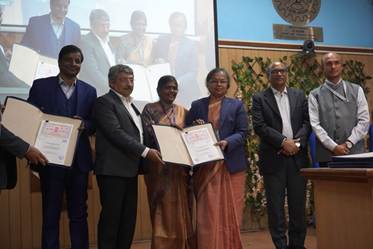
At a technology transfer and Memorandum of Understanding (MoU) signing event held at CSIR Headquarters in New Delhi, four CSIR laboratories presented technologies focused on infrastructure resilience, sustainable construction, road development and the productive use of industrial and agricultural waste.
The event brought together CSIR-Structural Engineering Research Centre (CSIR-SERC), Chennai; CSIR-Central Road Research Institute (CSIR-CRRI), New Delhi; CSIR-Advanced Materials and Processes Research Institute (CSIR-AMPRI), Bhopal; and CSIR-Indian Institute of Petroleum (CSIR-IIP), Dehradun.
The programme was chaired by Dr N. Kalaiselvi, Secretary of the Department of Scientific and Industrial Research (DSIR) and Director General of CSIR. It forms part of the council’s monthly initiative to strengthen industry partnerships and accelerate the commercialisation of technologies developed in its laboratories.
Emergency Power-Line Restoration and Green Construction Solutions
CSIR-SERC showcased three technologies designed to address infrastructure challenges while promoting resource-efficient construction.
One of the key innovations was the Emergency Retrieval System (ERS) for Power Lines, an indigenous, lightweight and modular structural system developed to help restore electricity transmission lines quickly after failures or disruptions. CSIR-SERC transferred the technology to IFAB Global for industrial deployment.
The laboratory also transferred its technologies for manufacturing eco-friendly bricks, hollow blocks and paver blocks using recycled aggregates to the National Automotive Test Tracks (NATRAX).
These construction products use 100% recycled aggregates and industrial waste, offering an alternative to conventional raw materials. The approach is intended to reduce dependence on natural aggregates and encourage the large-scale reuse of construction and demolition waste.
A third technology, Ultra-High-Performance Concrete (UHPC) Pavement, was also transferred to NATRAX for pilot-scale field implementation. Designed to withstand heavy axle loads, the material offers high strength, durability and lower maintenance requirements, with potential applications in longer-lasting road infrastructure.
Reclaimed Asphalt Technology to Reduce Dependence on Virgin Materials
CSIR-CRRI presented a portfolio of sustainable road construction technologies developed through collaborative research with CSIR-AMPRI and CSIR-IIP.
Among them was MicroReAct-RAP™, a cold micro-surfacing technology that incorporates up to 40% reclaimed asphalt pavement (RAP). The solution is designed to promote the reuse of existing road materials while reducing the need for virgin aggregates and bitumen emulsion.
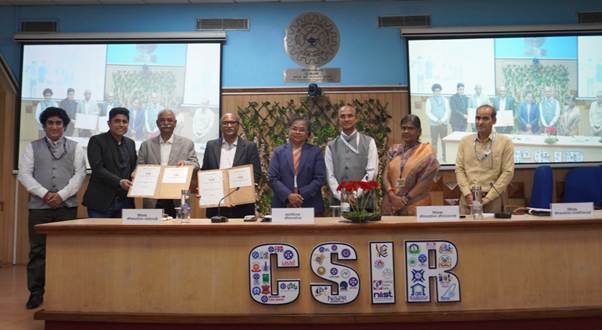
The technology was transferred to three companies: Innovative Roadztech Private Limited, Delhi; AVK BlackGold Infra Private Limited, Surat; and Hindustan Colas Private Limited (HINCOL), Mumbai.
By incorporating reclaimed road material into maintenance and surfacing solutions, the technology supports more resource-efficient road construction and the circular use of infrastructure materials.
Bio-Bitumen Converts Agricultural Waste into Road-Building Material
Another major development was the transfer of Bio-Bitumen, produced through collaborative research by CSIR-CRRI and CSIR-IIP.
The technology converts agricultural residues, including rice straw or parali, into a biomass-derived material that can partially replace conventional petroleum-based bitumen used in road construction.
The technology was transferred to RAACS Solutions Private Limited, Bihar, operating as BioBhoomi, and SAR Parivahan Private Limited, Kolkata.
The innovation offers a potential route to add value to agricultural waste while diversifying the materials available for road construction. It also reflects CSIR’s wider focus on developing technologies that connect industrial requirements with sustainability objectives.
New MoUs Expand Research and Industry Partnerships
Alongside technology transfers, CSIR-CRRI signed two MoUs to deepen research cooperation, technical exchange and industry engagement.
The first agreement was signed with the Global Automotive Research Centre (GARC), Tamil Nadu, under the National Automotive Board, Ministry of Heavy Industries. The partnership will cover joint research and development, access to testing facilities, technical projects, seminars and academic exchanges. Dr A. S. Ramadhas, Director of GARC, signed the agreement on behalf of the organisation.
The second MoU was signed with Pārakhi Skill Systems Private Limited, Patna. It focuses on collaborative research in driver risk assessment, cognitive and psychomotor evaluation, field trials, research publications and related technology deployment.
These partnerships are expected to strengthen cooperation between research institutions and industry in areas connected with road safety, automotive testing and technology development.
CSIR Emphasises Faster Transition from Laboratory to Market
Addressing the gathering, Dr Kalaiselvi said CSIR must expand the transfer of its technologies to industry so that research conducted in its laboratories delivers measurable economic, industrial and social benefits.
She emphasised that developing a technology is only one part of the innovation process. Effective mechanisms for industrial adoption, commercialisation and large-scale deployment are equally important to ensure that research outcomes reach users.
The monthly technology transfer programme, she noted, provides a platform for closer engagement between CSIR laboratories and industry partners, helping innovations move from the research stage towards practical applications.
The event concluded with a vote of thanks by Dr Thallada Bhaskar, Director of CSIR-AMPRI, who acknowledged the contributions of CSIR leadership, participating laboratories, industry partners and other stakeholders.
With technologies spanning power infrastructure, recycled construction products, road maintenance and agricultural-waste utilisation, the latest transfers underline CSIR’s efforts to turn indigenous scientific research into practical solutions for industry and sustainable development.