
New Delhi, Nov 19: In a fresh push to preserve and protect India’s traditional knowledge heritage, the CSIR-Traditional Knowledge Digital Library (CSIR-TKDL) Unit and the Indian Knowledge Systems (IKS) Division of the Ministry of Education have signed a Memorandum of Understanding (MoU) to expand cooperation in traditional knowledge, intellectual property rights (IPR) and the rights of communities that hold such knowledge.
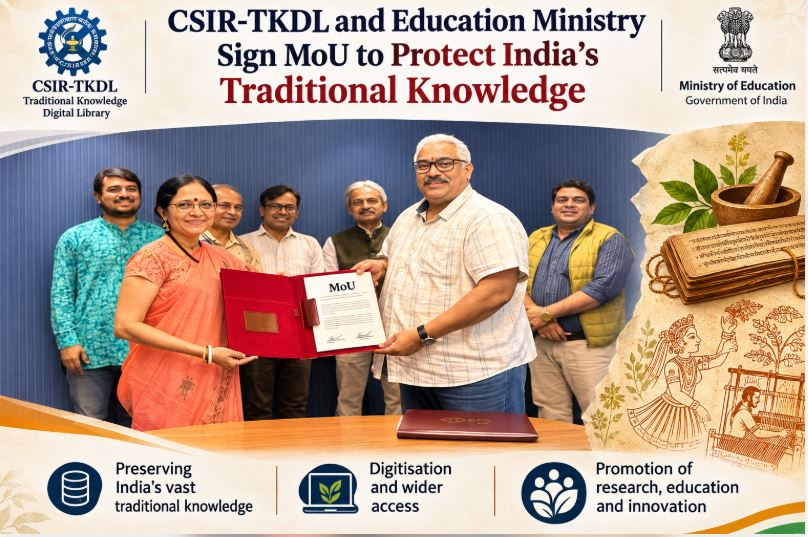
The agreement, signed on Wednesday, seeks to strengthen institutional collaboration in research, education, awareness and the responsible use of India’s traditional knowledge. It also aims to build a stronger framework for safeguarding the interests of traditional knowledge holders.
The MoU was signed by Prof. Ganti S. Murthy, National Coordinator of the IKS Division and Professor at IIT Indore, and Dr Viswajanani J. Sattigeri, Scientist-H and Head of the CSIR-TKDL Unit. Senior officials from both organisations attended the signing ceremony.
Building on an Established Partnership
The latest agreement extends a partnership that began with an MoU signed on June 29, 2023, in the presence of Union Minister of State (Independent Charge) for Science and Technology and Earth Sciences Dr Jitendra Singh, and CSIR Director General and DSIR Secretary Dr N. Kalaiselvi.
Since then, the two institutions have jointly organised 11 workshops focusing on traditional knowledge, intellectual property rights and the rights of knowledge-holding communities.
The programmes have reached students, research scholars, university faculty, scientists, Army personnel, yoga trainers and project associates. Participants came from several States and Union Territories, including Tamil Nadu, Karnataka, Maharashtra, Uttar Pradesh, West Bengal, Delhi, Punjab, Jammu and Kashmir, Kerala, Gujarat, Andhra Pradesh, Rajasthan, Puducherry and Chhattisgarh.
Their joint activities have also included training programmes, seminars, webinars, conferences, exhibitions and publications aimed at improving public and institutional understanding of India’s traditional knowledge systems.
Focus on Stronger IPR Protection and Community Rights
Speaking at the event, Prof. Murthy highlighted the importance of the partnership in advancing the objectives of the National Education Policy (NEP) 2020 and the vision of Atmanirbhar Bharat, guided by the country’s Bharatiya Gnana Parampara.
He called for greater awareness and guidance on intellectual property issues linked to Indian Knowledge Systems, particularly in areas such as patents, copyrights and geographical indications.
He also stressed the need for effective attribution mechanisms to ensure that traditional knowledge holders receive due recognition. Exploring suitable legal instruments to protect India’s traditional knowledge was identified as another important area for future cooperation.
Promoting Research, Innovation and Fair Benefit-Sharing
Dr Sattigeri said the workshops conducted under the earlier partnership had received encouraging responses from students, young faculty members and participating institutions.
She noted that the renewed collaboration could encourage wider adoption, research and development, and innovation based on Indian traditional knowledge, while supporting the country’s socio-economic progress.
She also underlined the importance of equitable benefit-sharing with traditional knowledge holders. Preserving the country’s knowledge heritage, while making it relevant to contemporary challenges and future generations, remains a key priority.
Supporting the Vision of Viksit Bharat 2047
Both institutions have reiterated their commitment to revitalising India’s traditional knowledge systems through education, research, innovation and coordinated institutional efforts.
By combining the strengths of the IKS Division and the Traditional Knowledge Digital Library, the partnership seeks to improve the preservation, protection and responsible application of traditional knowledge.
The renewed cooperation is expected to contribute to the wider national vision of Viksit Bharat 2047, while ensuring that India’s traditional knowledge remains protected, recognised and meaningfully connected to future generations.