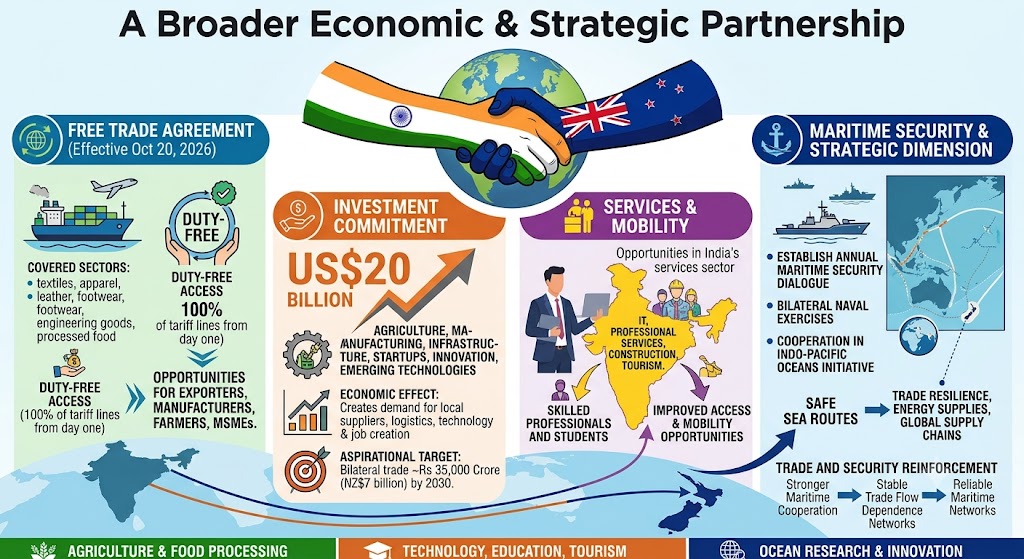
India and New Zealand are entering a new phase of economic and strategic cooperation, with the upcoming Free Trade Agreement (FTA), a major investment commitment and stronger maritime engagement creating a broader platform for growth.
The India-New Zealand FTA is scheduled to come into force on October 20, 2026, giving Indian exporters duty-free access to the New Zealand market across 100 per cent of tariff lines from day one. The agreement covers labour-intensive sectors such as textiles, apparel, leather, footwear, engineering goods and processed food, creating opportunities for manufacturers, farmers, exporters and MSMEs.
The economic impact could extend beyond higher exports. Easier market access can encourage companies to expand production, strengthen supply chains and explore new business partnerships. For MSMEs in particular, lower trade barriers can make it easier to enter an overseas market and build long-term commercial relationships.
Investment Could Strengthen India’s Growth Ecosystem
A key element of the partnership is New Zealand’s commitment to facilitate US$20 billion in investment in India. The investment commitment is expected to create opportunities across areas including agriculture, manufacturing, infrastructure, startups, innovation and emerging technologies.
Such investment can have a wider economic effect when capital flows into productive sectors. New projects can generate demand for local suppliers, logistics providers, technology companies and professional services while creating employment opportunities.
The two countries have also set an aspirational target of doubling bilateral trade in goods and services to NZ$7 billion, around Rs 35,000 crore, by 2030. With bilateral merchandise trade at around US$1.1 billion in 2025-26, the target indicates significant room for expansion.
The agreement also opens opportunities for India’s services sector. Indian companies and professionals will gain improved access across areas including IT, professional services, construction, tourism and other services, while provisions for skilled professionals and students create additional mobility opportunities.
Maritime Security Adds a Strategic Dimension
The partnership is not limited to trade and investment. Maritime cooperation is becoming an important part of the relationship as both countries look to strengthen security and resilience across the Indo-Pacific.
India and New Zealand have agreed to establish an annual Maritime Security Dialogue to improve coordination, information exchange and practical cooperation. The two sides have also welcomed naval activities, including bilateral exercises, and are exploring cooperation under New Zealand’s role as the maritime-security pillar partner of the Indo-Pacific Oceans Initiative.
This cooperation has practical economic significance as well. Secure sea routes are essential for international trade, energy supplies, food shipments and global supply chains. Greater coordination on maritime security, information sharing and issues such as illegal, unreported and unregulated fishing can contribute to safer and more resilient maritime networks.
Trade and Security Working Together
The growing economic relationship and maritime partnership can reinforce each other. Higher trade creates greater dependence on reliable shipping routes, ports and logistics networks, while stronger maritime cooperation can support the stability needed for businesses to move goods and investment across borders.
The partnership also extends into agriculture, food processing, technology, education, tourism, ocean research and innovation. Cooperation in these areas can create additional links between businesses, institutions and researchers in both countries.
For India, the relationship provides another channel to expand exports, attract overseas investment and connect Indian companies with opportunities in the wider Indo-Pacific. For New Zealand, the partnership provides access to India’s large and expanding market while creating opportunities for investment and collaboration in sectors ranging from agriculture to technology.
The coming into force of the FTA therefore represents only one part of a much broader relationship. With trade expansion, investment, services, maritime security and technology cooperation developing alongside each other, India-New Zealand ties are increasingly taking the shape of an economic and strategic partnership with wider implications for businesses and regional connectivity.