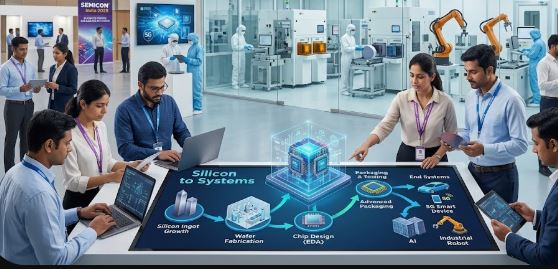
India’s electronics and semiconductor story is moving beyond the race to build factories. As investments pour into chip manufacturing, packaging, electronics production and related technologies, the next challenge is to connect these individual strengths and create an ecosystem that can compete across global value chains.
Industry experts are increasingly calling for a “whole-of-industry” approach, where semiconductor companies, electronics manufacturers, component suppliers, technology firms, research institutions, startups and skilled professionals work as parts of one connected ecosystem. The idea is to ensure that growth in one segment creates opportunities for the others rather than developing in isolation.
The shift is important because a semiconductor ecosystem is much larger than a fabrication plant. From materials and specialised equipment to chip design, manufacturing, testing, advanced packaging and finished electronics, every stage plays a role in determining how competitive the overall industry becomes.
This broader approach was also reflected in the theme of SEMICON India 2026 — “Silicon to Systems: Building the Ecosystem.” The event brought together more than 600 companies and participants from 52 countries, with discussions covering investment, manufacturing, innovation, talent and collaboration across the electronics and semiconductor value chain.
Moving Beyond Assembly
India has already established a sizeable electronics manufacturing base, but the next phase is expected to focus more heavily on domestic value addition. That means building stronger capabilities in components, semiconductor materials, equipment, design, packaging and research alongside the manufacturing of finished products.
The semiconductor push is already attracting large global investments. Applied Materials, for instance, announced plans to invest $5 billion in India over the next decade, while investment proposals worth around $11–12 billion were reported under Semicon 2.0 during SEMICON India 2026.
These investments are significant not simply because of the capital involved, but because they can bring technology, supplier networks, specialised skills and new business opportunities into the country.
Building the Missing Links
For India to become a stronger global electronics and semiconductor hub, experts say the supporting ecosystem will be just as important as the headline manufacturing projects.
That includes reliable access to materials and equipment, specialised logistics, testing and packaging facilities, research infrastructure and a workforce trained for highly technical manufacturing processes. Stronger links between universities, research institutions and industry can also help move ideas from laboratories into commercial production.
The opportunity extends well beyond chips. A stronger semiconductor base can support industries such as automobiles, telecommunications, consumer electronics, artificial intelligence, data centres, defence technology and electric mobility, all of which increasingly depend on advanced electronics.
India’s semiconductor market itself is projected to expand substantially, with an EY-IESA report estimating growth from around $64 billion in 2026 to $200 billion by 2035. The projection highlights the size of the domestic opportunity, while also underlining the need to develop manufacturing and supply-chain capabilities alongside rising demand.
Collaboration Will Shape the Next Phase
The emerging model is not necessarily about producing every component within India. Instead, the focus is increasingly on developing strong capabilities in strategically important areas while building partnerships with global companies for technologies and inputs where international collaboration remains essential.
For businesses, this could open opportunities across the supply chain—from semiconductor materials and equipment to packaging, logistics, software, components and specialised manufacturing services.
For workers and young professionals, the expansion could create demand for engineers, technicians, researchers, chip designers and other specialised talent. For manufacturers, a deeper domestic ecosystem could provide greater access to suppliers and technology while improving India’s ability to participate in global production networks.
India’s electronics and semiconductor ambition is therefore becoming less about building a few large plants and more about connecting the entire chain. The real opportunity lies in moving from “chips made in India” to a broader ecosystem in which chips, components, electronics and technology systems are designed, manufactured and developed together.