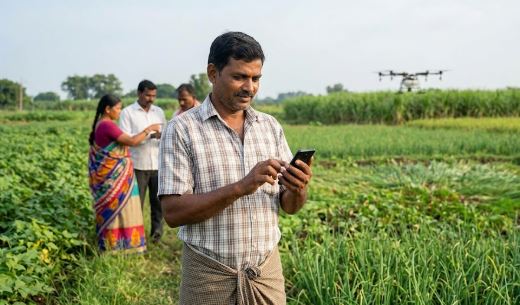
India’s small farmers are increasingly turning to technology to tackle some of agriculture’s most persistent challenges, from rising input costs and unpredictable weather to limited market access and fluctuating crop prices. While digital tools, modern machinery and online marketplaces are opening new opportunities, the real test lies in making these solutions affordable and accessible to farmers who need them most.
Small and marginal farmers account for more than 85% of India’s operational agricultural holdings. For these households, even a modest improvement in crop productivity, lower cultivation costs or better selling prices can make a meaningful difference to annual earnings. Technology can help deliver these gains, but its success depends on how effectively it addresses the everyday realities of farming.
Smart Farming Offers a Way to Reduce Costs
For small farmers, profitability often depends on controlling the cost of seeds, fertilisers, pesticides, water and labour. Traditional farming practices can lead to unnecessary expenditure when farmers lack timely information about soil conditions, pest attacks or changing weather patterns.
Digital soil testing, weather forecasting tools and mobile-based agricultural advisories can help farmers make more informed decisions. By understanding when to irrigate, how much fertiliser to apply and when to protect crops against pests, farmers can reduce waste and use resources more efficiently.
Drone technology is also creating new possibilities for crop monitoring and pesticide spraying. However, purchasing and maintaining a drone may be beyond the reach of an individual farmer with a small plot. Shared services, local rental providers and Farmer Producer Organisations (FPOs) can make such technology available at a more manageable cost.
Artificial intelligence is adding another layer of support through tools that analyse weather patterns, identify crop diseases and provide farming recommendations. When these services are available in regional languages and adapted to local conditions, they can help farmers make better decisions without requiring advanced technical knowledge.
The benefit is not simply the adoption of modern equipment. It is the possibility of producing more efficiently, avoiding preventable losses and protecting the income earned from each harvest.
Digital Marketplaces Can Improve Farmers’ Bargaining Power
Access to a reliable market remains one of the biggest challenges for small farmers. Many depend on nearby traders or wholesale markets because transporting produce to distant buyers can be expensive, time-consuming and risky. Limited information about prices in other markets can also weaken their negotiating position.
Digital agricultural marketplaces are helping bridge this information gap. The government’s Electronic National Agriculture Market, or e-NAM, connects participating agricultural wholesale markets through a common online trading platform. It aims to improve price discovery and make agricultural trading more transparent.
For farmers, access to market prices can help them compare available opportunities before deciding where and when to sell. However, better price information alone does not guarantee higher earnings. Quality testing, transport, storage facilities and prompt payments are equally important if farmers are to benefit from a wider market.
Agritech platforms are also connecting farmers with input suppliers, institutional buyers, retailers and other market participants. Direct purchasing arrangements can create additional selling opportunities, particularly for growers of fruits, vegetables and other perishable products.
Yet digital sales channels must remain commercially practical. If transport costs, packaging requirements or commission charges consume the additional revenue, farmers may see little improvement in their final earnings. The most effective platforms will be those that combine transparent pricing with dependable logistics and timely payments.
Digital Finance Can Strengthen Rural Livelihoods
Access to affordable credit is another important factor in improving farm incomes. Small farmers often need money before the sowing season to purchase seeds, fertilisers and equipment, while their earnings may not arrive until the crop is sold.
Digital financial services can simplify access to formal lending by helping financial institutions assess applications using available banking, transaction and agricultural information. Technology-enabled crop insurance can also support faster assessment of losses, although its effectiveness depends on reliable data, transparent claims procedures and timely compensation.
Government-backed digital payment systems have strengthened the delivery of agricultural support. Under the PM-KISAN scheme, eligible farmer families receive income support through direct bank transfers, helping them meet some farming and household expenses.
However, digital access should not become another hurdle for rural households. Incomplete land records, connectivity problems, difficulties with identity verification and limited familiarity with online services can prevent eligible farmers from receiving benefits or accessing credit. Accessible support through banks, agricultural extension workers and local service centres remains essential.
Farmer Producer Organisations Can Make Technology Affordable
The economics of technology often favour larger farms. Expensive machinery, specialised software and digital services may be difficult to justify when the same investment has to be recovered from a small area of land.
Collective purchasing and shared services offer a practical alternative. Through FPOs and farmer cooperatives, growers can pool demand, negotiate better rates, arrange bulk purchases and access equipment that would otherwise be too expensive for individual use.
A shared service model can allow farmers to pay for drone spraying, machinery rental, soil testing or digital advisory services only when required. This reduces the need for large upfront investments and makes modern farming tools more accessible to households with limited savings.
FPOs can also help farmers aggregate produce, improve sorting and grading, negotiate with buyers and explore storage or processing opportunities. These activities can strengthen their position across the agricultural value chain rather than limiting technology to the production stage.
For agritech businesses, this model offers an opportunity to reach more farmers through a single local institution. For farmers, it can turn technology from an expensive individual purchase into a service that supports collective economic gains.
Connectivity and Digital Literacy Remain Major Challenges
Despite its potential, technology cannot improve farm incomes equally everywhere. Patchy internet connectivity, limited digital literacy, language barriers and inadequate rural infrastructure continue to restrict adoption.
Farmers also need to know whether a technology will deliver benefits under their specific soil, weather and crop conditions. A tool designed for large commercial farms may not provide the same value to a household cultivating a small, fragmented plot.
There are concerns about the quality of agricultural advice, the protection of farmers’ data and dependence on private digital platforms. Farmers should be able to understand how their information is used and make decisions without being locked into a single service provider.
Investment in rural connectivity, practical training, local-language applications and reliable agricultural extension services will therefore be as important as developing new technology. Independent demonstrations and transparent information about costs and expected returns can help farmers assess whether an innovation is worth adopting.
The Future of Farm Technology Must Be Measured by Income
India’s agricultural technology market has considerable room to grow, but its long-term success will depend on whether innovation translates into better livelihoods. Higher crop yields alone are not enough if cultivation costs rise at the same time or farmers struggle to sell their produce at remunerative prices.
The next phase of agricultural development must bring together affordable technology, dependable markets, accessible credit, crop insurance and stronger rural infrastructure. Public institutions, agritech companies, banks, FPOs and local agricultural organisations all have a role to play in building this ecosystem.
For small farmers, the most valuable innovation may not be the most sophisticated machine or the newest application. It may be a simple weather alert that prevents crop damage, a shared machine that reduces labour costs, a reliable buyer who pays on time or a digital service that helps secure an affordable loan.
Ultimately, technology will fulfil its promise when it helps farmers retain more of what they earn, manage risks more confidently and build a more stable future for their families. The goal is not simply to modernise Indian agriculture, but to make farming a more viable and rewarding livelihood for the millions of households that depend on it.