Customer churn is one of the biggest challenges facing subscription businesses. Whether a company provides digital services, entertainment, online learning, software or regular product deliveries, its growth depends not only on attracting new customers but also on convincing existing subscribers to stay.
In a subscription business, customers pay regularly to access a product or service. When they cancel their subscriptions or stop renewing them, the business loses customers and potentially the recurring revenue they generate. This is known as subscription churn.
As consumers become more selective about their spending and competition increases across industries, businesses must continually demonstrate why their services are worth paying for. A complicated user experience, rising prices, poor customer support or recurring payment problems can all encourage subscribers to leave.
Reducing customer churn is therefore more than a customer service exercise. It is a business strategy that can help companies protect revenue, improve profitability and build stronger customer relationships. By understanding why subscribers leave and addressing those concerns early, businesses can create a more sustainable foundation for growth.
What Is Subscription Churn?
Subscription churn refers to the rate at which customers discontinue a subscription or fail to renew it during a specific period.
For example, if a business starts a month with 1,000 subscribers and 50 of those customers cancel during the month, its customer churn rate is 5%, assuming the calculation uses the opening customer base.
Customer churn rate formula:
Customer churn rate = (Customers lost during the period ÷ Customers at the beginning of the period) × 100
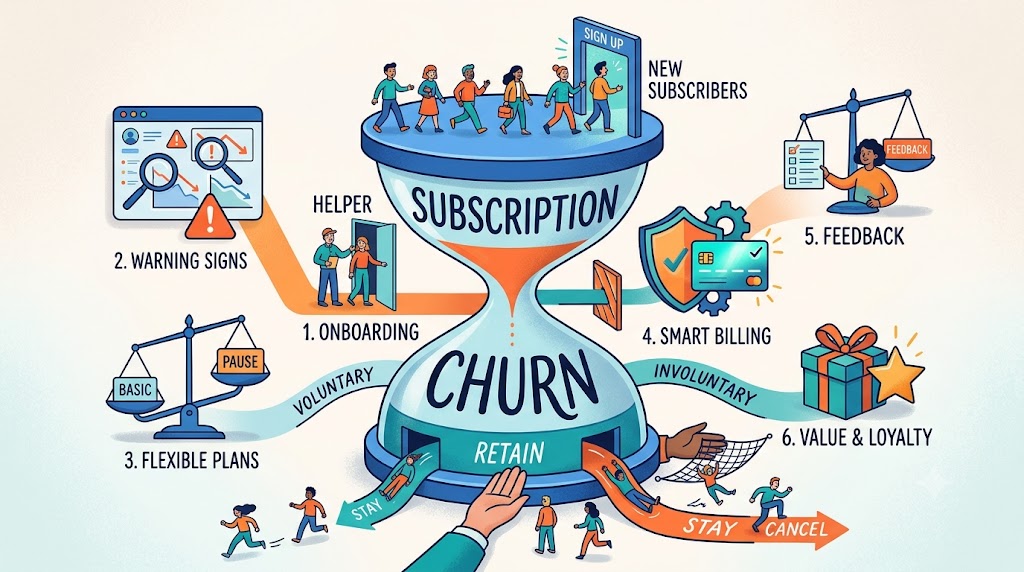
There are two main types of subscription churn.
-
Voluntary churn: Customers deliberately cancel because of price concerns, limited usage, dissatisfaction or changing needs.
-
Involuntary churn: Subscriptions end because of failed payments, expired cards or other billing issues, even when customers may want to continue.
Understanding this difference helps businesses choose the right retention strategies. Voluntary churn requires improvements to the customer experience and perceived value, while involuntary churn often calls for better payment systems and timely reminders.
1. Make the First Customer Experience Count
The relationship between a business and its subscriber often begins during onboarding. If customers find a service confusing or struggle to understand its benefits, they may cancel before they have a reason to stay.
Businesses can improve the experience by simplifying registration, providing clear instructions and helping new subscribers use the most valuable features quickly. Short tutorials, guided setup and relevant recommendations can make the service easier to understand.
The approach should reflect customer needs. A person joining an online learning platform may benefit from a clear learning plan, while a business adopting subscription software may need practical guidance on setting up its account.
A smooth start helps customers recognise the value of their subscription and encourages continued use.
2. Identify Warning Signs Before Customers Leave
Customers do not always announce their dissatisfaction before cancelling. A decline in logins, reduced feature usage, missed appointments or fewer purchases may indicate that a subscriber is losing interest.
Monitoring these patterns can help businesses identify customers who may need additional support. A company might offer a helpful tutorial, check whether a technical problem has occurred or recommend features that better match a customer’s needs.
Personalised communication can be effective when it is relevant and timely. However, businesses should avoid overwhelming customers with repeated promotional messages.
The aim is to address genuine concerns before they become reasons to cancel, rather than simply persuading customers to remain subscribed.
3. Offer Flexible Pricing and Subscription Plans
Price is an important factor in subscription decisions, particularly when customers are reviewing their monthly expenses. Some may be satisfied with a service but find that their current plan no longer fits their budget or usage.
Flexible options can provide an alternative to cancellation. Businesses may offer lower-cost plans, different billing cycles, temporary subscription pauses or the option to remove features customers no longer need.
For product-delivery services, customers may appreciate the ability to change delivery frequency. Software companies can provide plans suited to different business sizes, while digital platforms can offer clear choices based on access and features.
Transparent pricing is equally important. Customers should understand renewal dates, additional charges and cancellation terms from the beginning. Clear communication builds trust and reduces cancellations caused by unexpected costs.
4. Prevent Payment Failures With Smarter Billing
Not every lost subscriber has chosen to leave. Sometimes, a subscription ends because a payment cannot be processed.
Automated billing systems can help businesses reduce this type of churn by sending timely payment-failure notifications, reminding customers about expiring cards and making it easy to update payment information.
Automated payment retries can also recover some unsuccessful transactions, subject to payment-provider rules and customer consent. For businesses managing large subscriber bases, subscription management software can help monitor renewals and identify recurring billing problems.
These measures can protect revenue while making the payment experience more convenient for customers. Notifications should remain clear and helpful, without creating unnecessary pressure or repeated payment attempts.
5. Learn From Customers Who Cancel
When a customer decides to leave, the cancellation itself can provide useful information. A short, optional survey can help businesses understand whether the reason involves pricing, product quality, limited usage, missing features or changing circumstances.
Collecting feedback is only the first step. Businesses must use it to improve their services.
If customers repeatedly report confusing navigation, the company can simplify its platform. If support delays are a common complaint, it can improve response times. If customers struggle with affordability, the business can review its pricing structure.
Offering a plan downgrade or temporary pause during cancellation may also help retain customers when those alternatives meet their needs. However, the cancellation process should remain straightforward, allowing customers to leave without unnecessary obstacles.
6. Build Loyalty Through Consistent Value
Long-term customer retention depends on more than discounts and promotional offers. Subscribers are more likely to renew when a service consistently solves a problem, saves time or delivers an experience they value.
Loyalty programmes, exclusive benefits, useful product updates and personalised offers can strengthen the relationship. Regular communication can also help customers understand new features and improvements.
However, rewards cannot compensate indefinitely for poor service or an uncompetitive product. Businesses must continue to meet customer expectations through reliability, convenience and responsive support.
When customers feel that a subscription remains useful and fairly priced, they have a stronger reason to continue paying for it.
7. Track Customer Retention and Business Performance
Businesses need to measure customer churn alongside new subscriptions and revenue growth. Important indicators include the customer churn rate, renewal rate, failed-payment recovery rate and customer lifetime value.
These measures can show whether retention efforts are working. For example, a company may attract many new subscribers but still struggle financially if a large proportion cancel within a short period.
Reviewing performance across different plans and customer groups can reveal where improvements are needed. Businesses can then focus their resources on product development, customer support, pricing or billing processes that address the main reasons subscribers leave.
Regular monitoring also helps management distinguish between temporary changes and persistent problems that require a broader business response.
The Road Ahead for Subscription Businesses
As subscription models expand across industries, reducing customer churn will remain essential to sustainable business growth. Acquiring new customers is important, but retaining existing subscribers can help businesses maintain more predictable recurring revenue and make better use of their customer acquisition spending.
The most effective approach combines a smooth onboarding experience, fair pricing, reliable billing, useful customer communication and consistent service quality. Technology can help identify problems and automate routine tasks, but lasting customer loyalty depends on delivering genuine value.
Ultimately, successful subscription businesses do more than convince customers to sign up. They give people clear reasons to stay, renew and continue choosing their services over competing alternatives.