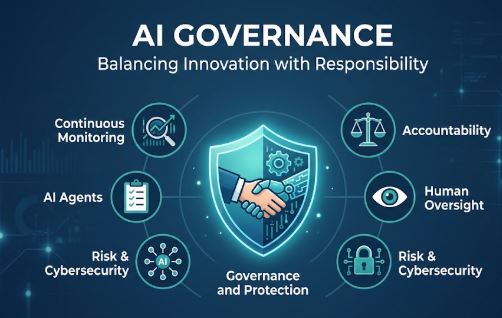
Artificial intelligence is changing how businesses operate, make decisions and serve customers. From automating routine tasks to analysing data and improving productivity, AI is creating new opportunities across industries. However, as companies rely more heavily on these systems, they must also address concerns around accuracy, data security, accountability and responsible use.
This has made AI governance in business an important part of corporate strategy. Companies are moving beyond basic compliance policies towards continuous monitoring, risk assessment and clear rules for using AI. The aim is to ensure that technology delivers measurable business value without creating unnecessary operational, legal or reputational risks.
For business leaders, effective AI governance is no longer simply a technical requirement. It is becoming a foundation for sustainable innovation, customer trust and long-term growth.
Why Businesses Need Continuous AI Monitoring
AI systems can produce inaccurate results, expose sensitive information or behave differently when conditions change. A model that performs well during testing may not always deliver reliable results in everyday operations.
Continuous monitoring helps businesses identify these issues early. Companies can track system performance, detect unusual behaviour, review outputs and investigate potential policy violations. Regular assessments also help organisations understand when a model needs to be updated or restricted.
For businesses, this approach can reduce errors, improve service quality and prevent small technical problems from becoming expensive operational setbacks.
Accountability Extends Beyond AI Developers
Many businesses use AI tools developed by external technology providers. However, purchasing a third-party solution does not remove the need to assess how it is used within the organisation.
Regulatory frameworks, including the European Union’s AI Act, establish responsibilities based on the type of AI system, its risk category and the role of the organisation. Businesses deploying AI must understand the obligations relevant to their activities rather than assuming that vendors are responsible for every aspect of compliance.
Companies should review supplier practices, data protection measures, system limitations and contractual responsibilities before introducing AI into important workflows. Clear documentation and internal approval procedures can further reduce uncertainty.
This is particularly important for businesses operating across markets, where legal requirements and expectations around AI may differ.
Managing the Risks of Autonomous AI
The emergence of AI agents is expanding automation beyond individual tasks. These systems can perform several connected actions, retrieve information and interact with business applications with limited human intervention.
Although autonomous workflows can improve efficiency, they also introduce new risks. An agent could access information it should not see, take an unintended action or continue a task after an error occurs.
Businesses should establish clear boundaries for automated systems. Access permissions, spending limits, approval requirements and activity logs can help prevent unauthorised actions. Human approval should remain essential for sensitive decisions involving payments, confidential data or significant customer and business consequences.
The objective is to capture the productivity benefits of autonomous AI while maintaining appropriate control over business operations.
AI Testing and Cybersecurity Become Essential
Before introducing AI into customer-facing or critical business processes, organisations need to test how systems respond to difficult or potentially harmful inputs.
AI red teaming is one approach. It involves deliberately testing a system to identify weaknesses, including attempts to bypass safeguards, obtain restricted information or generate misleading responses.
Such testing can help businesses identify vulnerabilities before they affect customers or employees. It should also continue after deployment, particularly when models, applications or data sources change.
Combining AI testing with established cybersecurity practices can strengthen protection against data leakage, manipulation and other emerging threats.
Human Oversight Helps Prevent Costly Mistakes
Automation can save time, but employees should not assume that every AI-generated answer is correct. When workers accept recommendations without reviewing them, inaccurate information can enter business decisions and customer communications.
Companies can reduce this risk by defining when human review is required. Routine, low-risk activities may be automated within approved limits, while sensitive decisions should receive additional scrutiny.
Employee training is equally important. Staff should understand how AI tools work, recognise their limitations and know how to report errors. Encouraging workers to question questionable outputs can help organisations maintain quality without losing the efficiency that automation offers.
AI Governance Requires Leadership Commitment
AI-related risks affect more than IT departments. They can influence financial performance, customer relationships, regulatory compliance and corporate reputation. Senior leaders therefore need to take an active role in setting priorities and assigning responsibility.
Businesses should identify who approves AI applications, who monitors performance and who responds when something goes wrong. Regular reviews can help management understand whether AI systems are meeting business objectives and operating within acceptable risk limits.
Useful indicators may include system accuracy, security incidents, compliance issues, human-review rates and the time taken to resolve problems. These measures should reflect the purpose and potential impact of each AI application.
Clear leadership helps prevent different departments from adopting AI tools without consistent safeguards or accountability.
New Opportunities for Skills and Services
As AI adoption grows, businesses need professionals who understand technology as well as risk management, privacy, cybersecurity and regulatory requirements.
This creates opportunities in AI auditing, model monitoring, security testing, employee training and governance consulting. Smaller businesses can also work with specialist providers to introduce appropriate safeguards without building large in-house teams.
Developing these capabilities can help companies make better use of AI while reducing the risks associated with poorly managed implementation.
Responsible AI Can Build Customer Confidence
Trust is becoming an important factor in how customers evaluate businesses that use artificial intelligence. Concerns about personal information, biased outcomes and unreliable automated decisions can weaken customer relationships if they are not addressed properly.
Transparent practices, careful data handling and clear channels for raising concerns can help organisations demonstrate responsibility. Businesses should also explain the role of AI where it is relevant to customer decisions or interactions.
Strong governance cannot eliminate every risk, but it provides a practical framework for identifying problems, responding to incidents and improving performance. This can protect brand reputation and support stronger relationships with customers and business partners.
The Future of AI Governance in Business
AI governance is evolving from a compliance exercise into an ongoing business responsibility. As artificial intelligence becomes more deeply integrated into daily operations, companies will need systems that combine continuous monitoring, clear accountability, regular testing and meaningful human oversight.
Businesses that approach governance strategically can make more informed decisions about where to use AI, which risks require additional controls and how to measure the results.
The real opportunity lies in balancing innovation with responsibility. By establishing clear safeguards and investing in the right skills, organisations can expand AI adoption with greater confidence, protect stakeholder trust and build a stronger foundation for long-term business growth.