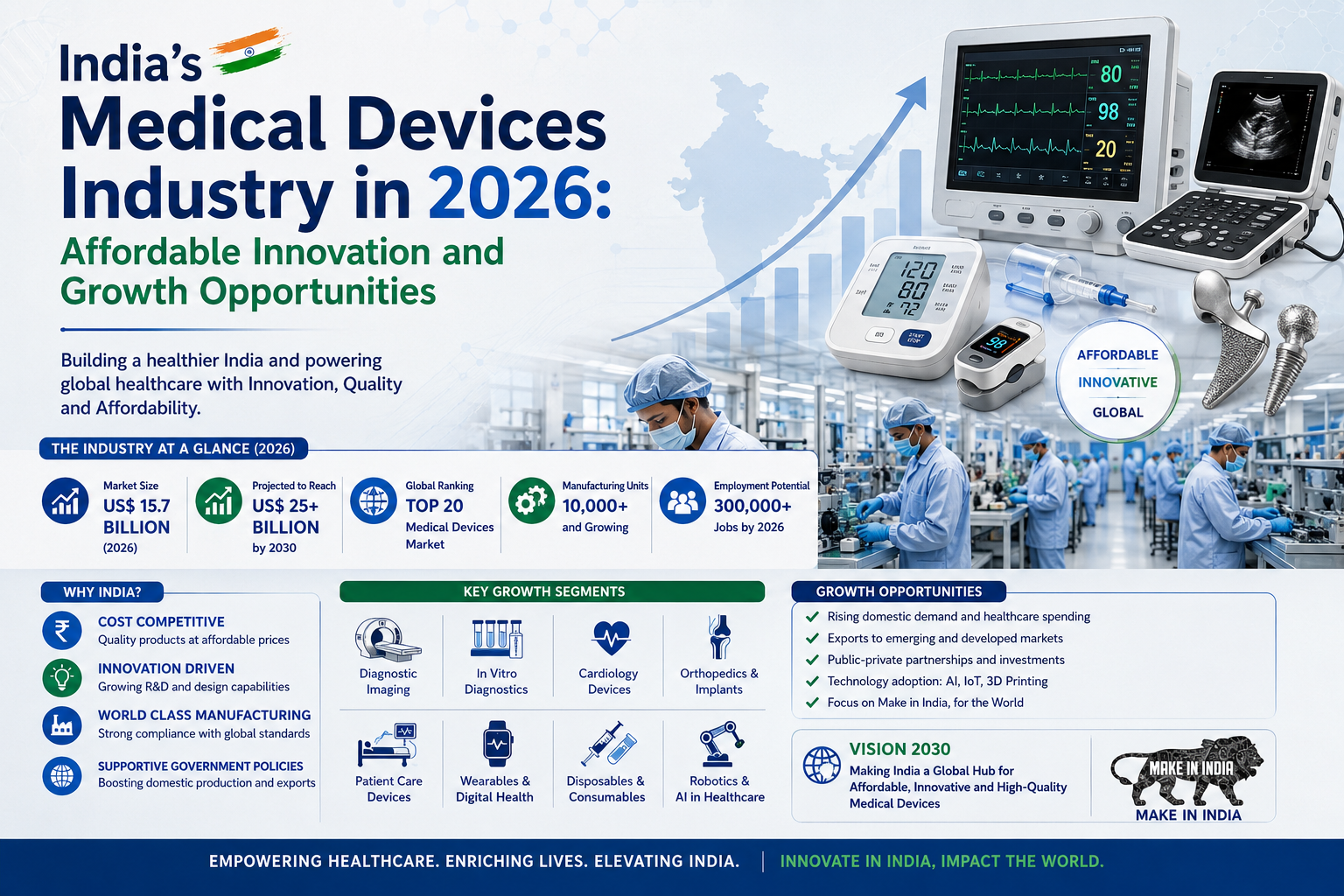
Oct 22: India’s medical devices industry is gaining importance as healthcare providers look for reliable, cost-effective equipment and manufacturers explore opportunities to expand domestic production. From diagnostic machines and surgical instruments to patient monitoring systems, medical technology plays an essential role in improving healthcare delivery.
However, access to advanced equipment remains a challenge for many healthcare facilities, particularly those working with limited budgets. This creates an opportunity for Indian manufacturers to develop affordable medical devices that meet clinical requirements without compromising quality, safety or performance.
In 2026, the focus is shifting beyond low-cost manufacturing towards practical innovation, stronger supply chains and technologies designed around the needs of Indian healthcare providers. For businesses, startups and investors, this presents opportunities across medical device manufacturing, product development and healthcare technology.
India’s Medical Devices Industry Is Expanding Its Global Presence
India’s medical devices industry covers a broad range of products, including medical consumables, diagnostic equipment, implants, surgical instruments and electro-medical devices. As healthcare infrastructure develops, demand for these products is creating opportunities for manufacturers across different segments.
The Economic Survey 2025–26 reported that India’s medical device exports increased from approximately US$2.5 billion in FY2020–21 to US$4.1 billion in FY2024–25. Indian manufacturers supplied medical devices to 187 countries in FY2024–25, reflecting the sector’s growing international reach.
The industry is also moving into more technically demanding product categories. Indian manufacturers are producing equipment such as MRI and CT scanners, cardiac stents, ventilators and linear accelerators. These developments indicate that domestic manufacturing is gradually expanding beyond traditional consumables and surgical supplies.
For Indian businesses, the opportunity lies in combining engineering expertise with an understanding of healthcare requirements, both at home and in international markets.
Industry Report: India’s Medical Device Exports and Imports
Government trade data highlights the progress made by India’s medical devices industry and the scope for further domestic manufacturing.
According to the Department of Pharmaceuticals’ Annual Report 2025–26, India’s medical device exports reached US$4.014 billion in FY2024–25, compared with US$2.532 billion in FY2020–21. Imports increased from US$6.242 billion to US$8.822 billion over the same period.
The figures illustrate two important trends. India’s export base is growing, but imports continue to exceed exports substantially.
This difference creates opportunities for manufacturers that can develop competitive domestic products, improve component sourcing and build dependable after-sales service networks. However, reducing import dependence will require more than increasing production capacity. Companies must also invest in research, testing, product quality and technologies that can compete with established international products.
For startups and established manufacturers, affordable diagnostic equipment, medical consumables, monitoring devices and specialised components are potential areas for further development.
Why Affordable Medical Innovation Matters
The cost of medical equipment can influence the range of services a healthcare facility can offer. Large hospitals may have the resources to invest in advanced systems, while smaller hospitals and diagnostic centres often need to manage equipment purchases alongside staffing, maintenance and other operating expenses.
Affordable medical technology can help address this gap when products are designed around real clinical needs.
Portable diagnostic devices, compact patient monitoring systems and cost-effective laboratory equipment can support healthcare delivery in facilities where space, budgets or technical resources are limited. Products designed for local conditions may also benefit from straightforward operation, accessible servicing and readily available replacement parts.
The important distinction is that affordable innovation does not simply mean reducing the selling price. It means delivering dependable performance at a cost healthcare providers can sustain.
A device that requires frequent repairs or expensive imported components may become costly over time. Manufacturers that consider the full cost of ownership can offer more practical solutions to hospitals and diagnostic centres.
Domestic Manufacturing Can Create New Business Opportunities
Strengthening medical device manufacturing in India is an important step towards building a more resilient healthcare supply chain.
The difference between exports and imports shows that Indian companies have room to expand production and develop capabilities in product categories currently supplied by international manufacturers. Opportunities extend beyond finished devices to electronic components, sensors, specialised materials, testing services and medical software.
Domestic manufacturing can improve access to technical support, reduce some supply-chain delays and help businesses adapt products to the requirements of local healthcare providers.
Smaller companies can also participate by supplying components, developing specialised software or manufacturing products for larger medical technology businesses. Such partnerships can help create a broader ecosystem of suppliers and technical expertise.
Nevertheless, local manufacturing does not automatically eliminate dependence on imported inputs. Developing reliable domestic component supply chains will require investment, skilled workers and collaboration between manufacturers, engineering institutions and research organisations.
Government Support for India’s Medical Device Industry
Government initiatives are helping create an environment for domestic manufacturing and technological development.
The Production Linked Incentive Scheme for Promoting Domestic Manufacturing of Medical Devices was introduced to encourage investment in selected high-value segments, including medical imaging, radiotherapy, anaesthesia, critical-care equipment and implants.
The government has also established initiatives relating to medical device parks, shared manufacturing infrastructure, skills development and clinical studies. The Department of Pharmaceuticals lists these programmes among its efforts to strengthen the medical technology ecosystem.
These initiatives can help manufacturers access specialised resources and develop new capabilities. For startups, access to testing facilities, technical expertise and industry partnerships can be particularly valuable when moving from product development to commercial production.
However, sustainable growth will depend on how effectively businesses translate these opportunities into reliable products that meet regulatory requirements and healthcare providers’ expectations.
How Startups Can Drive Affordable Healthcare Innovation
Medical technology startups can contribute by identifying specific problems in healthcare delivery and developing products to address them.
Advances in sensors, connected devices and software are creating opportunities in remote patient monitoring, portable diagnostics, point-of-care testing and rehabilitation technology. These products can help healthcare professionals monitor patients or conduct selected assessments in settings where conventional equipment may be less practical.
For example, a compact diagnostic system designed for a smaller facility may offer value through easier installation, simpler maintenance and lower operating costs. Its success, however, will depend on whether it meets the required clinical standards and fits into existing healthcare workflows.
Startups need to work closely with clinicians, biomedical engineers and healthcare administrators to understand these requirements. They must also account for product testing, regulatory compliance, manufacturing costs and after-sales support.
The strongest business opportunities are likely to emerge when a product solves a clear problem rather than simply introducing new technology.
Quality and Patient Safety Must Remain a Priority
Affordable medical devices must still meet the safety, quality and performance standards required for their intended use.
Manufacturers need to follow applicable regulations, maintain appropriate quality assurance processes and ensure that products are tested according to relevant requirements. The exact obligations depend on the device’s classification, intended purpose and target market.
Reliability is particularly important in healthcare environments, where equipment failure can disrupt services and create additional costs. Hospitals also need access to maintenance, calibration, replacement parts and trained technical personnel.
For this reason, manufacturers should consider the entire product lifecycle, from design and testing to servicing and eventual replacement.
Companies that combine competitive pricing with consistent quality and dependable technical support are better positioned to build trust among healthcare providers and distributors.
Export Opportunities for Indian Medical Device Manufacturers
Growing exports offer another avenue for the development of India’s medical devices industry.
Indian manufacturers already supply products to a wide range of international markets. To expand further, companies need to understand the regulatory requirements, procurement practices and service expectations of each market they enter.
Affordable products may appeal to healthcare systems seeking cost-effective equipment, but pricing alone is rarely enough to establish a sustainable export business. Manufacturers also need appropriate certifications, consistent production, reliable distribution and accessible after-sales support.
There are opportunities across established categories such as consumables and surgical instruments, as well as more specialised equipment. Businesses that invest in product development and quality systems can explore higher-value market segments over time.
Export growth can also encourage domestic manufacturers to improve their processes and compete on factors beyond price, including durability, technical performance and customer support.
Challenges Facing India’s Medical Devices Industry
Despite its growth potential, the industry faces several challenges that businesses must address.
Imported components: Dependence on specialised electronics, sensors and other inputs can affect production costs and supply-chain stability.
Research and development costs: Developing new devices requires engineering expertise, testing, investment and, where applicable, clinical evaluation.
Regulatory requirements: Manufacturers must understand the relevant rules for product classification, licensing, quality management and market access.
Technical infrastructure: Smaller businesses may have limited access to advanced testing facilities and specialised manufacturing equipment.
Maintenance and servicing: Devices need reliable technical support throughout their working life, particularly when used in critical healthcare settings.
Commercial sustainability: Manufacturers must balance affordable prices with the cost of quality materials, compliance, servicing and continued innovation.
Addressing these challenges will require sustained investment and closer collaboration between businesses, research institutions, healthcare providers and government agencies.
The Future of India’s Medical Devices Industry
The next phase of growth will depend on India’s ability to combine manufacturing scale with practical, high-quality innovation.
Healthcare providers need products that meet clinical requirements, fit their budgets and remain dependable over time. Manufacturers that understand these priorities can develop solutions for hospitals, diagnostic centres and other healthcare facilities while building opportunities in international markets.
Investment in research, skilled technical talent, domestic component production and collaboration with healthcare professionals can help strengthen the industry.
For startups and established companies, the opportunity is not simply to manufacture more devices. It is to develop technologies that solve specific healthcare problems and deliver measurable value to the people who use them.
Conclusion
India’s medical devices industry has significant potential to grow through affordable innovation, domestic manufacturing and expanding exports. Government initiatives and increasing international reach provide a foundation for further development, while the gap between imports and exports highlights the scope for building stronger domestic capabilities.
Long-term success will depend on more than competitive pricing. Product quality, regulatory compliance, reliable servicing and investment in research will remain essential to building a sustainable medical technology business.
By combining cost-conscious engineering with dependable manufacturing and patient-focused design, Indian companies can strengthen their position in global healthcare markets while helping more healthcare facilities access essential medical technology.