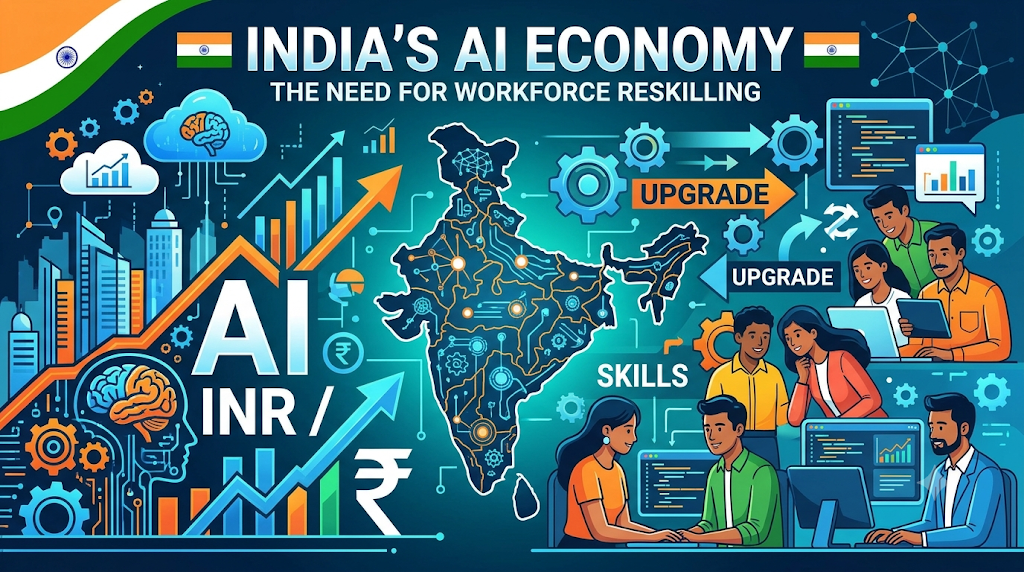
India’s AI economy is creating new opportunities for businesses, industries and professionals, but the country’s ability to benefit from this transformation will depend heavily on how quickly its workforce adapts to changing skill requirements. Artificial intelligence is moving beyond the technology sector and becoming part of everyday business operations, influencing everything from customer service and financial services to manufacturing, healthcare and agriculture. As companies increasingly adopt AI-powered solutions to improve productivity, reduce operating costs and develop new services, the demand for skilled professionals is rising. However, a shortage of job-ready talent and gaps in existing workforce capabilities could slow the country’s progress.
India’s AI opportunity is not limited to creating technology companies or developing advanced digital products. It also lies in helping existing businesses work more efficiently and enabling employees to take on new responsibilities. For a country with a large and diverse workforce, this transition presents both an economic opportunity and an important employment challenge.
AI Is Changing the Way Indian Businesses Operate
Artificial intelligence is gradually becoming a business necessity rather than an experimental technology. Companies across industries are exploring ways to use AI for data analysis, customer support, inventory management, marketing, financial planning and administrative operations.
For IT services companies, AI tools are changing software development, testing and routine support activities. Banks and financial institutions are using intelligent systems to improve fraud detection, customer service and risk assessment. In manufacturing, AI can help businesses monitor equipment, identify operational problems and reduce production delays.
These applications can improve efficiency and allow companies to manage larger workloads without increasing costs at the same pace. However, they also change the type of skills employers need.
Employees who previously concentrated on repetitive tasks may increasingly be expected to work with automated systems, interpret information, solve complex problems and make decisions that require human judgement.
For businesses, this means technology investment must go hand in hand with investment in people.
The Growing Gap Between AI Demand and Available Skills
One of the biggest challenges facing India’s AI economy is the shortage of professionals with relevant technical and practical capabilities.
As organisations adopt machine learning, data analytics, generative AI and automation, they need employees who can develop, implement and manage these technologies. Yet many workers have limited exposure to advanced digital tools or lack opportunities to update their existing skills.
The challenge extends beyond hiring specialised AI engineers. Businesses also need professionals who understand how to apply AI within their respective industries.
A finance professional, for instance, may need to understand AI-assisted analysis, while a marketing executive may need to work with automated content tools and customer analytics. Similarly, manufacturing employees may require training to operate intelligent production systems.
This creates demand for both advanced technical education and practical AI literacy.
Without sufficient investment in training, companies may find it difficult to fill emerging positions, while existing employees could struggle to adapt to changing job expectations.
The IT Sector Is Facing a Major Workforce Transition
India’s IT and business process management industries are among the sectors experiencing significant changes due to AI adoption.
Traditionally, these industries created large employment opportunities through software development, technical support, data processing and back-office operations. However, generative AI and automation are increasingly capable of handling parts of these workflows.
This is encouraging companies to rethink hiring requirements, particularly for roles involving repetitive and standardised tasks. At the same time, demand is growing for professionals who can manage AI applications, oversee digital transformation, maintain cybersecurity and integrate technology into business operations.
The transition could make entry-level employment more competitive, particularly for fresh graduates who have theoretical knowledge but limited practical experience.
For young professionals, a conventional degree may no longer be enough to remain competitive. Familiarity with AI tools, analytical thinking, problem-solving and the ability to learn new technologies are becoming increasingly valuable.
For IT companies, the challenge is to redesign training and recruitment strategies so that automation improves productivity without creating an unnecessary gap between experienced specialists and new entrants.
AI Is Creating Opportunities Beyond the Technology Industry
The impact of artificial intelligence is expanding well beyond India’s IT hubs. Agriculture, healthcare, manufacturing, retail and logistics are also finding practical applications for the technology.
In agriculture, AI-enabled systems can help farmers monitor crop conditions, identify potential pest problems and make more informed decisions about irrigation. In healthcare, intelligent tools can support medical image analysis, administrative processes and patient management. Manufacturing businesses can use predictive maintenance to identify equipment issues before they disrupt production.
Retailers can apply AI to understand purchasing patterns, forecast demand and manage inventory more efficiently. Small businesses can also use accessible AI tools for customer communication, digital marketing and routine administrative work.
These developments create opportunities for workers in traditional industries to acquire new digital capabilities without necessarily moving into technology careers.
For India’s economic growth, this broader adoption is particularly important. AI can improve productivity across different sectors, but its benefits will depend on whether workers have the knowledge and confidence to use these systems effectively.
Reskilling Can Help Protect Employment and Improve Productivity
Workforce reskilling is becoming one of the most important requirements of India’s AI transition. Rather than treating technology adoption and employment as opposing priorities, businesses need to consider how employees can develop the capabilities required to work alongside intelligent systems.
Reskilling involves learning new skills to move into changing roles, while upskilling helps employees strengthen their capabilities within existing positions.
For example, a customer service employee may learn to use AI-assisted support systems to resolve enquiries more efficiently. An accountant may develop skills in automated financial analysis, while a production supervisor may learn to interpret data generated by smart manufacturing equipment.
Such training can help employees move away from repetitive work towards responsibilities involving supervision, decision-making, communication and problem-solving.
Human capabilities will remain important even as automation expands. Creativity, critical thinking, ethical judgement, leadership and customer understanding are difficult to replace with technology alone.
Businesses that combine these capabilities with technical training can build more adaptable teams and improve the returns on their AI investments.
Businesses and Educational Institutions Must Work Together
India’s reskilling challenge cannot be addressed by individual companies or educational institutions working separately. A stronger connection between industry requirements and education will be essential.
Companies need to communicate the skills they expect from future employees, while colleges and training institutions must ensure that students receive practical exposure to emerging technologies.
Initiatives such as FutureSkills Prime and the IndiaAI Mission reflect the growing focus on expanding AI education, digital capabilities and technology infrastructure.
However, training must extend beyond introductory courses and certificates. Employees need opportunities to work on practical projects, understand industry applications and develop confidence in using AI tools.
Businesses can contribute through internal training programmes, partnerships with educational institutions, internships and structured learning opportunities for existing employees.
For small and medium-sized enterprises, affordable training programmes and accessible digital learning resources will be particularly important because they may not have the budgets to establish dedicated technology departments.
The Employment Challenge Also Requires Wider Access to Skills
India’s AI transformation must reach workers beyond major metropolitan technology centres. Employees in smaller cities, traditional industries and rural communities also need opportunities to participate in the changing digital economy.
Affordable internet access, regional-language learning resources, practical training centres and industry-linked certification programmes can help make AI education more accessible.
Women returning to employment, young graduates and workers in routine occupations could particularly benefit from flexible reskilling opportunities.
If access to advanced digital education remains concentrated among a limited section of the workforce, the economic benefits of AI may become unevenly distributed.
Wider participation will therefore be important not only for employment generation but also for ensuring that businesses across different regions can access skilled talent.
Turning India’s AI Potential into Sustainable Economic Growth
Artificial intelligence could become a significant contributor to India’s long-term economic expansion by improving productivity, encouraging innovation and creating new business opportunities. However, technology alone cannot deliver this potential.
The country’s success will depend on how effectively businesses, educational institutions, policymakers and employees respond to changing workforce requirements.
For companies, investing in employee development can help reduce skill shortages, improve operational efficiency and support smoother technology adoption. For workers, continuous learning will become increasingly important for maintaining career opportunities in a changing employment market.
India’s AI economy should not be measured only by the number of companies adopting new technologies or the amount invested in digital infrastructure. Its broader success will also depend on how many people can acquire the skills needed to participate in this transformation.
Ultimately, the real strength of India’s AI economy will come from combining technological progress with human capabilities. Reskilling the workforce is not simply a response to automation; it is an investment in productivity, employment opportunities and the country’s future economic competitiveness.