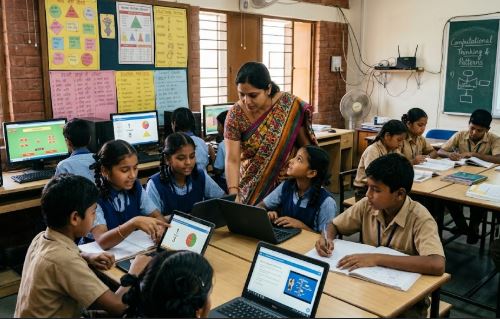
AI in Indian schools is becoming an important part of the country’s education transformation, offering new ways to personalise learning, support teachers and prepare students for a technology-driven future. From explaining difficult concepts to helping children practise at their own pace, artificial intelligence is creating opportunities to make classroom learning more flexible and engaging.
The shift is becoming more visible in India’s school curriculum. In the 2026–27 academic year, a dedicated Computational Thinking and Artificial Intelligence curriculum was introduced for Classes III to VIII. The initiative focuses on logical reasoning, problem-solving, recognising patterns and understanding how AI works in everyday life.
For students, this means learning about technology is no longer limited to operating computers or using educational apps. The emphasis is increasingly on understanding how technology works, when it can be useful and why it must be used responsibly.
However, introducing AI into education is only the beginning. Its real value will depend on whether it helps students understand their subjects better and gives teachers more time to focus on individual learning needs.
Personalised Learning Can Help Students Progress at Their Own Pace
Every classroom has students who learn differently. Some understand a new concept quickly, while others need more examples, additional practice or a different explanation. Managing these differences can be difficult when teachers have to support many students at once.
AI-powered learning tools can help by adjusting practice exercises, offering alternative explanations and identifying topics that may need further attention. A student struggling with fractions, for example, could work through simpler problems before moving to more advanced questions.
This approach can make learning less intimidating for children who hesitate to ask questions in class. It can also help advanced learners explore subjects beyond the standard classroom exercise.
Still, personalised learning does not mean allowing software to take charge of a child’s education. AI-generated answers can be inaccurate, and automated assessments may not fully capture a student’s understanding. Teachers remain essential for identifying learning difficulties, encouraging curiosity and providing the personal guidance that technology cannot replicate.
Teachers Can Spend More Time Teaching
Teachers do far more than explain lessons. They prepare worksheets, plan activities, assess assignments, communicate with parents and support students who need additional attention. These responsibilities can leave limited time for individual guidance.
AI tools can assist with routine tasks such as preparing question sets, organising lesson material and developing classroom activities. Used carefully, they can reduce preparation time and give teachers more opportunities to engage directly with students.
But effective use requires more than access to an application. Teachers need training to assess the accuracy of AI-generated content, protect student information and choose tools that suit their students’ age and learning requirements.
Schools must also ensure that teachers are not expected to adopt new technology without adequate support, infrastructure or time to learn. AI should make teaching more manageable, not create another layer of pressure.
The Digital Divide Could Limit the Benefits
One of the biggest challenges facing AI in Indian schools is unequal access to digital infrastructure. While some schools have computer laboratories, reliable internet and modern learning platforms, others continue to face shortages of devices and connectivity.
India’s school education data for 2025–26 showed that 69.9% of schools had computer access and 67.4% had internet connectivity. These figures highlight the distance still to be covered before digital learning can become equally accessible across the country.
The divide extends beyond schools. Some children have personal devices and internet access at home, while others share a family phone or depend entirely on school facilities. If AI-supported learning becomes increasingly common without addressing these differences, students from better-equipped schools could gain an additional advantage.
Bridging this gap requires affordable devices, reliable internet, electricity, technical support and accessible educational platforms. Schools should also have practical alternatives for students who cannot depend on continuous internet access.
The goal must be to make technology a bridge to better education rather than another barrier for disadvantaged children.
Regional Languages Can Make Education More Accessible
Language plays a major role in how children understand and engage with lessons. Students may find it easier to grasp a complicated idea when it is explained in their preferred language rather than in unfamiliar terminology.
AI-powered translation, voice tools and language-processing systems can help make educational material available in more Indian languages. These technologies could support children who struggle with English-language resources and help teachers adapt explanations to their students’ needs.
However, translation alone is not enough. Learning material must be accurate, culturally relevant and suitable for the child’s age. AI tools may misinterpret local expressions or provide explanations that do not match the school curriculum.
Developing high-quality multilingual resources, therefore, will be just as important as expanding access to AI software.
Students Must Learn to Question AI, Not Just Use It
AI can explain a difficult topic, suggest ideas for a project or help a student practise writing. But when children use it to complete every assignment without understanding the answers, the technology can become a shortcut rather than a learning aid.
There is also the risk of students accepting incorrect information simply because it is presented confidently. Generative AI systems can produce factual errors, misleading explanations and fabricated details.
Schools need to teach students how to verify information, compare sources and explain their reasoning in their own words. Lessons should also cover online safety, personal data protection, bias and the responsible use of AI-generated content.
These skills will become increasingly important as students encounter AI tools in education, entertainment and their future workplaces. The aim should not be to discourage the use of technology, but to help children use it with confidence and sound judgement.
What Schools Need to Make AI Work
For AI to improve education meaningfully, schools must focus on learning outcomes rather than simply introducing new technology.
The priorities are straightforward:
-
Strengthen digital infrastructure: Ensure schools have reliable connectivity, suitable devices and technical support.
-
Train teachers: Provide practical guidance on using AI tools safely and effectively in classrooms.
-
Develop local-language content: Make educational resources accessible to students from different linguistic backgrounds.
-
Protect student privacy: Establish clear rules for handling children’s personal information and using AI platforms.
-
Encourage independent thinking: Use AI to support practice and exploration without replacing students’ own efforts.
-
Measure learning outcomes: Evaluate whether technology improves understanding, participation and problem-solving skills.
Government agencies, school administrators, teachers and technology providers all have a role in making these changes work. Successful implementation will depend on consistent support, not simply the availability of new tools.
Conclusion: Better Education Must Remain the Priority
AI in Indian schools presents an opportunity to make learning more engaging, adaptable and accessible. It can help students revisit difficult topics, give teachers additional classroom support and expand access to educational resources in different languages.
Yet technology alone cannot solve the deeper challenges facing India’s education system. Unequal infrastructure, limited teacher training and the risk of overdependence on automated answers must be addressed alongside innovation.
The most effective classrooms will be those that combine the strengths of technology with the experience, empathy and judgement of teachers. AI can offer explanations and practice, but children still need encouragement, meaningful interaction and the freedom to think independently.
The future of AI in Indian education will depend not on how much technology enters the classroom, but on how effectively it helps every child learn, grow and prepare for the opportunities ahead.