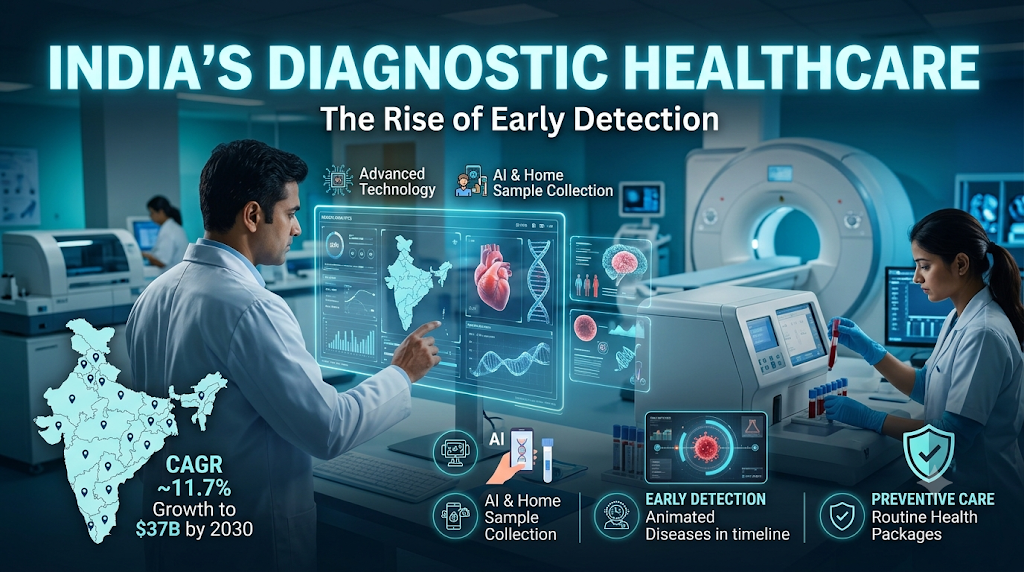
India’s diagnostic healthcare market is expanding as rising cases of diabetes, cardiovascular diseases and other chronic conditions increase the demand for early detection and preventive screening. Greater health awareness, growing household spending on healthcare and the adoption of advanced testing technologies are also changing how people access diagnostic services. For businesses, this shift is creating opportunities across pathology laboratories, radiology centres, home sample collection, medical technology and digital healthcare.
The role of diagnostics is changing. Traditionally, many people visited a laboratory only after experiencing symptoms or receiving a doctor’s prescription. Today, more consumers are considering routine health checks to identify potential risks before they become serious. This growing interest in preventive healthcare is giving diagnostic providers a larger role in India’s healthcare system.
India’s Diagnostic Healthcare Market Is Entering a New Growth Phase
India’s diagnostic services industry is attracting attention from healthcare investors and service providers because of its expanding customer base and increasing demand for specialised testing.
A market estimate published in 2026 values India’s diagnostic services market at around US$11.8 billion in 2025, with a projection of approximately US$22.2 billion by 2031, representing an estimated annual growth rate of 11.1%. Separately, a CRISIL assessment projected the industry to reach ₹1,275–1,375 billion by FY2028, reflecting expected annual growth of 10–12% from FY2024. These estimates use different research periods and methodologies, but both point towards sustained expansion.
The industry is broadly divided into two major segments:
-
Pathology testing: Includes blood tests, urine tests, liver and kidney function tests, diabetes screening, thyroid tests and other laboratory investigations. It accounts for the larger share of diagnostic services because many conditions require regular testing and monitoring.
-
Radiology and imaging: Includes X-rays, ultrasound, CT scans, MRI scans and other imaging procedures. Demand is increasing as doctors rely on imaging for more accurate diagnosis, disease monitoring and treatment planning.
The expansion of both segments is encouraging diagnostic companies to invest in modern laboratories, advanced equipment, collection centres and digital reporting systems.
Rising Chronic Diseases Are Increasing the Need for Early Detection
One of the strongest drivers of diagnostic demand is India’s growing burden of non-communicable diseases. Diabetes, hypertension, heart disease and kidney-related conditions often develop gradually and may remain undetected until complications emerge.
The International Diabetes Federation’s 2025 estimates indicate that around 90 million adults in India were living with diabetes in 2024. The number is projected to rise to approximately 157 million by 2050. The scale of the challenge highlights the need for better screening, regular monitoring and wider access to reliable testing.
Cardiovascular diseases are another major concern. Data presented by the World Heart Federation’s India profile records more than 3.1 million cardiovascular disease deaths for 2024. This reinforces the importance of identifying risk factors such as high blood pressure, abnormal cholesterol and elevated blood glucose at an early stage.
For diagnostic businesses, these conditions create demand that extends beyond one-time testing. Patients may need regular blood sugar monitoring, lipid profiles, kidney function assessments and other investigations as part of long-term care.
However, screening must be guided by age, medical history, symptoms and a healthcare professional’s advice. More testing is not automatically better; accurate interpretation and appropriate follow-up are equally important.
Preventive Healthcare Is Changing Consumer Behaviour
Healthcare spending is gradually moving beyond treatment after illness towards greater attention to prevention and routine monitoring.
Consumers are showing interest in annual health assessments, diabetes screening, thyroid tests, cholesterol checks and other investigations. Working professionals, older adults and people with a family history of chronic conditions are among the groups seeking more convenient access to diagnostic services.
This shift is encouraging laboratories to offer customised health packages and wellness testing options. Home sample collection, online appointment booking and digital reports are also making routine testing more convenient.
For diagnostic providers, preventive healthcare can create repeat customer relationships and more predictable demand. Instead of depending entirely on hospital referrals or illness-related visits, companies can develop direct relationships with consumers through accessible services and clear communication.
The challenge is to build trust. Customers need transparent pricing, accurate reports, dependable turnaround times and clear guidance on when to consult a doctor.
Home Sample Collection Is Expanding the Market Beyond Cities
Convenience has become an important factor in the diagnostic services business. Home sample collection allows patients to access routine blood and urine tests without travelling to a laboratory.
This model is particularly useful for senior citizens, people with limited mobility, busy professionals and patients who require frequent monitoring. It also allows diagnostic companies to reach customers in neighbourhoods where establishing a full-scale laboratory may not be commercially practical.
The business model often combines local collection centres with larger central laboratories. Samples are collected closer to the patient and transported to facilities equipped for testing.
This hub-and-spoke approach can help companies expand their geographic reach while managing the high costs of laboratory equipment and specialised staff. However, reliable sample handling, transport conditions and reporting systems are essential to maintaining quality.
Technology and AI Are Improving Diagnostic Services
Technology is becoming an important competitive factor in India’s diagnostic healthcare market. Laboratory automation, digital records, artificial intelligence and remote reporting are helping providers improve efficiency and expand specialised services.
AI-based tools can assist trained professionals in reviewing medical images, identifying patterns and prioritising cases that may require closer examination. In pathology, digital slide imaging and telepathology can support remote review and consultation between specialists.
Portable diagnostic devices are also creating possibilities for screening in smaller towns, community health centres and remote locations. These technologies can help bring selected tests closer to patients who would otherwise need to travel to larger cities.
For healthcare technology companies, the opportunity extends beyond manufacturing equipment. Businesses can develop software for laboratory management, digital reporting, appointment booking, data integration and quality monitoring.
At the same time, AI should support rather than replace qualified medical professionals. Diagnostic results require clinical interpretation, and technology must be validated for accuracy, safety and appropriate use.
Rural India Offers Significant Untapped Business Potential
One of the biggest gaps in India’s diagnostic sector is the unequal distribution of testing facilities.
A CRISIL assessment found that rural areas accounted for only around 24% of diagnostic industry revenue in FY2024, despite being home to roughly 70% of the country’s population. The gap reflects limited access to advanced laboratories, fewer specialists, transport challenges and lower availability of organised diagnostic services.
This underpenetrated market offers opportunities for diagnostic chains, local entrepreneurs, hospitals and healthcare technology providers.
Businesses can consider several approaches:
-
Collection centres: Establish smaller sample collection facilities in towns and rural markets, connected to central laboratories.
-
Mobile diagnostic services: Use mobile units to conduct selected screening tests and reach communities with limited healthcare infrastructure.
-
Hospital and clinic partnerships: Work with local doctors, nursing homes and healthcare centres to improve access to testing.
-
Tele-radiology networks: Enable medical images to be reviewed by qualified specialists remotely, where appropriate.
-
Affordable testing packages: Offer clearly priced screening services suited to local income levels and healthcare needs.
Eastern and northeastern India also present opportunities for better diagnostic coverage. Investment in local infrastructure, trained personnel and reliable sample transportation could help reduce dependence on distant urban facilities.
Organised Diagnostic Chains Are Reshaping Competition
India’s diagnostic market has traditionally been fragmented, with standalone laboratories, hospital-based facilities and organised diagnostic chains operating alongside one another.
Organised providers are investing in wider collection networks, standardised processes, automated laboratories and digital customer services. Their ability to operate across multiple locations can help them improve capacity utilisation and offer a broader range of tests.
At the same time, independent laboratories continue to serve important local markets through relationships with doctors and communities. Smaller providers can remain competitive by focusing on service quality, specialised testing, affordability and reliable turnaround times.
For investors, the sector offers opportunities, but expansion alone does not guarantee profitability. Businesses must manage equipment costs, staff expenses, logistics, pricing pressure and the need for consistent quality across locations.
Quality Standards and Skilled Manpower Remain Major Challenges
The expansion of diagnostic services must be supported by stronger quality systems. An inaccurate test result can lead to delayed treatment, unnecessary medical procedures or incorrect clinical decisions.
Accreditation, internal quality controls, equipment calibration, trained technicians and proper sample handling are therefore essential. Laboratories need to maintain reliable processes rather than compete only on low prices.
The industry also faces shortages of skilled laboratory technicians, radiologists, pathologists and other specialised professionals, particularly outside major cities. Expanding diagnostic access will require investment in training, recruitment and professional development.
Data privacy is another growing responsibility. As more test reports and medical records move online, diagnostic companies must protect sensitive patient information and maintain secure digital systems.
Business Opportunities Across the Diagnostic Value Chain
The growth of early detection is creating opportunities for businesses beyond traditional laboratories.
-
Medical equipment manufacturers: Demand for analysers, imaging systems, testing kits and portable diagnostic devices can support equipment suppliers.
-
Healthcare technology startups: Digital platforms can improve appointment management, laboratory operations, reporting and patient communication.
-
Pharmaceutical and biotechnology companies: Growth in specialised testing can support demand for reagents, molecular diagnostic products and laboratory consumables.
-
Logistics providers: Reliable sample collection and transportation services are becoming increasingly important as diagnostic networks expand.
-
Healthcare investors: Regional laboratory networks, specialised testing facilities and technology-enabled diagnostic models may attract investment.
-
Local entrepreneurs: Collection centres and partnerships with established laboratories can provide entry points into the sector without the cost of building a large testing facility.
The strongest business models will combine affordability, operational efficiency, dependable quality and convenient access.
The Road Ahead for India’s Diagnostic Healthcare Market
India’s diagnostic healthcare market is moving towards a model in which early detection, regular monitoring and technology-supported services play a larger role in patient care. Rising chronic disease cases and growing awareness are creating demand, while home collection, organised laboratory networks and digital tools are changing how diagnostic services are delivered.
However, long-term growth will depend on making quality testing accessible beyond major cities. Better infrastructure, trained professionals, reliable accreditation and affordable services will be essential to building public confidence.
For businesses, the opportunity lies in addressing real gaps in healthcare access rather than simply increasing the number of tests. Companies that combine accurate diagnostics with patient convenience and responsible pricing can build sustainable operations while supporting earlier medical intervention.
Ultimately, early detection is becoming both a healthcare priority and a significant growth opportunity for India’s diagnostic industry.