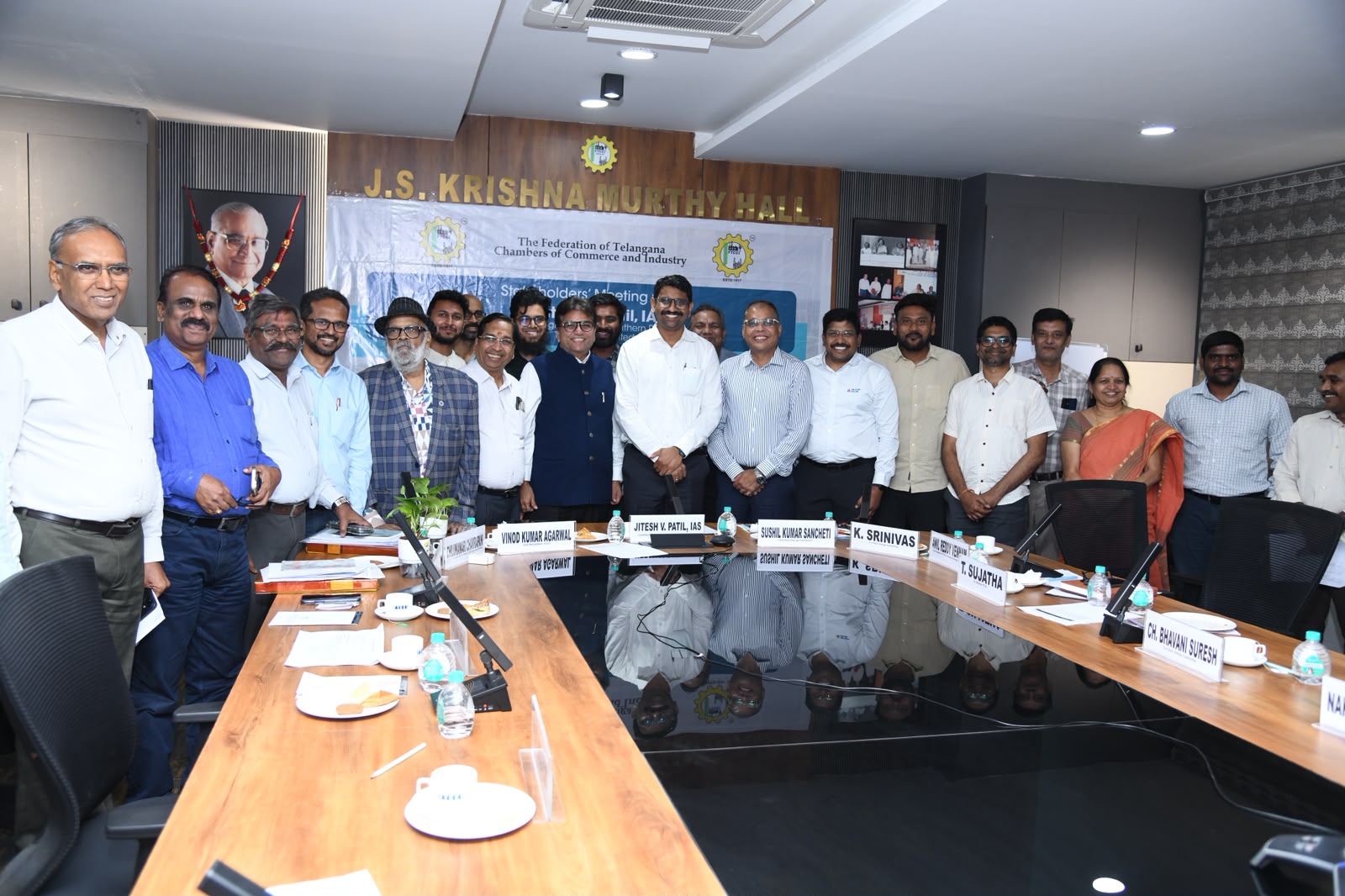
FTCCI Stakeholders’ Meeting discusses industry representations covering power supply, Open Access, solar, PM-KUSUM and consumer services
Hyderabad, Aug 21 The Federation of Telangana Chambers of Commerce and Industry (FTCCI) held its 5th Stakeholders’ Meeting with Sri Jitesh V. Patil, IAS, Chairman and Managing Director, TGSPDCL, on August 20 at Federation House, Hyderabad, to discuss key issues faced by industrial and commercial consumers.
A key outcome was TGSPDCL’s proposal to introduce a Customer Relationship Manager (CRM) mechanism for industrial consumers. The CMD informed that guidelines would be formulated within a month for nominating Assistant Divisional Engineers (ADEs) as CRMs. The CRM would act as a single point of contact for industrial consumers, facilitating resolution of issues ranging from service connections to service-quality-related matters.
TGSPDCL also assured that a dedicated email ID for industrial consumers would be provided for lodging complaints and requests, enabling centralised logging, monitoring and faster resolution of grievances.
Frequent power interruptions affecting industries were taken up with the CMD. He directed the concerned Superintending Engineers (Operations) to examine and take corrective action in cases relating to industrial units at IDA Mallapur, Keesara, Balangar, Shadnagar and Toopran.
In the case of Hyderabad Precision Manufacturing Co. Pvt. Ltd., TGSPDCL informed that consumers could opt for a second source of power supply to improve redundancy, subject to applicable one-time fixed charges.
TGSPDCL will also make grid maps available to FTCCI, enabling members to identify and select the nearest substation while applying for a power connection.
FTCCI also sought clear guidelines regarding the HT flag appearing on LT consumers when their Recorded Maximum Demand crosses the prescribed threshold, including the procedure for removal of the flag where the LT load has not exceeded the applicable limit.
Several representations relating to solar power and Open Access were discussed.
In the case of a 5 MW solar power plant under Open Access, the CMD agreed to review the request relating to change of Open Access consumer and continuation of the facility.
FTCCI also raised the issue of Time-of-Day (TOD) charges on solar Open Access energy, seeking implementation of Telangana Electricity Regulatory Commission and Hon’ble High Court directions regarding non-levy of TOD charges and adjustment/refund of excess charges collected prior to March 2024.
The meeting also discussed wheeling losses, wheeling charges, banking charges on deemed banking units and payment of 50% of APPC as against full APPC, in accordance with applicable regulations.
PM-KUSUM: CUF, ABT meters and grid constraints
Several representations concerning PM-KUSUM farmers and PPA conditions were taken up.
FTCCI sought clear guidelines on no penalty for grid constraints/back-down and generation compensation for grid unavailability under the relevant PPA provisions. The CMD stated that the issue would be examined.
FTCCI also raised concerns regarding the minimum 19% Capacity Utilisation Factor (CUF) requirement under PM-KUSUM PPAs. It was brought to the CMD’s attention that the requirement is reportedly being enforced by certain Discom officers on a monthly basis, whereas FTCCI pointed to PPA Clauses 4.3.1 and 4.3.3, which provide for the CUF/energy requirement on an annual basis. The CMD agreed to review the PPA provisions and the need for appropriate guidelines.
FTCCI also highlighted the “Lead Unblock” setting in ABT meters being issued to PM-KUSUM generators. It was pointed out that the setting could substantially increase auxiliary power consumption and potentially result in consumption exceeding the 0.75% limit prescribed under PPA Clause 10.4.1. The CMD agreed to review the matter for both new and already-issued ABT meters.
The meeting also discussed the mandatory GST registration requirement for issuance of ABT meters to PM-KUSUM farmers. The CMD agreed to review the request for waiver.
FTCCI thanked the CMD for his prompt support in establishing a Google Sheet-based mechanism for online interaction between PM-KUSUM PPA holders and the TGSPDCL CE (IPC). Fourteen complaints/requests have already been logged, with the CE (IPC) coordinating with concerned officers for resolution and updating the status.
TGSPDCL also informed that the work order issue relating to auto-estimated materials has been addressed and a vendor number is not required.
The meeting discussed implementation of the PM E-DRIVE scheme for EV charging infrastructure in Telangana. TGSPDCL advised M/s Power Apex to approach the VCMD, TGREDCO, the nodal agency, regarding implementation of charging infrastructure under the scheme.
It was also informed that, for electric vehicles, a separate transformer can be approved for an existing consumer, facilitating the development of EV charging infrastructure.
FTCCI requested consideration of a One-Time Settlement (OTS) mechanism for long-pending dues. The matter is under discussion by TGSPDCL with the Chief Secretary and a decision is awaited.
FTCCI also raised a query regarding Open Access permission relating to M/s GMR Energy Trading. The Director (Finance) clarified that Open Access permission can be granted only to eligible consumers and not to power traders.
The meeting also considered representations from TGOADA and individual solar power developers on issues relating to solar generators, bulk consumers, wheeling and banking.
The discussions reinforced the importance of continued institutional engagement between TGSPDCL and industry to resolve operational issues, improve consumer services and bring greater clarity to regulatory and procedural matters.
Vinod Kumar Agarwal, Vice President, FTCCI; Sushil Kumar Sancheti, Chair, Energy Committee, FTCCI; Co-Chairs, Advisors and Members of the Energy Committee; officials from TGSPDCL; and representatives from industry participated in the meeting.
The meeting was organised by the FTCCI Energy Committee as part of its continuing initiative to provide industry with a direct platform to engage with the power utility and pursue resolution of issues affecting businesses and industrial consumers.