
For Indian startups, the challenge is no longer simply to grow fast. It is to build a business that can sustain that growth. As investors become more selective about where they deploy capital, founders are rethinking expansion plans, tightening cost controls and paying closer attention to the financial strength of their businesses.
This marks a notable shift from the funding boom of 2021 and 2022, when abundant venture capital encouraged startups to pursue rapid customer acquisition, enter new markets and scale operations quickly. While that period helped establish new businesses and accelerate innovation, it also exposed the risks of expanding without a clear path to profitability.
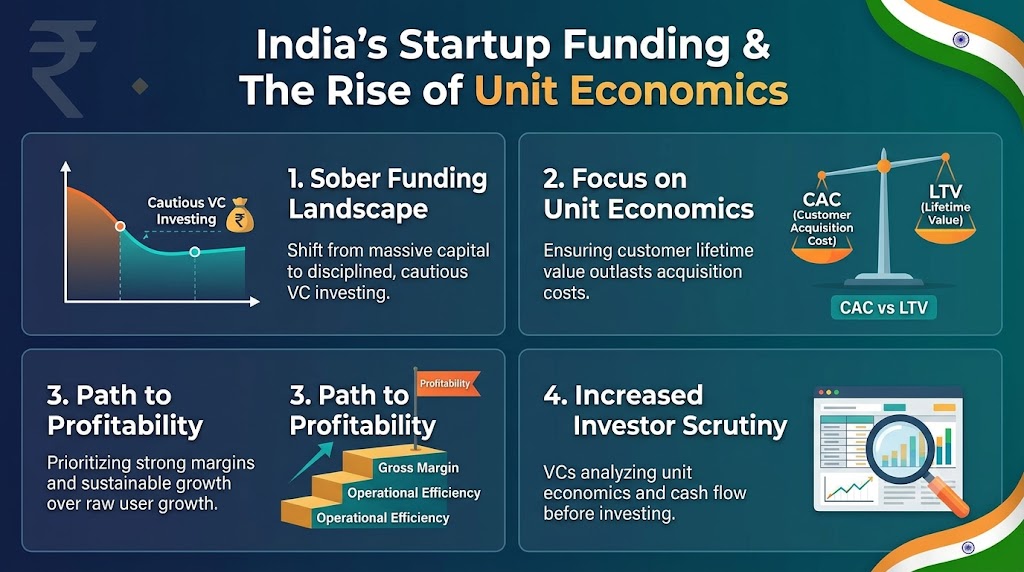
The current funding environment is placing greater weight on commercial fundamentals. Investors want to see how startups generate revenue, retain customers, manage operating expenses and turn capital into lasting business value. Growth remains important, but the ability to grow efficiently is increasingly central to investment decisions.
The change does not signal the end of entrepreneurial ambition in India. Instead, it points to a more disciplined phase in which strong business models, responsible financial management and genuine customer demand are becoming essential to long-term success.
Startup Funding Becomes More Selective
India’s startup ecosystem continues to attract investment, but funding decisions are increasingly shaped by the quality of a business rather than its growth story alone. Investors are examining revenue visibility, market demand, competitive strength and the ability to use capital effectively.
For founders, this means that a compelling pitch must be supported by credible financial projections and measurable progress. Startups that can demonstrate customer demand, manage costs and explain how they intend to build a sustainable business may be better placed to secure funding.
The shift is also influencing how companies approach expansion. Instead of entering multiple markets or increasing headcount at the earliest opportunity, founders are reassessing priorities and directing resources towards activities that deliver clear commercial value.
Early-stage businesses continue to have opportunities to attract investors, particularly when they address unmet needs or offer differentiated solutions. However, they must also show that their ideas can develop into viable businesses with realistic revenue models.
For the wider ecosystem, this more selective approach could encourage stronger financial planning and a greater emphasis on building companies that can withstand changes in investor sentiment.
Why Unit Economics Is Becoming a Business Priority
Unit economics helps startups understand whether each customer, order or transaction contributes positively to the business. It connects everyday operating decisions with the broader question of whether a company can become financially sustainable.
A startup may report rising sales and attract a large customer base, yet continue to lose money if the cost of acquiring customers, fulfilling orders and providing services exceeds the revenue generated. Expanding such a business without addressing the underlying problem can increase financial pressure.
Investors are therefore paying closer attention to customer acquisition costs, customer lifetime value, contribution margins and the time required to recover marketing expenses.
These measures also help founders make practical decisions. They can identify products that generate stronger returns, assess whether discounts are necessary and determine which customer segments offer the greatest long-term value.
For startups, the objective is not necessarily to achieve immediate profitability. Some businesses require substantial investment before reaching commercial scale. What matters is understanding the economics of the business and having a credible plan to improve margins as operations mature.
Customer Retention Matters as Much as Acquisition
Winning new customers can be expensive, particularly in markets where businesses compete through advertising, discounts and promotional offers. When customers make only one purchase or stop using a service soon after signing up, the cost of attracting them can outweigh the revenue they generate.
This is encouraging startups to look beyond customer numbers and focus on retention, repeat purchases and customer satisfaction.
Reliable products, consistent service and effective customer support can help businesses build lasting relationships. Referral programmes and organic marketing can also complement paid advertising, reducing dependence on expensive acquisition campaigns.
India’s diverse consumer market makes this approach particularly important. Customer preferences, purchasing power and distribution needs differ across regions. Startups that understand these differences can make more effective decisions about pricing, product development and market expansion.
Sustainable customer growth comes from creating a product or service that people continue to value, rather than relying on repeated spending to attract new buyers.
Managing Costs to Protect Margins
For many startups, profitability depends on expenses that can easily be overlooked when attention is focused on sales growth. Delivery charges, packaging, product returns, payment processing, warehousing and discounts can significantly reduce the amount earned from each transaction.
This is especially relevant for e-commerce and direct-to-consumer businesses, where fulfilment costs and unsuccessful deliveries can affect margins. If these expenses are not accurately measured, rising sales may create the impression of progress without improving the company’s financial position.
A more detailed understanding of operating costs helps founders identify where money is being lost. Better inventory planning, realistic pricing, improved demand forecasting and more efficient logistics can strengthen margins without compromising customer experience.
Businesses may also need to reconsider products or sales channels that generate high volumes but contribute little towards covering fixed expenses.
For smaller startups, where working capital is often limited, managing these costs carefully can provide greater flexibility to invest in product quality, technology and customer service.
Cash Flow Shapes the Pace of Expansion
Even a startup with a promising product and growing revenue can face difficulties if cash leaves the business faster than it comes in. Delayed payments, excess inventory, rising payroll costs and premature expansion can reduce the funds available for everyday operations.
Cash runway—the period a company can continue operating with its available funds—has consequently become an important measure of financial resilience.
Founders need a clear understanding of monthly spending, expected income and upcoming financial commitments. This helps them determine whether they can afford to expand, need to adjust expenses or should begin preparing for another funding round.
Financial discipline does not mean avoiding investment altogether. Hiring, technology upgrades and market development may be necessary for future growth. The key is to ensure that spending supports defined business objectives and produces measurable progress.
By managing cash more carefully, startups can reduce the risk of making rushed decisions and approach investors with a stronger understanding of their financial position.
New Opportunities Across India’s Startup Ecosystem
India’s entrepreneurial base continues to expand beyond established technology and investment centres. Businesses are emerging across sectors such as manufacturing, agriculture, healthcare, financial services and enterprise technology, creating opportunities to address specific regional and national needs.
Entrepreneurs in smaller cities may benefit from lower operating costs and a closer understanding of local markets, although access to skilled talent, investor networks and specialised infrastructure can vary.
At the same time, areas such as artificial intelligence, deep technology, climate solutions and advanced manufacturing are attracting interest because of their potential to solve complex problems and create new markets. These businesses may require longer development cycles and substantial technical investment, making realistic financial planning particularly important.
For investors, this broadening range of opportunities offers the chance to support businesses with specialised capabilities and clear market demand. For founders, it reinforces the importance of developing solutions that customers are willing to pay for and that can grow without placing unsustainable pressure on finances.
What the Shift Means for Founders and Investors
The changing funding environment is encouraging founders to treat financial performance as an ongoing management priority rather than something to address only before approaching investors.
Understanding margins, customer retention, operating expenses and cash flow can help businesses identify weaknesses early and make better-informed decisions. It can also support more realistic expansion plans and improve a startup’s ability to respond to changing market conditions.
Investors, meanwhile, are looking for businesses that combine innovation with strong execution. A credible growth strategy, transparent financial reporting and a clear understanding of profitability can help establish confidence in a company’s long-term prospects.
This emphasis on financial strength can benefit the wider business ecosystem as well. Startups with more stable operations are better positioned to maintain supplier relationships, support employees and make consistent investments in product development.
The broader lesson is that sustainable growth is not the opposite of ambition. It is what allows ambition to translate into a lasting business.
Conclusion
India’s startup funding landscape is moving towards a model in which growth must be supported by sound financial fundamentals. Investors continue to seek innovation and market potential, but revenue quality, unit economics, cost discipline and cash flow are playing a greater role in determining which businesses are prepared to scale.
For founders, this calls for a more considered approach to expansion. Rather than pursuing growth at any cost, startups need to understand their customers, strengthen their core business models and ensure that each stage of expansion creates measurable value.
This transition could help build a more resilient entrepreneurial ecosystem, where companies are better equipped to manage uncertainty and less dependent on continuous funding to sustain routine operations.
The next phase of India’s startup story will not be defined by scale alone. It will increasingly depend on the ability to turn innovation into commercially viable businesses that create lasting value for customers, investors and the wider economy.