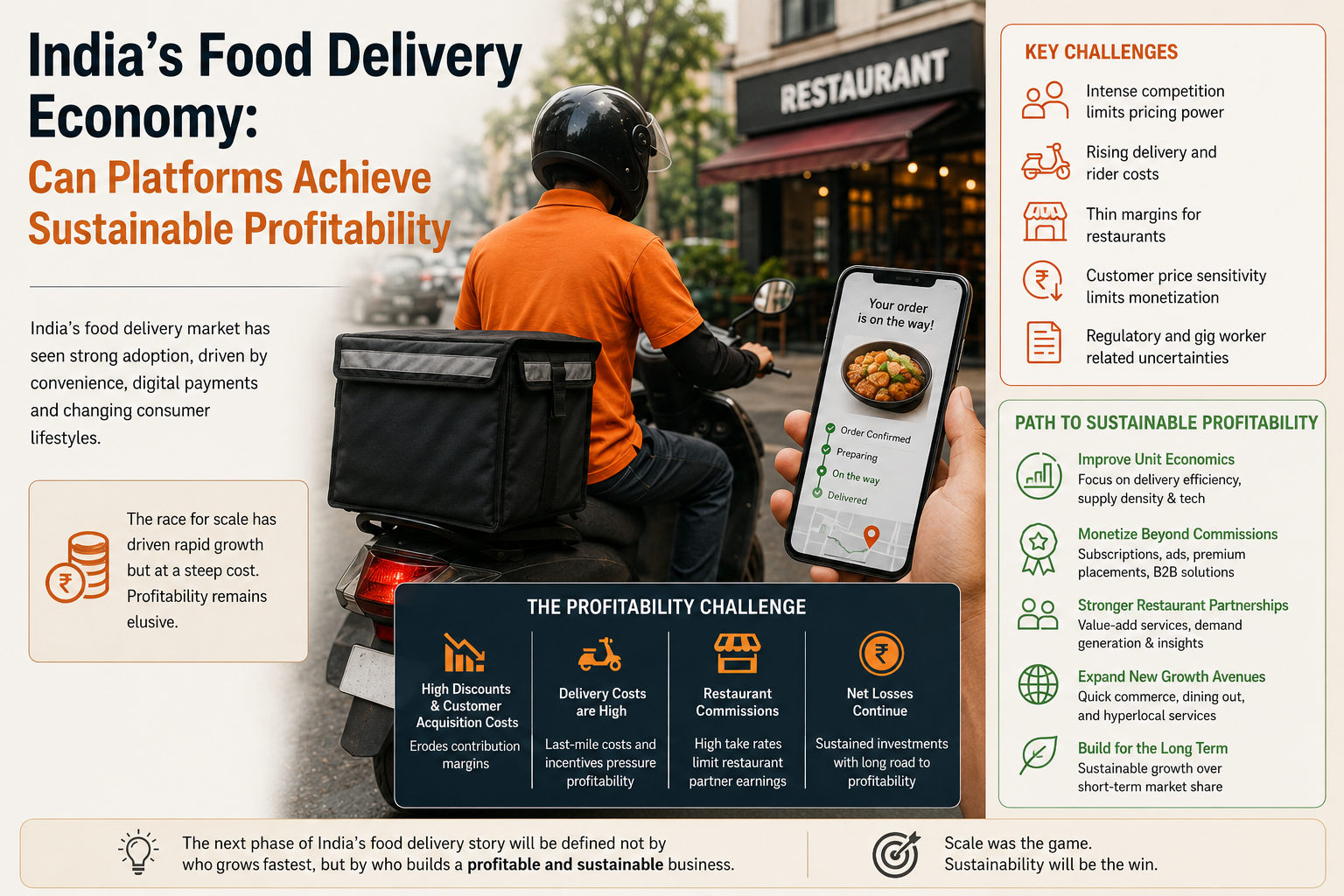
Oct 21: India’s food delivery market is entering a new phase. What began as a convenience-driven service has evolved into a major part of the country’s urban consumption economy, connecting millions of customers with restaurants through digital platforms. Growing smartphone adoption, digital payments, changing work patterns and demand for convenient meals have created significant opportunities for online food ordering.
Yet growth brings a difficult business challenge: how can food delivery platforms increase order volumes and customer loyalty while maintaining healthy margins?
The answer will depend on more than expanding into new cities or offering attractive discounts. Platforms must improve delivery efficiency, strengthen restaurant partnerships, manage customer acquisition costs and create a business model that rewards sustained demand rather than promotional spending.
For India’s food delivery industry, sustainable profitability is becoming as important as market expansion.
India’s Food Delivery Market: Growth Opportunities Ahead
India’s broader food services industry offers substantial room for digital expansion. A market report by Redseer Strategy Consultants, reported by the National Restaurant Association of India in July 2026, estimated that the country’s food services market could grow from around US$90 billion in 2025 to US$150 billion by 2030. The report also projected that online delivery would account for a growing share of food service spending as digital adoption and organised dining expand.
These estimates cover the overall food services sector, including dine-in and other channels, rather than online food delivery alone. Nevertheless, they highlight the potential for delivery platforms to benefit as more consumers embrace digital ordering and organised restaurant brands.
The opportunity extends beyond metropolitan areas. Tier-II and Tier-III cities offer scope for local restaurants, regional cuisines and emerging food brands to reach customers without investing immediately in additional physical outlets. However, success in these markets will depend on local demand, delivery distances, average order values and the availability of suitable restaurant partners.
For platforms, the next stage of growth will require a balance between expanding their customer base and ensuring that each market can support an economically viable delivery network.
What Recent Financial Results Reveal
Company results offer a clearer picture of the relationship between order growth and profitability.
In its results announced on May 8, 2026, Swiggy reported that its food delivery gross order value (GOV) grew 22.6% year-on-year to ₹9,005 crore in the fourth quarter of FY2025–26. Its food delivery adjusted EBITDA reached ₹297 crore for the quarter, with the adjusted EBITDA margin improving to 3.3% of GOV. For the full financial year, food delivery adjusted EBITDA exceeded ₹1,000 crore, according to the company.
These figures indicate that rising transaction values can accompany stronger operating performance. They also demonstrate why different financial measures need to be understood separately.
Gross order value represents the value of orders processed, not the revenue retained by the platform. Adjusted EBITDA measures operating performance before certain expenses and adjustments; it is not equivalent to net profit or free cash flow.
For food delivery businesses, sustainable profitability ultimately depends on how much revenue is generated from each order, how much it costs to fulfil that order and whether the remaining contribution can support fixed expenses and long-term investment.
Discounting: The Cost of Winning Customer Loyalty
Discounts, promotional codes, free-delivery offers and subscription benefits have helped food delivery platforms attract customers and encourage repeat ordering. However, these strategies can become expensive when consumers choose an app primarily because it offers the lowest price.
When discounts are used too frequently, platforms risk training customers to wait for promotions rather than building loyalty around service quality, restaurant selection and reliability. The result can be high order volumes without a proportionate improvement in profitability.
Restaurants also face the consequences. A discounted meal may generate additional sales, but the restaurant still has to pay for ingredients, staff, packaging and other operating expenses. Depending on the commercial agreement, platform commissions and promotional contributions may further reduce the amount retained.
A more sustainable strategy involves targeted promotions that encourage repeat purchases, introduce customers to new restaurants or increase average order value. Platforms must evaluate whether these incentives generate lasting demand rather than simply shifting orders from one day or app to another.
The objective is not to eliminate discounts altogether. It is to make every promotional expense commercially meaningful.
Restaurant Commissions and the Economics of Small Businesses
Online delivery gives restaurants access to customers beyond their immediate neighbourhoods. It can help independent eateries increase visibility, test new menu offerings and reach customers without opening additional outlets.
However, digital reach does not automatically translate into higher profits.
Restaurants must account for platform commissions, food costs, packaging, preparation time, discounts, refunds and the operational adjustments required for delivery orders. The financial impact varies according to cuisine, average order value, pricing, location and the restaurant’s own cost structure.
For a small restaurant selling relatively low-priced meals, even modest additional expenses can make online orders difficult to sustain. A larger chain with standardised preparation and greater purchasing power may be better positioned to absorb these costs.
Restaurants can improve their economics by analysing profitability at the dish level, designing delivery-friendly combinations, reducing avoidable packaging expenses and monitoring the performance of individual menu items. They can also evaluate whether delivery menus and prices need to differ from dine-in offerings, while complying with platform agreements and applicable rules.
Platforms have a commercial interest in supporting these improvements. Restaurants that can earn sustainable returns are better positioned to maintain food quality, invest in their operations and remain active partners over the long term.
Delivery Efficiency: A Key Driver of Profitability
Last-mile delivery remains one of the most important cost considerations in the business. Traffic congestion, long distances, adverse weather, order preparation delays and uneven demand can affect delivery time and operational efficiency.
The economics of a densely populated neighbourhood can differ considerably from those of a less concentrated market. When riders travel longer distances for fewer orders, the cost of serving each customer may rise. Delays between restaurant preparation and rider arrival can also reduce productivity and affect food quality.
Technology can help platforms address these challenges through improved demand forecasting, more accurate delivery-time estimates, efficient allocation of delivery partners and better coordination with restaurants. Order batching may also improve utilisation where it is operationally suitable and does not compromise food quality or delivery commitments.
However, efficiency cannot be measured by speed alone. Safe working conditions, reasonable delivery expectations and reliable customer service remain important to the long-term health of the industry.
A well-designed delivery network should minimise avoidable costs while protecting the experience of customers, restaurants and delivery partners.
Quick Commerce and the Battle for Consumer Spending
Food delivery platforms are also operating in a wider convenience economy shaped by quick commerce, ready-to-eat meals and rapid grocery delivery. Consumers increasingly have multiple ways to satisfy immediate food needs, from ordering a restaurant meal to purchasing snacks or preparing something at home.
This creates both competition and opportunities for companies operating across multiple services. Shared customer relationships, technology and selected infrastructure may offer efficiencies, but food delivery and quick commerce have different operational requirements and cost structures.
The distinction matters when evaluating performance. Strong growth in grocery delivery does not automatically mean that restaurant delivery is becoming more profitable, just as food delivery margins cannot be used to assess the economics of every other business segment.
Platforms must understand which services generate repeat demand, where shared resources create genuine savings and which activities require separate investment. Expanding into adjacent categories makes commercial sense only when the additional complexity is supported by a credible path to sustainable returns.
Advertising, Loyalty and New Revenue Opportunities
Food delivery platforms connect restaurants with customers at the moment they are deciding what to eat. This creates opportunities for restaurant advertising, sponsored listings and promotional placements.
For restaurants, these tools can improve visibility and help reach relevant audiences. For platforms, advertising can generate revenue without relying exclusively on commissions or customer-facing fees. However, advertising needs to remain transparent and useful to consumers if it is to support long-term trust.
Loyalty programmes can also strengthen customer retention. Membership benefits may encourage customers to order more frequently, provided that the resulting revenue and additional activity justify the cost of discounts and other benefits.
Personalised recommendations, group ordering, scheduled meals and easier reordering can further improve convenience. The commercial goal should be to increase customer lifetime value by creating a better experience, rather than encouraging purchases through repeated subsidies.
Sustainability Is Becoming Part of the Business Equation
Profitability is not the industry’s only long-term consideration. Food packaging, delivery-related emissions and food waste are also important to the environmental impact of online ordering.
Eternal, the parent company of Zomato, has identified climate-conscious deliveries and waste reduction among its sustainability priorities. The company states that it aims to facilitate 100% electric-vehicle-based food deliveries by 2030 and has initiatives focused on reducing packaging waste.
For the wider industry, electric two-wheelers, efficient routing, reduced unnecessary packaging and better food-waste management could contribute to more sustainable operations. Their commercial value will depend on infrastructure, implementation costs, local conditions and the ability to integrate these measures into daily operations.
Sustainability initiatives are most effective when they support measurable environmental improvements alongside operational reliability and economic viability.
What Will Make India’s Food Delivery Industry More Profitable?
The path towards sustainable profitability rests on several priorities.
-
Improve unit economics: Measure the true cost and contribution of each order, including incentives, delivery expenses, refunds and customer support.
-
Build customer loyalty: Prioritise dependable service, useful recommendations and restaurant choice instead of relying excessively on discounts.
-
Strengthen restaurant partnerships: Help restaurants understand demand, improve menu performance and manage delivery-related costs.
-
Optimise delivery networks: Use better forecasting and coordination to reduce avoidable delays and improve resource utilisation.
-
Expand selectively: Enter new markets where order density, customer demand and operating costs support a viable business model.
-
Diversify revenue carefully: Develop advertising and loyalty offerings that create value for both restaurants and customers without undermining trust.
These priorities are interconnected. More efficient operations can support better margins, while stronger restaurant relationships can improve selection and service quality. A better customer experience, in turn, can encourage repeat orders and reduce dependence on expensive promotions.
The Road Ahead
India’s food delivery economy has considerable growth potential, but its long-term success will depend on the quality of that growth. Recent company results show that higher order values and improving operating margins can coexist. Sustaining that progress will require disciplined spending, better delivery efficiency and a business model that works for restaurants, customers and delivery partners.
For restaurants, online delivery should be treated as a distinct sales channel with its own cost structure and menu strategy. For platforms, expansion must be supported by evidence that new customers and additional orders can generate meaningful economic returns.
The industry’s next phase will not be defined by order volumes alone. It will be shaped by the ability to turn digital convenience into a reliable and commercially sustainable service.
In India’s food delivery market, growth attracts attention, but sustainable profitability will determine which business models endure.