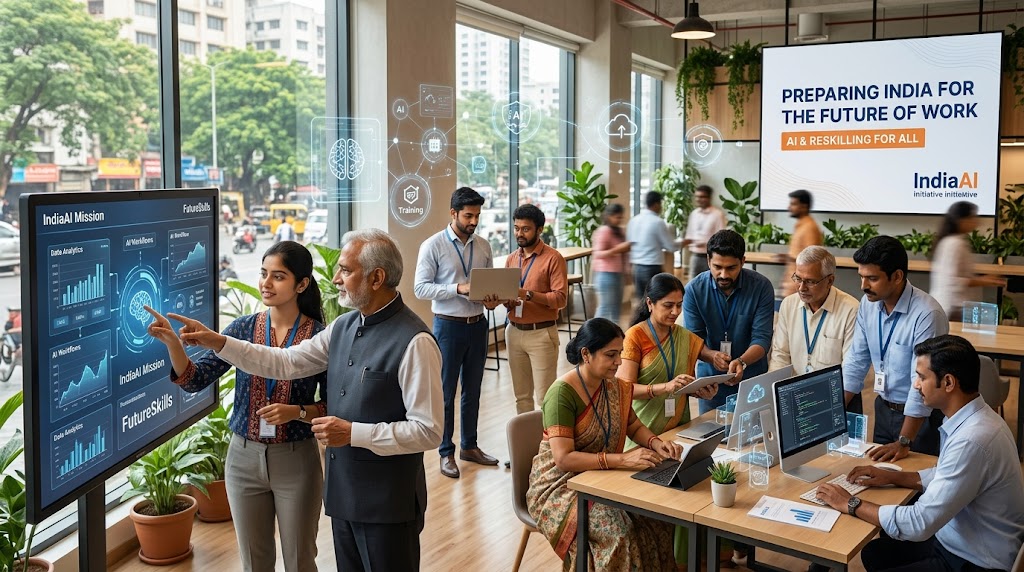
Artificial intelligence (AI) is changing how businesses operate across India. From IT services and banking to manufacturing, retail and logistics, companies are increasingly using AI to automate routine tasks, analyse information and improve decision-making. This shift is creating new business opportunities while changing the skills employees need to remain relevant in a rapidly evolving workplace.
India has the potential to become a major beneficiary of the global AI expansion. However, realising this opportunity will require more than investment in technology. Businesses must also prepare their employees to work confidently with AI, while ensuring that students, job seekers and smaller enterprises have access to the skills needed to participate in the changing economy.
India’s AI Economy Gains Momentum
India’s growing technology sector, digital infrastructure and skilled workforce provide a strong foundation for AI adoption. Businesses are exploring AI applications to improve customer service, streamline operations, strengthen cybersecurity and develop new products and services.
The government’s IndiaAI Mission, approved with an outlay of approximately ₹10,372 crore, is designed to strengthen the country’s AI ecosystem through computing infrastructure, innovation, access to data and skills development. More than 38,000 GPUs had been onboarded under the initiative by early 2026, expanding access to computing resources for developers, researchers and startups.
These investments can support innovation and create opportunities for businesses across industries. However, the wider economic benefits will depend on how effectively companies translate AI capabilities into improved productivity, better services and sustainable growth.
How AI Is Changing Jobs and Hiring
AI tools can now assist with tasks such as preparing documents, analysing data, writing basic code, processing invoices and handling routine customer enquiries. Work that once required considerable manual effort can often be completed more quickly with automated assistance.
For businesses, this can lower operating costs and allow employees to focus on more complex responsibilities. At the same time, employers are increasingly looking for people who can combine technical knowledge with problem-solving, communication and sound judgement.
Entry-level employment is an important part of this transition. As AI takes on some routine assignments traditionally given to fresh graduates, employers may place greater emphasis on practical experience, digital skills and the ability to use technology responsibly.
This does not mean that AI will eliminate all entry-level opportunities. New roles will emerge as businesses adopt and develop AI solutions. However, the path into employment may change, making hands-on learning and continuous skill development more important than ever.
Why Workforce Reskilling Matters
Reskilling involves learning new capabilities for changing job responsibilities, while upskilling helps employees strengthen the skills required in their current roles. Both are becoming essential as AI becomes part of everyday business operations.
Not every employee needs to become an AI engineer. Many workers simply need to understand how to use AI tools effectively, check the accuracy of their output, protect confidential information and recognise when human judgement is necessary.
For example, marketing professionals can use AI to support research and content planning, accountants can automate parts of routine data processing, and customer service teams can use intelligent tools to respond more efficiently to common enquiries. In each case, industry knowledge and human oversight remain important.
Training can also help experienced employees adapt to new responsibilities instead of being left behind by changing technology. Their understanding of customers, business processes and workplace challenges remains valuable when combined with new digital capabilities.
Small Businesses Need Greater Access to AI Skills
The benefits of AI extend beyond large technology companies. Small and medium enterprises can use these tools to manage inventory, analyse sales, prepare marketing materials, respond to customers and simplify administrative work.
For businesses operating with limited staff and tight budgets, these improvements can free up time for sales, customer relationships and expansion. Even modest efficiency gains can make a difference to daily operations and profitability.
However, smaller businesses often lack specialist technology teams, dedicated training budgets and the time to evaluate new tools. Without practical support, the adoption gap between large companies and smaller enterprises could widen.
Affordable training, industry-led workshops and accessible digital learning programmes can help address this challenge. The focus should be on showing business owners and employees how AI can solve specific operational problems, rather than encouraging adoption without a clear purpose.
Government and Industry Must Work Together
India’s AI development strategy includes initiatives to expand access to AI education and practical training. The IndiaAI Mission’s FutureSkills programme aims to strengthen the talent pipeline, while plans for Data and AI Labs in Tier 2 and Tier 3 cities seek to extend learning opportunities beyond major technology centres.
These efforts can help more students and workers gain exposure to emerging technologies. Their long-term impact, however, will depend on whether training matches the skills employers actually need.
Businesses, educational institutions, vocational training providers and government agencies must work together to develop practical courses, workplace projects and recognised qualifications. Training should cover not only AI applications but also data literacy, cybersecurity, critical thinking and responsible technology use.
Employers can support this transition by identifying changing skill requirements early, offering regular training and giving employees opportunities to apply what they learn. Such an approach can help organisations adapt while making better use of their existing workforce.
Reskilling Is a Business Investment
For businesses, workforce development should be treated as an investment in productivity rather than simply an additional expense. AI tools are unlikely to deliver their full value if employees do not know how to use them effectively or assess their limitations.
A well-trained workforce can help companies reduce repetitive work, improve accuracy and respond more quickly to customer needs. Employees who understand both the technology and the business can also identify new ways to improve services and create value.
A clear reskilling strategy can help companies determine which tasks are changing, where new capabilities are required and how employees can move towards higher-value responsibilities. It can also support employee confidence during periods of technological change.
The objective is not simply to do more work with fewer people. It is to help businesses become more productive while enabling employees to develop skills that remain valuable as job requirements evolve.
Preparing India for the Future of Work
India’s expanding AI economy presents opportunities to encourage innovation, improve productivity and create new areas of employment. But the benefits will depend on how effectively the country prepares its workforce for this transition.
Fresh graduates need stronger practical skills, experienced employees need opportunities to learn new tools, and smaller businesses need affordable ways to build digital capabilities. AI literacy must therefore become relevant across industries, not just within the technology sector.
As artificial intelligence becomes more deeply integrated into business operations, India’s competitive strength will depend on the combination of technology, skilled people and adaptable organisations. Businesses that invest in both innovation and workforce development will be better positioned to navigate change, improve performance and achieve sustainable growth.