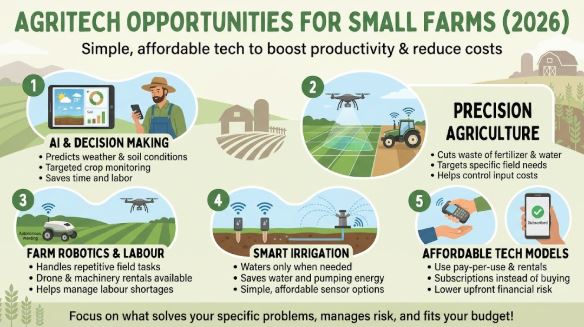
Agritech innovation in 2026 is creating new opportunities for US small businesses to reduce operating costs, improve farm productivity and respond to unpredictable weather. With labour shortages, expensive agricultural inputs and tighter profit margins affecting farm operations, technology is becoming a practical business tool rather than simply a symbol of modernisation. From AI-powered crop monitoring to smart irrigation and automated machinery, new solutions are helping farmers make better decisions about how they use time, labour, water and other resources.
For small farms, however, adopting technology is not just about buying new equipment. Every investment must deliver a clear benefit without placing unnecessary pressure on cash flow. The most promising developments are therefore those that solve specific problems, remain affordable and produce measurable improvements in day-to-day operations.
AI Helps Farmers Make Better Business Decisions
Artificial intelligence is becoming increasingly useful in agricultural planning by helping farmers interpret weather forecasts, soil conditions, crop health information and potential pest risks. Instead of relying solely on manual inspections, growers can use digital tools to identify emerging problems and determine where attention is needed.
For example, combining weather information with soil moisture readings can help farmers plan irrigation more carefully. Crop monitoring systems can also flag areas that may require inspection, helping growers focus their time and resources where they are most needed.
These tools can support better decisions and reduce unnecessary fieldwork, particularly for small businesses managing multiple plots with limited staff. However, AI recommendations still require human judgement. Farmers must consider local growing conditions and verify important findings before making decisions that could affect crop yields or operating expenses.
The commercial value comes from using AI to improve existing processes, not from adopting technology simply because it is available.
Precision Agriculture Helps Control Rising Input Costs
Fertiliser, pesticides, fuel and water can place considerable pressure on agricultural budgets. Applying the same amount of resources across an entire field may also result in waste when different areas have different requirements.
Precision agriculture helps address this challenge by using sensors, satellite imagery, field mapping and targeted application equipment to guide farming activities. These tools allow farmers to identify areas that need additional attention and apply inputs more selectively.
For small agricultural businesses, better resource management can support healthier profit margins. More targeted spraying may reduce unnecessary chemical use, while improved monitoring can help detect crop problems earlier.
The financial results will depend on farm size, crop type, local conditions and the cost of the technology. Businesses should therefore compare actual savings with equipment, installation and maintenance expenses before expanding their investment.
Agricultural Robotics Offers New Ways to Manage Labour
Labour availability remains an important concern for many US farming operations, particularly during planting, harvesting and other time-sensitive activities. Agricultural robotics and automation are providing additional ways to manage repetitive work and improve operational consistency.
Robotic weeders, automated machinery, agricultural drones and precision spraying systems can support selected tasks while reducing the amount of manual intervention required. For smaller farms, these technologies may be particularly useful when labour shortages delay essential fieldwork.
However, purchasing advanced machinery outright can be expensive. Equipment rental, shared machinery arrangements and pay-per-use services offer alternative ways to access automation without committing substantial capital.
This also creates business opportunities for local service providers that offer drone monitoring, equipment operation, maintenance and technical support. Businesses that combine reliable technology with practical field knowledge can help smaller farmers adopt automation more confidently.
Smart Irrigation Supports Water Savings and Climate Resilience
Unpredictable rainfall, drought and changing temperatures are making water management increasingly important for agricultural businesses. Smart irrigation systems use soil moisture sensors, weather information and automated controls to help farmers determine when and how much water their crops need.
By improving visibility into soil conditions, these systems can help reduce unnecessary irrigation and support more consistent crop management. They may also help farmers manage energy costs associated with pumping water.
For small farms, the objective is to use water more efficiently without investing in unnecessarily complicated systems. Affordable sensors and targeted irrigation upgrades may be sufficient for some operations, while larger or more complex farms may require integrated monitoring solutions.
Agricultural service companies can also benefit by providing sensor installation, irrigation maintenance and monitoring services tailored to local farming conditions.
Biological Crop Solutions Expand Farmers’ Options
Agricultural innovation is also creating new options for crop protection and soil management. Biological crop inputs, including certain microbial products, can support specific crop-management objectives and complement established agricultural practices.
When combined with suitable crop varieties and targeted application methods, these products may help farmers develop more precise approaches to managing pests, soil health and plant growth. Their effectiveness varies according to the crop, product, environmental conditions and intended use.
Small businesses should evaluate product performance, costs and compatibility with existing farming practices before making changes. Biological solutions are not a universal substitute for conventional fertilisers or pesticides, and integrated crop management may remain necessary.
For agricultural suppliers and advisers, this evolving market creates opportunities to provide product distribution, technical guidance and field-level support.
Affordable Technology Models Help Small Farms Get Started
One of the biggest barriers to agritech adoption is the initial cost of purchasing machinery, installing sensors and implementing digital management systems. These expenses can be difficult to justify when farms operate on seasonal income and uncertain margins.
Flexible purchasing and service models can make technology more accessible. Equipment-as-a-Service, machinery rentals, shared ownership and software subscriptions allow businesses to access selected tools without paying the full purchase price upfront.
For example, a small farm may find it more economical to hire specialised equipment during planting or harvesting rather than own machinery that remains unused for much of the year. Subscription-based software can also provide access to monitoring and planning tools without a major initial investment.
For agritech providers, these models offer opportunities to reach smaller customers and develop recurring revenue through subscriptions, maintenance and technical services. Transparent pricing and dependable support are essential to making the arrangements commercially sustainable.
New Business Opportunities Beyond Farming
The growth of agritech is creating opportunities for small businesses across the agricultural supply chain. Entrepreneurs can develop services around drone-based crop monitoring, farm software, sensor installation, irrigation management, machinery maintenance and agricultural data analysis.
Local service providers may be particularly well positioned to serve farmers because they understand regional crops, weather patterns and practical operating challenges. Combining digital tools with hands-on assistance can make technology easier to adopt for businesses that lack dedicated technical teams.
Eligible farms and agricultural service companies may also be able to access government or local funding programmes for specific equipment, conservation projects or efficiency improvements. Availability and eligibility vary, so businesses should verify current programme requirements before including financial assistance in their investment plans.
The strongest opportunities will come from solving genuine problems for farmers. Technology that is affordable, reliable and supported by responsive service is more likely to build long-term customer relationships.
How Small Businesses Can Measure Agritech Returns
Before investing in new technology, agricultural businesses should identify the operational problem they want to solve. A farm dealing with high water expenses, for instance, may benefit more from moisture sensors and irrigation improvements than from investing in expensive autonomous machinery.
Businesses should calculate the total cost of ownership, including equipment, installation, training, maintenance, connectivity and subscription charges. They should then compare these expenses with expected benefits such as lower input consumption, reduced labour requirements, fewer crop losses and time savings.
Testing a solution on a limited scale can help establish whether it performs well under actual farm conditions. If the results justify the expense, the business can expand its use gradually.
This approach helps farmers avoid unnecessary spending and ensures that technology investments support commercial goals rather than add another layer of cost.
Conclusion
Agritech innovation in 2026 is giving US small businesses new ways to manage rising expenses, improve productivity and prepare for changing agricultural conditions. AI, precision farming, robotics and smart irrigation can help address practical challenges when they are chosen carefully and matched to a farm’s needs.
For smaller operators, success does not depend on adopting every new technology. It depends on identifying where innovation can make a measurable difference, managing investment risks and choosing solutions that fit available resources. By combining practical technology with sound business planning, US farms and agricultural service companies can strengthen efficiency, protect margins and build more resilient operations.