
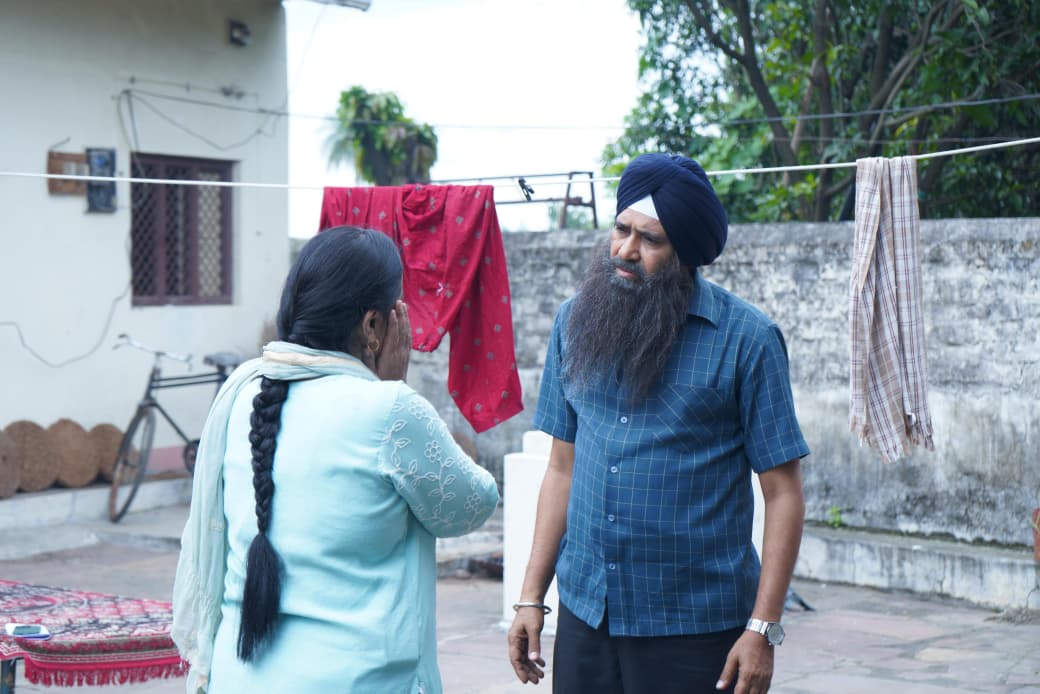
In Shabad – Reet Aur Riwaaz, Suvinder Vicky essays a deeply layered character shaped by faith, tradition and unspoken emotional conflict. Set against the cultural and spiritual landscape of Punjab, the ZEE5 series explores the fragile bond between a father and son, where legacy often overshadows love and silence replaces conversation. In this candid conversation, Suvinder Vicky reflects on what drew him to the role, his understanding of heritage and freedom, and how the story holds up a mirror to real-life generational relationships.
“What was it about Shabad – Reet Aur Riwaaz that made you say yes? Was it the cultural specificity of Punjab, the restraint in its storytelling, or the emotional complexity of a man who loves deeply but struggles to articulate that love?
Yes, definitely. When I was offered the character in Shabad – Reet aur Riwaaz, I did not waste any time in deciding that I wanted to play this character. First of all, there were many possibilities for me as an actor. Secondly, the story is connected to Punjab, and within that, it is closely linked to gurdwaras and religion. I have seen all these things around me, so it felt familiar yet challenging. I had never played such a character before, which made it even more exciting. I felt it was something different, and the character has many specialities and nuances that I could explore and portray well.
*”At his core, what do you believe your character fears more—losing his art and legacy, or losing his son?*
Personally, I felt that the talk of art and heritage shown in this series, and through this character, about preserving the heritage of our ancestors and carrying it forward, was a priority for me. That is why I strongly felt that I had to do this. As far as losing my son is concerned, there was no fear that I would lose him, because he was behaving this way and was unable to speak. Due to the duality of my character, I felt that he was doing this on purpose, that he was trying to save himself from sacrifice or from becoming a ragi. Because of this duality, the character never felt that he would lose his son. For him, the heritage, tradition, and art of his ancestors were more important, and that is why my focus remained on that.
*”Do you consciously gravitate towards roles that demand emotional discomfort and inner conflict? What does a role like Shabad give you as an actor that more overtly dramatic parts may not?*
No, there is nothing that I am intentionally attracted to. Yes, every actor has a comfort zone. I think I am more inclined towards emotional aspects that come from within the actor, inner acting. Instead of doing something melodramatic, I prefer emotional performances that I can deliver well. I always feel I should look for work that explores relationships between a father and son, father and daughter, husband and wife, or even friendships and the small joys of life. When I get to explore and resolve these emotions in an artistic way, I feel more satisfied as an actor.
*”As a person, how do you view the idea of legacy today—do you see it more as passing down values and art, or as giving the next generation the freedom to redefine them?*
Freedom, I think, is our birthright. In the same way, I would say that if we want to carry our heritage forward, we need to have belief in the generation to whom we are passing it on. It is important to trust that generation and have faith in how the art, tradition, and heritage will move forward in its own way. Time never stops for anyone, right? It should not be that because my father did something a certain way, I must follow the same path. I believe we should leave it to the next generation to decide how they want to maintain and carry forward the heritage.
*”What do you think fathers watching Shabad – Reet Aur Riwaaz might recognise—or perhaps reflect on—about their own relationships with their children?*
Definitely, when this series reaches the public, there will be a lot of fathers who will sit and think that, to satisfy their ego, they bothered their children. At the same time, there will be a few children who will feel that they have failed to fulfill the dream of their parents. So definitely, there is a message in it that a generation gap will remain forever, still how can we support each other as a family. So this message will definitely come out in the series.
*”Shabad – Reet Aur Riwaaz premieres on ZEE5, giving the series access to audiences across generations and geographies. How do you feel about this story finding resonance in homes far beyond Punjab?*
I am feeling happy that this series is reaching people in the roots of India through ZEE5, and the culture of Punjab will also reach the audience. I feel that this is a medium which people can watch at the comfort of their homes and experience other cultures, so I am definitely happy that the series is reaching the audience through ZEE5.