
Malkangiri, Nov 18 (UDN): In an age when road connectivity, electricity, education and safe drinking water are considered basic necessities, four villages in Odisha’s Malkangiri district continue to struggle for these essential facilities. Located barely 15 kilometres from Malkangiri town, Laxmanpur, Sulipani, Jamguda and Sindhibhata under Tandgiri Gram Panchayat remain cut off from basic infrastructure, leaving residents to face enormous hardships in their everyday lives.
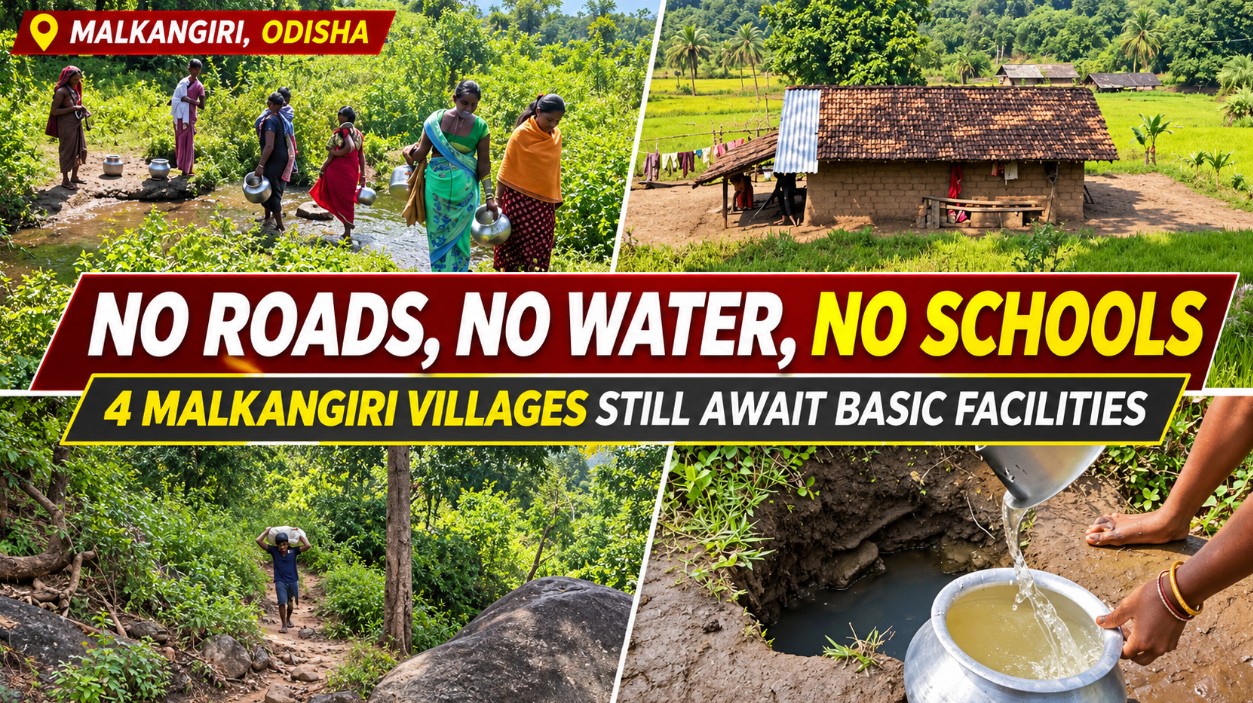
Representational Image
Surrounded by hills and dense forests, these villages are accessible mainly through difficult and steep pathways. The absence of motorable roads has made transportation a major challenge, while the lack of reliable drinking water facilities has forced residents to depend on traditional wells and makeshift water pits.
For villagers, even travelling to nearby areas has become a physically demanding task.
Two-hour trek just to reach the foothills
Residents say reaching the main road from their settlements requires considerable time and effort. Those living on hilltops have to walk for nearly two hours just to reach the foothills.
“We live on a hilltop, and it takes us around two hours just to get down to the base. The absence of a proper road has made our lives extremely difficult. We do not have drinking water facilities either and are forced to depend on well water,” a villager said.
The lack of basic infrastructure has affected almost every aspect of daily life, from accessing essential services to transporting agricultural produce and meeting household needs.
Patients carried on cots during medical emergencies
The situation becomes particularly alarming during medical emergencies.
With no motorable roads connecting the villages, residents are often forced to carry sick or injured people on cots through steep and uneven hill paths to reach healthcare facilities.
The challenge becomes even more severe at night, when navigating the difficult terrain is risky and time-consuming.
“We have to cross two hills to carry a patient to the hospital. It becomes extremely difficult at night. If a proper motorable road is constructed, ambulances will be able to reach our village. Our children are also unable to attend school regularly because of the poor connectivity,” another resident said.
The absence of proper road infrastructure has thus emerged as a major obstacle to healthcare access and children’s education.
Drinking water and education remain major concerns
Apart from road connectivity, access to safe drinking water remains another pressing concern for residents.
Villagers continue to depend on wells and makeshift water sources to meet their daily requirements, despite the risks associated with inadequate water infrastructure.
Education has also suffered due to the geographical isolation of the settlements. Children face difficulties travelling to educational institutions, with the absence of proper roads making their daily commute particularly challenging.
Residents largely depend on agriculture and forest resources for their livelihoods, making relocation or migration difficult for many families.
They claimed that repeated appeals to the local administration for basic facilities, particularly road construction, have yet to bring a lasting solution.
Forest clearance cited as road construction hurdle
Responding to the concerns, Malkangiri Collector Arvind Rajeshirke said issues related to forest land clearance had created hurdles in taking up road construction work in the area.
He assured residents that the district administration would examine their grievances and take necessary steps to address the problems.
The Collector said a block-level team would visit the villages, assess the situation and prepare a report identifying residents who continue to lack access to basic facilities and entitlements.
The team would interact directly with villagers and attempt to resolve issues that could be addressed immediately. Matters requiring policy-level decisions, including road connectivity and electricity infrastructure, would be taken up at the district level, he added.
Will development finally reach these remote villages?
The Collector’s assurance has raised hopes among residents, who have been waiting for years for basic infrastructure and improved connectivity.
However, for the people of Laxmanpur, Sulipani, Jamguda and Sindhibhata, the immediate questions remain unanswered: When will proper roads reach their villages? When will safe drinking water become available? And how long will patients continue to be carried across hills on cots to reach hospitals?
The plight of these four villages highlights the challenges of delivering essential public services to remote tribal settlements. Residents are now looking towards the district administration for concrete action rather than assurances, hoping that access to roads, water, education, electricity and healthcare will finally become a reality.