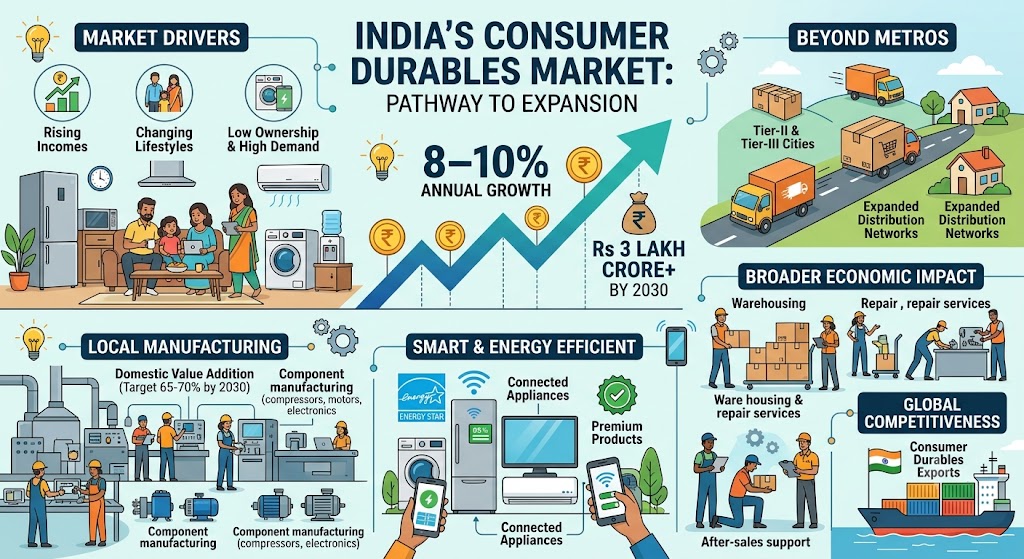
India’s consumer durables market is entering an important phase of expansion as rising incomes, changing lifestyles and growing demand for modern household products create new opportunities for businesses.
The market is expected to grow at an annual rate of 8–10 per cent and could reach around Rs 3 lakh crore to Rs 3.25 lakh crore by 2030. The growth is expected to come not only from higher household consumption but also from increasing demand for better-quality, energy-efficient and technology-enabled products.
For businesses, the expansion presents opportunities across the entire value chain. Manufacturers can increase production, while suppliers, retailers, logistics companies, repair services and other supporting businesses can benefit from rising demand.
More households, bigger opportunities
A major growth driver for the consumer durables market is the relatively low ownership of several household appliances in India compared with other regional markets. This leaves considerable room for products such as refrigerators, washing machines, air conditioners and other appliances to reach more households.
Demand is also spreading beyond major cities. Rising purchasing power in smaller towns, wider e-commerce networks and easier access to consumer finance are helping more customers purchase higher-value products.
For businesses, this creates an opportunity to expand distribution networks and reach new consumer markets across Tier-II and Tier-III cities.
Local manufacturing can create more value
The next phase of growth will depend heavily on how much of the manufacturing value chain can be developed within India.
Domestic value addition in the sector is currently estimated at around 50–55 per cent of its potential and could increase to 65–70 per cent by 2030 as local component manufacturing expands. This could create an additional Rs 40,000–50,000 crore opportunity for domestic value addition.
This presents opportunities for manufacturers and smaller businesses involved in components, electronics, motors, compressors, insulation materials and other parts used in household appliances.
Greater localisation could also reduce dependence on imported components and make domestic supply chains more resilient.
Technology is changing consumer demand
Consumers are increasingly looking beyond basic products. Energy efficiency, smart features, connected appliances and improved convenience are becoming important factors in purchasing decisions.
This shift is encouraging businesses to invest in product development and technology. Companies that can combine affordability with useful features could find more opportunities as consumer expectations change.
The growth of premium products is also becoming visible in the market, while financing and festive-season offers are supporting purchases among a wider section of consumers.
Growth can support jobs and smaller businesses
Expansion in the consumer durables market can have an impact well beyond manufacturers. Higher production creates demand for packaging, warehousing, transportation, installation, maintenance and after-sales services.
This can open opportunities for MSMEs and local service providers, particularly as appliance ownership increases in smaller cities and towns.
The sector can therefore become an important source of business activity across both manufacturing and services.
Export opportunity is also growing
India’s consumer durables industry also has an opportunity to increase its presence in international markets. Building a stronger domestic component ecosystem, improving production efficiency and achieving greater economies of scale could help Indian manufacturers become more competitive globally.
India’s electronic goods exports reached $47.96 billion in FY2025-26, up 24.3 per cent from the previous year, showing the broader expansion of the country’s electronics manufacturing ecosystem.
A larger market with wider business impact
The growth of the consumer durables market is therefore not just a story about more appliances being sold. It represents a wider business opportunity involving manufacturing, components, technology, retail, logistics and services.
If domestic production keeps pace with rising demand, the sector could support greater investment, strengthen local supply chains and create new opportunities for smaller businesses.
With the market potentially reaching Rs 3.25 lakh crore by 2030, the consumer durables sector is set to become an increasingly important part of India’s consumption and manufacturing economy.