
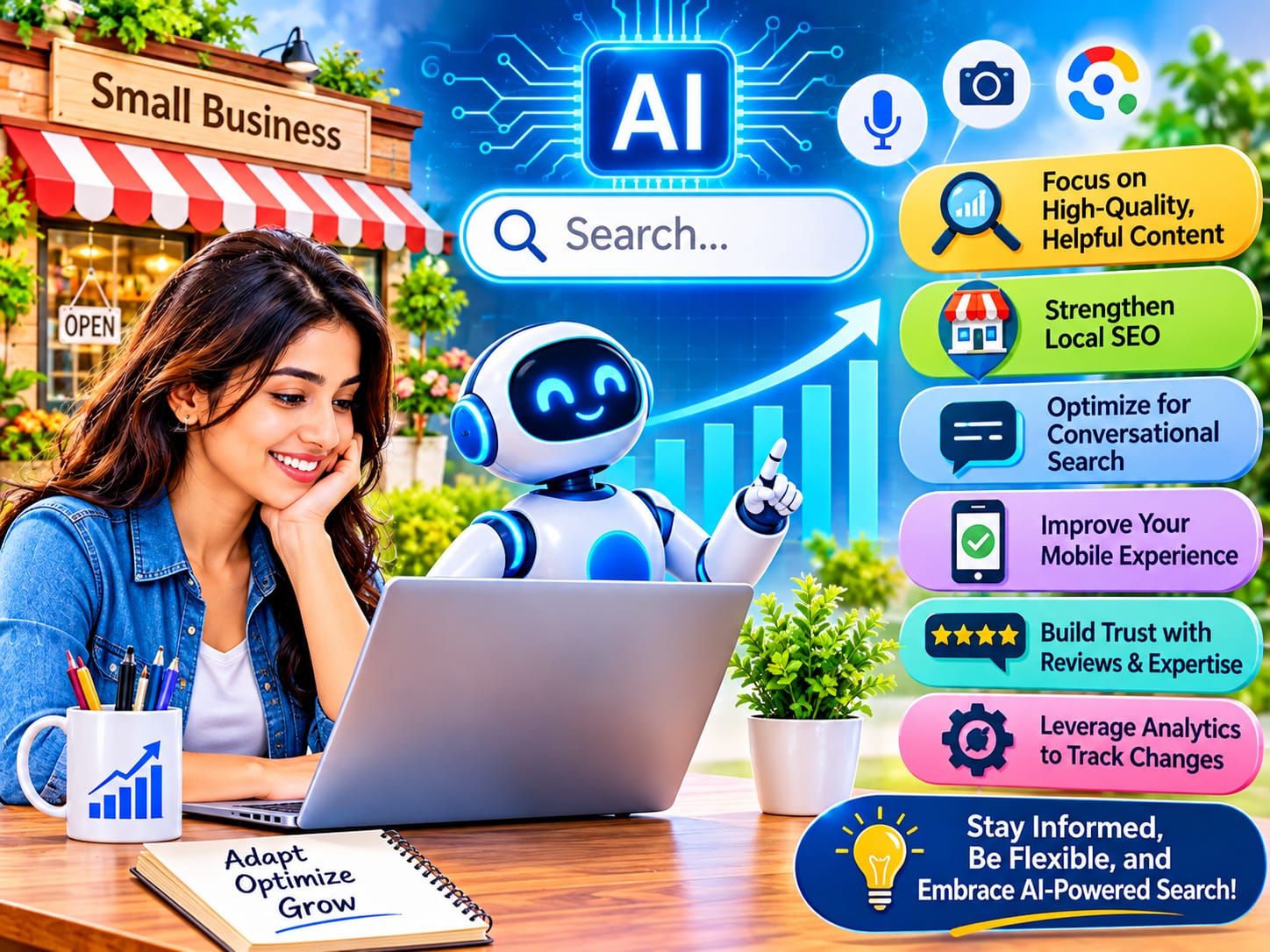
Nov 28: Search is undergoing one of the biggest transformations in the history of digital marketing. Artificial intelligence is changing how customers discover businesses, compare products, evaluate services, and make purchasing decisions. Traditional search engines are increasingly incorporating AI-generated summaries, conversational answers, and recommendations, changing the way websites receive traffic and generate leads.
For small businesses, this transformation presents both a challenge and a significant growth opportunity. Companies that adapt their digital strategies early can improve online visibility, build customer trust, attract qualified prospects, and compete more effectively with larger organizations.
The focus is no longer limited to achieving a first-page ranking on Google. Businesses must also become credible sources of information that AI-powered search experiences can understand, reference, and recommend.
Understanding the Shift from Traditional SEO to AI-Powered Search
Traditional search engines generally present a list of links based on relevance, authority, and other ranking signals. AI-powered search takes a different approach. It interprets a user’s question, gathers information from multiple sources, and generates a direct response that may include business recommendations, product comparisons, summaries, and website citations.
Customers are increasingly asking conversational questions such as:
- Which service provider offers the best value in my area?
- What should I consider before purchasing a particular product?
- Which company provides reliable solutions for small businesses?
- What are the differences between competing service providers?
- Where can I find an affordable and trustworthy professional?
These questions create new opportunities for businesses that publish useful, accurate, and relevant information online.
The change also means that a business can have a well-designed website and reasonable traditional search rankings but still receive limited visibility in AI-generated answers.
Recent Research and Industry Data: Why Businesses Should Pay Attention
Recent research highlights how quickly search behaviour is evolving.
Pew Research Center’s 2025 study examined actual browsing activity from 900 US adults. It found that approximately 58% had encountered at least one Google search containing an AI-generated summary during March 2025. Users clicked traditional search-result links less frequently when an AI summary appeared. The click rate was approximately 8% when an AI summary was present, compared with 15% when it was absent. This demonstrates why businesses cannot rely exclusively on traditional organic clicks to measure online visibility.
McKinsey’s October 2025 research, based on its AI Discovery Survey of 1,927 US consumers, reported that approximately half of consumers were already using AI-powered search. Its analysis projected that AI-powered search could influence $750 billion in US revenue by 2028. This indicates that AI discovery is becoming an important commercial consideration rather than simply a technology trend.
British Chambers of Commerce research reported in November 2026 provides an especially important warning for smaller businesses. Among 1,100 surveyed businesses, only 9% had taken steps to improve their visibility in AI search. Among businesses that had checked their AI search results, 47% found inaccurate information or discovered that competitors were appearing ahead of them. Additionally, 30% of businesses employing fewer than ten people were unaware that they could appear in AI search results.
Taken together, these findings suggest that AI search is creating a visibility gap. Businesses that maintain accurate digital information, publish useful content, and establish online credibility have an opportunity to strengthen their competitive position.
How Small Businesses Can Prepare for AI-Driven Search
Create Content That Answers Real Customer Questions
One of the most effective ways to improve AI search visibility is to develop content around the questions customers genuinely ask before making purchasing decisions.
Instead of publishing generic promotional articles, businesses should create informative content that addresses customer concerns, explains services, compares available solutions, and provides practical recommendations.
For example, an accounting firm could publish articles about tax planning, bookkeeping costs, financial compliance, and common accounting mistakes. A home improvement business could provide guidance on renovation budgets, material selection, maintenance, and project timelines.
Content should provide clear answers, relevant examples, and actionable information. Frequently asked questions, detailed service explanations, buying guides, and industry insights can help search systems understand the business’s expertise.
Strengthen Website Authority and Trust
AI-powered search systems need reliable information when generating answers and recommendations. Businesses should therefore focus on establishing credibility across their websites and other relevant online platforms.
Important improvements include:
- Publishing original research, expert insights, and practical industry advice.
- Providing clear company information, service descriptions, and contact details.
- Displaying genuine customer testimonials and verified reviews.
- Maintaining consistent business information across relevant directories.
- Including author credentials and relevant professional experience.
- Linking to credible research and authoritative industry resources.
A business should demonstrate not only what it offers but also why customers should trust its knowledge and services.
Optimise Local Search Visibility
Local businesses can benefit significantly from AI-driven discovery because customers frequently search for services based on location, availability, price, and reputation.
Businesses should maintain accurate location details, business hours, contact information, service categories, and customer reviews across their online profiles.
Local landing pages should explain the services available in specific locations rather than simply repeating city names to attract search traffic.
For example, a digital marketing agency serving multiple cities can create useful location-specific pages explaining local business challenges, available services, and relevant market insights.
Structured data, including LocalBusiness, Organization, Product, and Service schema where appropriate, can also help search systems interpret website information more accurately.
Make Website Content Easy for AI Systems to Understand
Website structure plays an important role in search visibility.
Businesses should organise information using descriptive headings, concise paragraphs, meaningful page titles, and clearly defined service categories.
Technical improvements should include:
- Mobile-friendly website design.
- Fast page-loading performance.
- Secure HTTPS connections.
- Proper XML sitemaps and crawlable pages.
- Accurate metadata and canonical URLs.
- Relevant structured data markup.
- Accessible and descriptive image information.
Businesses should also ensure that important information is available in readable website content rather than being hidden exclusively inside images, videos, or interactive elements.
These improvements support both traditional search engine optimisation and emerging AI discovery experiences.
Build a Strong Digital Reputation Beyond the Website
AI search does not operate in isolation from the broader online environment. Information about a business may appear across industry publications, professional directories, review platforms, news websites, and relevant online communities.
Small businesses should therefore develop a consistent digital presence across channels where their potential customers research products and services.
Participating in professional discussions, contributing expert articles, securing relevant industry mentions, and encouraging authentic customer feedback can strengthen a business’s overall reputation.
The objective should be to establish genuine authority rather than artificially generate backlinks or manipulate online mentions.
Use AI Tools to Improve Marketing Productivity
AI technology can also help small businesses manage their digital marketing activities more efficiently.
Businesses can use AI-assisted tools to identify customer questions, analyse competitors’ content, develop article outlines, research keywords, improve website content, and understand customer feedback.
However, AI-generated content should always be reviewed by someone with relevant industry knowledge. Publishing large volumes of generic or inaccurate material can damage credibility rather than improve search performance.
The most effective approach combines AI-assisted productivity with human expertise, original insights, and practical business experience.
A Practical AI Search Strategy for Small Businesses
Businesses do not need large marketing budgets or specialised technical departments to begin adapting to AI-powered search.
A practical approach starts with improving the existing digital foundation.
Review the website to identify outdated information, missing service details, weak content, and technical problems. Update business profiles and ensure that contact information, operating hours, locations, and service descriptions are consistent.
Next, identify the questions customers ask during enquiries and sales conversations. Turn these questions into informative website pages, articles, and frequently asked questions.
Monitor how the business appears across traditional search engines and AI-powered answer platforms. Test relevant customer queries and examine whether the business is mentioned, whether its information is accurate, and which competitors are being recommended.
Finally, measure business outcomes rather than focusing exclusively on rankings and traffic.
Useful performance indicators include qualified enquiries, phone calls, appointment bookings, conversion rates, branded searches, referral traffic from AI platforms, and customer acquisition costs.
The Business Impact: From Online Visibility to Revenue Growth
The real value of AI search optimisation is its potential to connect businesses with customers who already have a specific requirement or purchasing intention.
For small businesses, this can create several commercial advantages.
Better-qualified leads: Customers who discover a business through detailed AI-generated recommendations may already understand its services, pricing considerations, and expertise.
Stronger brand recognition: Being referenced in relevant AI-generated answers can increase awareness, even when customers do not immediately visit the website.
Improved customer acquisition: Informative content can help businesses attract customers who are actively researching solutions rather than simply browsing.
Greater competitive advantage: Businesses that establish credible digital information early may benefit as AI-driven discovery becomes more widespread.
More efficient marketing investment: Combining AI-assisted research, content development, and performance analysis can help smaller teams achieve more without significantly increasing marketing expenditure.
However, AI search visibility does not guarantee leads or sales. Businesses must connect digital discovery with compelling service offerings, transparent pricing, responsive customer support, and a strong conversion experience.
Challenges Small Businesses Should Anticipate
Despite its opportunities, AI-driven search introduces several challenges.
One significant concern is declining website traffic from informational searches. Customers may receive sufficient information directly through AI-generated answers without visiting the original website.
Another challenge is the difficulty of measuring visibility. Traditional SEO tools provide information about keyword rankings, impressions, and clicks, but AI recommendations can vary according to the question, location, platform, and available information.
Small businesses must also be cautious about inaccurate AI-generated descriptions. Incorrect service details, outdated pricing, or misleading business information can influence customer perceptions.
To address these challenges, businesses should regularly review their online presence, monitor customer feedback, maintain accurate information, and assess the quality of leads generated through different discovery channels.
Future Outlook: Preparing for the Next Phase of Digital Discovery
AI-driven search is likely to become increasingly integrated into everyday purchasing decisions. Customers will increasingly expect digital platforms to provide personalised recommendations, compare service providers, explain purchasing options, and simplify decision-making.
For small businesses, this means digital marketing must evolve beyond traditional keyword targeting and website optimisation.
A successful strategy will combine technical SEO, high-quality content, local search optimisation, digital reputation management, structured data, and AI-assisted marketing.
Businesses should also prepare for the growth of AI agents that may eventually help customers compare providers, check availability, request quotations, and initiate purchases. Accurate service information, accessible business systems, and reliable customer communication will become increasingly important.
Conclusion
AI-driven changes in search are reshaping how customers discover, evaluate, and select businesses. For small businesses, adapting to this transformation is no longer simply about improving website rankings. It is about building digital credibility, providing genuinely useful information, and ensuring that business services can be accurately understood and discovered across emerging search platforms.
The latest industry research highlights a clear opportunity: many smaller businesses have yet to develop a dedicated AI search strategy, while customer adoption of AI-powered discovery continues to expand.
Businesses that invest in strong digital foundations, authoritative content, accurate online profiles, and measurable marketing strategies will be better positioned to compete.
The future of business search visibility will belong to companies that are not only easy to find but also credible, relevant, and valuable enough to be recommended.