
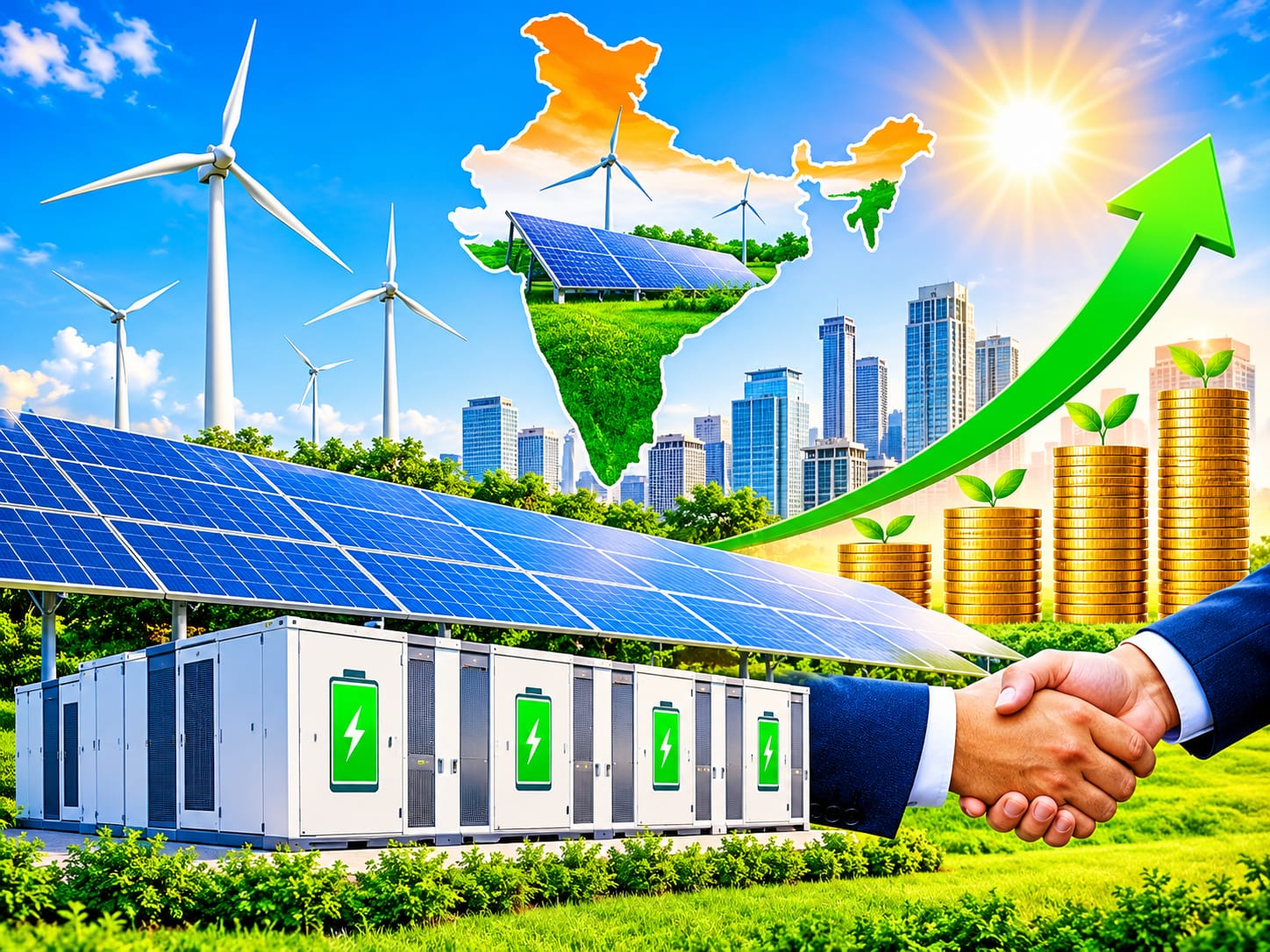
Nov 21:India’s renewable energy sector is entering a defining phase of growth. Driven by rising electricity demand, ambitious decarbonisation targets, supportive government policies and increasing private-sector participation, the country is rapidly emerging as one of the world’s most attractive markets for clean energy investment.
Solar power and battery energy storage are at the centre of this transformation. While solar energy is expanding India’s electricity-generation capacity, battery storage is addressing one of its biggest challenges: ensuring a reliable supply of electricity when the sun is not shining.
This shift is creating opportunities that extend far beyond conventional power generation. From solar project development and equipment manufacturing to energy storage, engineering, digital energy management and specialised infrastructure services, the renewable energy ecosystem is opening new avenues for entrepreneurs, investors, manufacturers and established businesses.
For companies looking to participate in India’s next phase of infrastructure development, the renewable energy market represents more than an environmental opportunity. It is becoming a significant commercial growth sector.
India’s Renewable Energy Market: Strong Growth and Expanding Investment
India has established ambitious renewable energy goals as part of its broader strategy to strengthen energy security, reduce dependence on fossil fuels and achieve long-term climate commitments.
The country’s clean energy expansion is being supported by several structural factors. Electricity consumption is increasing as urbanisation, industrial activity, infrastructure development and digital services expand. At the same time, businesses are facing growing pressure to manage energy costs, improve sustainability performance and reduce carbon emissions.
Solar power has become particularly attractive because of improving technology, competitive project costs and the ability to deploy installations at different scales. Large solar parks, rooftop systems and decentralised solar projects are all contributing to market expansion.
However, the next stage of growth will depend increasingly on the availability of flexible electricity infrastructure. Battery energy storage systems are therefore becoming an essential part of India’s renewable energy investment landscape.
The combination of solar generation and energy storage is creating a broader business ecosystem in which value can be generated through electricity production, storage, distribution, equipment supply, project development and energy management.
Solar Energy: The Foundation of India’s Clean Energy Economy
Solar power remains one of the most commercially significant segments of India’s renewable energy industry. Its scalability allows businesses to participate through large infrastructure projects as well as smaller, customer-focused installations.
Solar Energy: A Major Business Opportunity in India
Solar power is one of the fastest-growing segments of India’s renewable energy industry, creating opportunities across large-scale projects, rooftop installations and domestic manufacturing.
Utility-scale solar projects
Large solar power plants attract investors and developers through economies of scale and long-term power purchase agreements. They also generate demand for EPC services, electrical infrastructure, equipment supply, grid connectivity and maintenance.
Rooftop solar
Commercial buildings, factories, hospitals and residential properties are increasingly adopting rooftop solar to reduce electricity costs. Government initiatives such as PM Surya Ghar are supporting market growth and creating opportunities for installers, contractors, distributors and maintenance providers.
Domestic solar manufacturing
India’s push for domestic manufacturing is creating demand for solar modules, cells, inverters, mounting structures, cables and other components. Both large manufacturers and specialised suppliers can benefit from this expanding supply chain.
Battery Energy Storage: The Next Major Investment Opportunity
The expansion of solar and wind power is increasing demand for reliable electricity storage. Battery Energy Storage Systems (BESS) store surplus electricity and release it when demand rises or renewable generation falls, making them essential to India’s clean energy infrastructure.
Government support, including viability gap funding initiatives, is improving the prospects for large-scale storage projects. The reported November 2026 support programme of ₹14,500 crore for 92 GWh highlights growing policy interest.
Grid-scale storage
Large battery installations help stabilise electricity supply and manage peak demand. They create opportunities for battery manufacturers, system integrators, infrastructure developers and maintenance providers.
Commercial and industrial storage
Factories, hospitals, data centres and commercial buildings can use battery systems to reduce peak electricity costs, improve backup power and maximise solar energy usage.
Energy Storage as a Service
Under this model, providers finance, install and operate battery systems while customers pay a service fee. It reduces upfront investment for businesses and creates recurring revenue opportunities for service providers.
Emerging Opportunities in Floating Solar and Hybrid Renewable Energy
India’s renewable energy expansion is also encouraging the development of innovative project formats.
Floating solar projects, which install photovoltaic panels on suitable water bodies, can help make productive use of existing water surfaces while reducing competition for land.
Reservoirs and other appropriate water bodies may offer potential locations, subject to technical feasibility, environmental assessment, regulatory approvals and grid connectivity.
Floating solar projects require specialised engineering, anchoring systems, floating platforms, electrical infrastructure and ongoing maintenance. These requirements create opportunities for companies with expertise in marine engineering, fabrication, civil works and solar project development.
Hybrid renewable energy projects are another important growth area. By combining solar, wind and battery storage, developers can create more consistent electricity supply profiles.
Such projects may become increasingly relevant for utilities and large commercial and industrial customers seeking dependable low-carbon electricity.
Business Models Creating New Revenue Streams
India’s renewable energy investment boom is creating opportunities for companies with different levels of capital, technical capability and risk appetite.
Solar EPC and project development
EPC companies design, procure, install and commission solar projects for residential, commercial and industrial customers. Success depends on technical expertise, competitive pricing, reliable equipment and quality execution.
Solar-as-a-Service
Providers install and operate solar systems while customers pay through long-term service or energy agreements. This reduces upfront costs for customers and creates recurring revenue for providers.
Independent Power Producers
IPPs develop, own and operate power-generation assets, earning revenue through electricity sales. This model offers long-term potential but requires significant capital and regulatory expertise.
Energy Storage as a Service
Providers install and manage battery systems for businesses, generating revenue through storage services, backup power and energy-cost optimisation.
Digital energy solutions
Energy monitoring, predictive maintenance, battery management and performance analytics offer opportunities for technology companies without requiring ownership of energy infrastructure.
Where Entrepreneurs and Investors Can Participate
Renewable energy opportunities extend beyond owning solar parks or battery installations. Businesses can participate through equipment distribution, electrical contracting, project consultancy, installation, maintenance, specialised manufacturing, energy audits and technology services.
Entrepreneurs with limited capital can start with rooftop solar installation or maintenance, while medium-sized businesses can explore EPC contracting, project development and battery integration. Larger investors may consider utility-scale projects, energy storage and domestic manufacturing. The ideal business model depends on available capital, technical expertise, customer access and risk appetite.
Eastern India and Odisha: An Emerging Opportunity
Eastern India, particularly Odisha, offers growing opportunities for renewable energy businesses due to industrial expansion, urbanisation and rising electricity demand.
- Industrial demand: Metals, mining and manufacturing industries offer potential for renewable power and energy-management solutions.
- Solar installations: Factories, warehouses, commercial buildings, educational institutions and public infrastructure create demand for rooftop solar.
- Technical services: EPC contracting, electrical infrastructure, battery backup, energy audits and maintenance offer opportunities for local businesses.
- Entrepreneurial potential: Businesses in Bhubaneswar and across Odisha can start by serving local industries, institutions and commercial customers.
- Scope for expansion: Companies with strong technical capabilities and reliable execution can gradually expand into larger renewable energy projects.
Government Policies and the Investment Environment
Government policy continues to play an important role in shaping India’s renewable energy market.
Programmes supporting rooftop solar, domestic manufacturing, large-scale renewable deployment and battery storage are helping create a more structured investment environment.
Important initiatives include the PM Surya Ghar: Muft Bijli Yojana, the National Programme on High Efficiency Solar PV Modules, renewable energy park development and viability gap funding support for eligible battery storage projects.
Policies and incentives can improve project economics, but their benefits depend on eligibility, implementation guidelines, financing arrangements and regulatory approvals.
Investors should distinguish between announced policy objectives and operational schemes that are open for applications. Financial projections should be based on current official notifications rather than assumed subsidies or unconfirmed funding commitments.
Financial Considerations: Building a Sustainable Renewable Energy Business
Renewable energy projects can offer attractive long-term commercial opportunities, but profitability depends on careful financial planning.
For solar EPC companies, important factors include equipment procurement costs, installation expenses, customer acquisition costs, project completion timelines and payment cycles.
For independent power producers, financial performance depends on capital expenditure, debt financing, electricity tariffs, generation levels, operating costs, grid availability and contractual terms.
Battery storage projects require additional analysis. Investors must evaluate battery degradation, replacement costs, round-trip efficiency, operating conditions, system warranties and the expected revenue from storage utilisation.
For service-based businesses, recurring maintenance contracts and long-term customer relationships can provide more predictable income than relying entirely on one-time installations.
A sound investment assessment should include realistic cash-flow projections, sensitivity analysis, financing costs, regulatory risks and contingency provisions.
Risks Businesses Must Understand
Despite strong growth potential, renewable energy businesses must consider several challenges:
- Market competition: Intense competition can reduce equipment prices and profit margins.
- Policy and regulatory changes: Approval delays, policy changes and grid connectivity issues can affect project timelines.
- Financial constraints: Working-capital shortages, delayed payments and fluctuating equipment costs can impact operations.
- Battery technology risks: High battery costs, degradation, safety standards and evolving technologies create investment uncertainties.
- Supply-chain dependence: Reliance on imported components and critical battery materials can affect costs and availability.
- Business execution: Success requires careful project selection, reliable suppliers, financial discipline and strong customer relationships.
A Practical Market-Entry Strategy
New entrepreneurs should begin with a focused business segment, such as rooftop solar installation, maintenance, industrial EPC services, battery integration, specialised equipment manufacturing or energy-management technology. The choice should match their capital, technical expertise and market demand.
Before investing, businesses should assess competition, licences, suppliers and financing requirements while building relationships with customers and industry partners. A strong focus on service quality, repeat customers and sustainable growth can create a solid foundation for long-term success.
The Road Ahead: From Renewable Generation to Integrated Energy Infrastructure
India’s clean energy transition is moving beyond the simple addition of solar and wind capacity.
The next phase will increasingly involve integrating renewable generation with battery storage, modernising electricity infrastructure, improving energy efficiency and using digital technology to manage power systems.
This evolution will create opportunities across manufacturing, infrastructure development, engineering, software, project financing and specialised energy services.
Solar power is providing the foundation for this expansion, while battery storage is helping address the reliability challenges associated with renewable electricity.
For businesses and investors, the opportunity lies in identifying where their capabilities can solve practical problems within this evolving energy ecosystem.
Companies that combine technical competence with commercial discipline, dependable execution and a clear understanding of customer needs will be better positioned to benefit from the sector’s expansion.
Conclusion: A Growing Business Opportunity Beyond Clean Energy
India’s renewable energy boom is creating significant business opportunities across solar power, battery storage, manufacturing and energy services. As the sector expands, businesses that identify market gaps, deliver reliable solutions and build strong customer relationships will be well positioned to grow. Renewable energy is no longer just an alternative power source; it is becoming a major driver of investment, innovation, industrial development and employment in India.For forward-looking businesses, the time to understand this market and identify a viable entry strategy is now.