
New Delhi, Nov 17: With growing attention on preventive healthcare, lifestyle-related diseases and holistic well-being, India is strengthening its naturopathy network through new hospitals, medical education, research initiatives and community-based healthcare programmes.
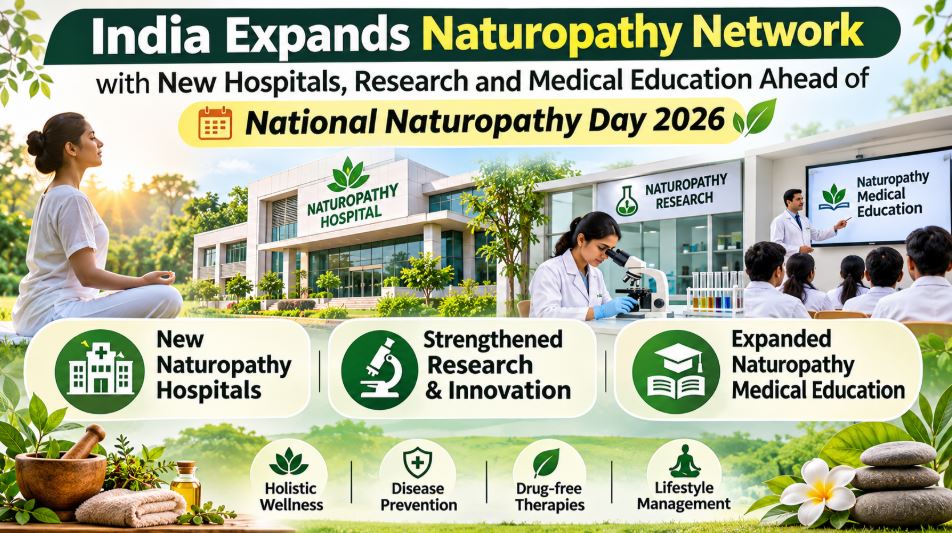
Representational Image
The renewed focus comes ahead of the 9th National Naturopathy Day on November 18, which will be observed at the Central Research Institute of Yoga and Naturopathy (CRIYN) in Nagamangala, Karnataka, under the theme ‘Prakrutik Chikitsa, Swasth Bharat’.
The theme places emphasis on healthy eating, physical activity, yoga and stress management, with particular attention to preventing obesity and promoting healthier lifestyles.
Naturopathy is a drug-free system of healthcare that uses natural approaches such as diet, fasting, hydrotherapy, mud therapy, massage and lifestyle modification. Based on the principle that the body has an inherent capacity to heal, it promotes a way of living in harmony with nature.
India’s expanding institutional framework for naturopathy includes the National Institute of Naturopathy (NIN) in Pune, a network of research centres, dedicated hospitals, training programmes and central registration facilities for practitioners.
National Naturopathy Day puts preventive healthcare in focus
The annual observance of National Naturopathy Day commemorates Mahatma Gandhi’s contribution to promoting nature cure in India.
On November 18, 1945, Gandhi became the Lifetime Chairman of the All India Nature Cure Foundation Trust in Pune and signed its deed. The Ministry of Ayush designated the date as National Naturopathy Day in 2018.
Gandhi strongly advocated simple living, proper nutrition, sanitation and physical activity as essential elements of good health. His association with nature cure also extended to the campaign he led at Uruli Kanchan near Pune in 1946.
The 2026 observance will highlight the role of naturopathy and yoga in preventing lifestyle-related disorders and encouraging healthier habits across age groups.
Union Minister of State (Independent Charge) for Ayush and Minister of State for Health and Family Welfare Prataprao Jadhav said naturopathy encourages people to understand the relationship between lifestyle, nature and overall health.
He emphasised the importance of strengthening the system through credible research, quality education and responsible integration with conventional healthcare.
Nisarg Gram emerges as a major centre for naturopathy
A major step in expanding naturopathy infrastructure was the development of **Nisarg Gram**, the new campus of the National Institute of Naturopathy in Pune.
Inaugurated by Prime Minister Narendra Modi on February 25, 2024, the 25-acre campus was developed at a cost of Rs. 213.55 crore. It houses a 250-bedded naturopathy hospital, a research and extension centre, and a medical college offering undergraduate, postgraduate and paramedical courses.
The hospital is equipped with facilities for hydrotherapy, magnetotherapy, chromotherapy, massage and physiotherapy, along with a yoga hall and a Saatvik diet centre.
The campus also hosts the first Bachelor of Naturopathy and Yogic Sciences (BNYS) college established by a Central Government institution. For the 2026-27 academic session, it has an intake capacity of 100 students.
The institute’s outpatient services include specialised clinics for maternal care, diabetes management and mind-body medicine. These clinics use dietary guidance, yoga, meditation and lifestyle interventions as part of their approach to healthcare.
Naturopathy education expands with new training opportunities
The government is seeking to strengthen the availability of qualified naturopathy professionals through formal medical education and skill development.
The BNYS programme at NIN is affiliated with Shri Lal Bahadur Shastri National Sanskrit University, New Delhi. The course spans five-and-a-half years, comprising four-and-a-half years of academic and clinical training followed by a compulsory one-year residential internship.
Classes for the 2026-27 batch at Nisarg Gram are scheduled to begin on November 30, 2026.
Nationally, 71 undergraduate naturopathy colleges had an admission capacity of 5,214 students, while six postgraduate colleges could accommodate 144 students, according to figures as of April 1, 2024. A total of 5,083 naturopathy practitioners were registered with State Boards and Councils as of January 1, 2024.
The Naturopathy Registration Board, constituted by the Ministry of Ayush under NIN, provides central registration to eligible practitioners and accredits naturopathy institutions and hospitals.
NIN also conducts short-term courses in acupressure, naturopathy, naturopathy cooking, massage, fitness training and yoga. These programmes aim to promote self-care and create professional opportunities in wellness-related fields.
Research drive seeks stronger scientific evidence
Scientific research and clinical evaluation are central to the government’s efforts to strengthen the credibility of naturopathy.
The Central Council for Research in Yoga and Naturopathy (CCRYN), established in 1978 and fully funded by the Ministry of Ayush, leads research and development activities in the sector. It operates through 22 units across the country.
The Ministry’s five research councils collectively published 653 research papers during 2025-26.
NIN also has a dedicated research department and an Institutional Ethics Committee registered with the Department of Health Research. Its activities include research methodology workshops, Good Clinical Practice training, observational studies and collaborative research.
Ongoing studies at the institute are examining different fasting methods, hip baths, wet sheet packs, the effects of sun exposure on type 2 diabetes and integrated yoga-naturopathy interventions.
Other research areas include the relationship between naturopathy, yoga and gut microbiota, as well as the management of knee osteoarthritis.
Secretary of the Ministry of Ayush Vaidya Rajesh Kotecha said scientific validation was essential to improve the credibility and wider application of naturopathy. He highlighted the role of systematic research, clinical evaluation and institutional collaboration in assessing practices through appropriate scientific methods.
New hospitals strengthen national healthcare network
India’s naturopathy infrastructure is expanding beyond Pune, with dedicated facilities and educational institutions being developed in different parts of the country.
The government has established 200-bed Yoga and Naturopathy hospitals at Jhajjar in Haryana and Nagamangala in Karnataka, along with postgraduate institutes focused on education and research.
The CRIYN facility at Jhajjar, spread across 19 acres and built at a cost of Rs. 63.88 crore, was inaugurated by the Prime Minister on February 25, 2024. Foundation stones were also laid in 2024 for two additional CRIYN institutions at Khorda in Odisha and Raipur in Chhattisgarh.
As of April 1, 2024, naturopathy services were available through 35 hospitals with a combined capacity of 1,663 beds and 95 dispensaries across the country.
These facilities are intended to improve access to naturopathy-based care while creating opportunities for education, clinical practice and research.
Naturopathy reaches tribal communities
The expansion of natural healthcare services is also being extended to tribal areas through community-focused initiatives.
With support from the Tribal Development Department of Maharashtra, NIN has established the Nisarg Arogya Sadhana Kendra at Gohe (Budruk) in Ambegaon taluka of Pune district.
The facility functions as a yoga and naturopathy hospital for tribal communities, with 20 beds, separate wards for men and women, a yoga hall and a diet centre.
Its approach focuses on meeting nutritional needs through locally available resources and developing a sustainable healthcare model based on natural therapies.
The centre also serves as a training facility for tribal youth. Its Treatment Assistant Training Course can accommodate 40 tribal students annually, helping them acquire skills that can be applied in community healthcare.
The initiative builds on the connection between nature-based living and traditional knowledge within tribal communities. The government has also been working to involve traditional healers in local health outreach.
A national capacity-building programme held in Hyderabad on January 16, 2026, brought together the Ministry of Tribal Affairs, the Ministry of Health and Family Welfare, the Indian Council of Medical Research and the Ministry of Ayush to strengthen engagement with tribal healers.
The government has set an indicative national target of enabling the recognition of one lakh tribal healers. A subsequent conclave held in Hyderabad on November 1 and 2 during Janjatiya Gaurav Pakhwada 2026 brought together around 1,500 traditional healers from nine States and Union Territories.
Yoga and naturopathy form part of India’s Ayush framework
In India, naturopathy is closely associated with yoga and draws on the traditional understanding of the five elements — earth, water, air, fire and ether, collectively known as Panchabhuta.
The system promotes natural therapies alongside changes in diet, exercise, rest and daily habits. Yoga complements this approach through physical postures, breathing practices, meditation and stress management.
Yoga and Naturopathy are recognised together under the Ayush framework, alongside Ayurveda, Unani, Siddha, Sowa Rigpa and Homoeopathy.
The government has supported their development through dedicated education programmes, research institutions, practitioner registration and specialised healthcare facilities.
The National Institute of Naturopathy, established on December 22, 1986, operates as an autonomous body under the Ministry of Ayush. Its responsibilities include promoting education, research, standardisation and the wider dissemination of knowledge in naturopathy and yoga.
Its headquarters, Bapu Bhavan in Pune, also serve as a living memorial to Mahatma Gandhi’s association with nature cure.
India positions traditional wellness for international patients
India’s traditional healthcare systems are also gaining visibility among international patients seeking wellness programmes, rehabilitation and support for lifestyle-related conditions.
The number of foreign patients visiting India for all forms of medical care increased from 1,82,945 in 2020 to 6,44,387 in 2024. Yoga, Ayurveda and wellness-based therapies have contributed to the growing interest in India’s traditional healthcare offerings.
To facilitate access for foreign nationals seeking treatment under Ayush systems, the government introduced a dedicated Ayush Visa on July 27, 2023. The facility also covers attendants accompanying patients.
The visa forms part of the broader Heal in India initiative, which seeks to promote the country as a destination for medical value travel.
Ayush centres are also proposed as part of five Regional Medical Value Tourism Hubs announced in the Union Budget in February 2026. These hubs are expected to bring together modern medical treatment, traditional therapies, wellness services and rehabilitation.
A broader push towards healthier living
The 9th National Naturopathy Day comes at a time when preventive healthcare and lifestyle management are receiving greater attention.
Through Nisarg Gram, research institutions, medical colleges, hospitals and community-level programmes, India is working to expand the reach of naturopathy while strengthening its education and scientific foundations.
The emphasis on balanced nutrition, regular physical activity, adequate rest and stress management reflects a wider effort to encourage people to take a more active role in maintaining their health.
As the country observes National Naturopathy Day on November 18, the message of *‘Prakrutik Chikitsa, Swasth Bharat’* places natural living and preventive care at the centre of the vision for a healthier India.