
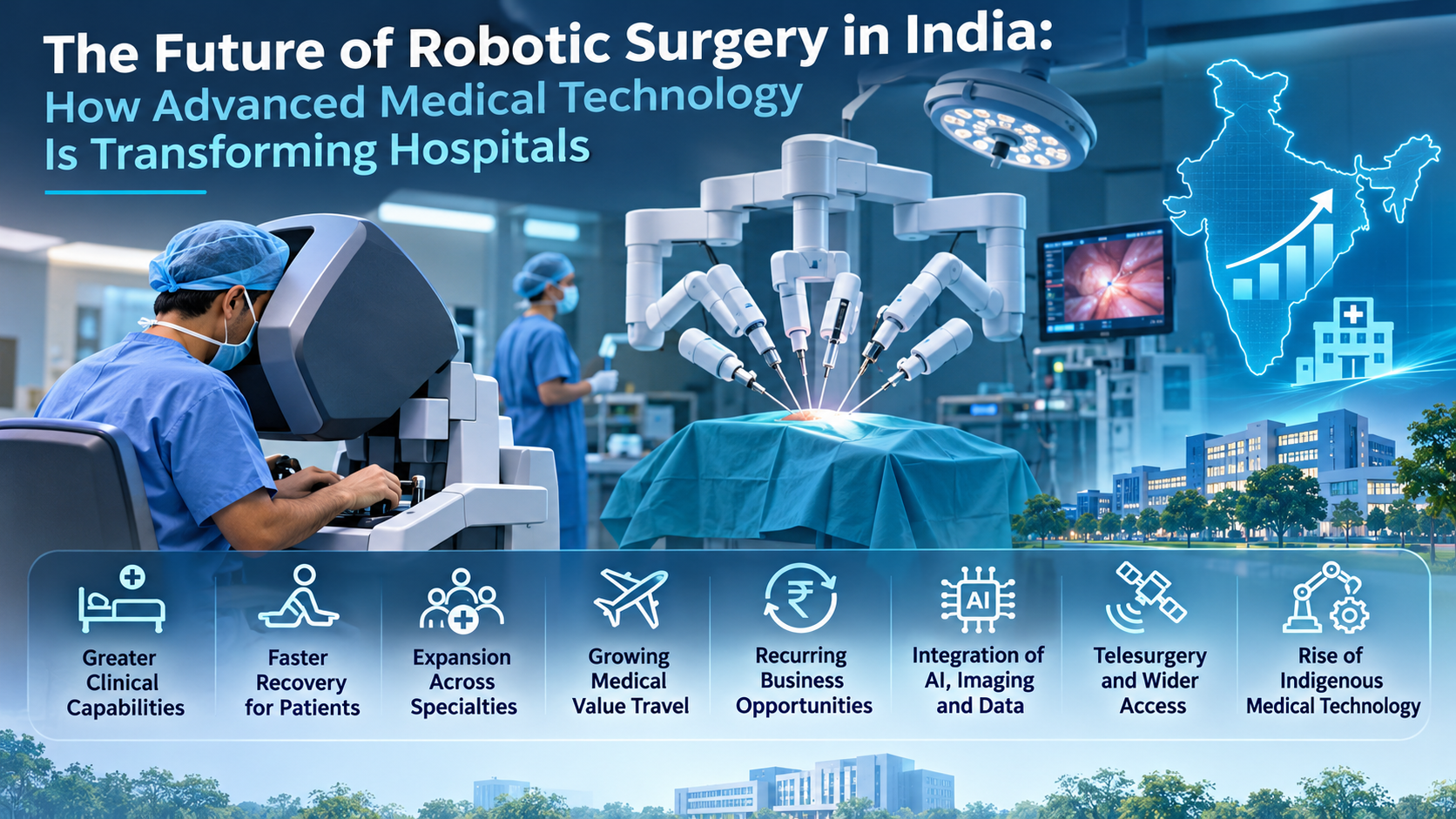
Nov 13: Surgery is entering a new era as precision, technology and medical expertise come together to transform patient care. From cancer operations to urological, orthopaedic and gynaecological procedures, robotic-assisted surgery is changing how doctors perform complex treatments and expanding access to advanced surgical techniques.
Indian hospitals are increasingly investing in robotic systems, advanced imaging, specialised operating rooms and surgeon training. This reflects a broader shift towards technology-driven healthcare, with a focus on improving clinical capabilities, operational efficiency and patient experience.
However, the growth of robotic surgery depends on more than advanced machines. Skilled professionals, strong hospital infrastructure, affordable treatment and measurable patient benefits will be essential. At the same time, this shift is creating opportunities for medical technology companies and India’s indigenous healthcare innovation ecosystem.
Understanding Robotic Surgery and How It Works
Robotic-assisted surgery is a form of minimally invasive surgery in which a surgeon controls specialised robotic instruments through a computer console. The system translates the surgeon’s hand movements into precise movements of small instruments positioned inside the patient’s body.
Many systems provide magnified three-dimensional views of the operating area, allowing surgeons to examine delicate structures more clearly. Robotic instruments can also offer greater flexibility and movement in confined surgical spaces compared with conventional instruments.
Importantly, robotic surgery does not generally mean that a robot operates independently. The surgeon remains in control throughout the procedure, making clinical decisions and directing every surgical movement.
By combining human expertise with advanced technology, robotic systems can support complex procedures while potentially reducing the physical impact of surgery in suitable cases.
Why Indian Hospitals Are Increasingly Investing in Robotic Surgery
India’s healthcare sector is seeing rising demand for advanced treatments and minimally invasive procedures. As patients become more aware of treatment options, hospitals are increasingly adopting technologies that strengthen their clinical capabilities.
This trend is reflected in robotic surgery adoption. According to figures presented at the Society of Robotic Surgery India conference, robotic-assisted procedures increased from 8,912 in 2021 to 44,857 in 2025, although access remains concentrated in larger hospitals and specialised centres.
Several factors are encouraging hospitals to invest:
- Advanced clinical capabilities: Robotic systems can support complex procedures requiring precise movements and detailed visualisation.
- Growing patient expectations: Greater awareness of minimally invasive treatment is increasing interest in advanced surgical options.
- Hospital competitiveness: Modern surgical infrastructure can strengthen a hospital’s position in the premium healthcare segment.
- Specialty expansion: Robotic technology is being adopted across urology, gynaecology, general surgery, oncology and orthopaedics.
- Medical tourism: Advanced surgical facilities can help Indian hospitals attract international patients seeking specialised treatment.
For hospitals, robotic surgery is increasingly becoming a long-term investment in clinical development, technology adoption and service differentiation.
India’s Surgical Robotics Market: Strong Growth Potential
The rapid adoption of robotic-assisted procedures is creating a significant commercial opportunity for India’s healthcare and medical technology sectors.
According to Grand View Research, India’s AI-based surgical robots market generated revenue of approximately USD 176 million in 2023 and is projected to reach USD 901.1 million by 2030, representing a compound annual growth rate (CAGR) of 26.3% between 2024 and 2030.
The broader surgical robotic systems market is also expanding. Grand View Research estimates that it generated approximately USD 309.2 million in 2025 and could reach USD 1.63 billion by 2033, growing at a CAGR of 21.94% between 2026 and 2033. These forecasts cover different market categories and should be understood separately. Together, they highlight the growing commercial importance of surgical robotics, including equipment, accessories, consumables and support services.
Another important development is the growth of recurring revenue opportunities. Robotic instruments and accessories require replacement or replenishment, while hospitals also need installation, maintenance, software upgrades and technical support. Grand View Research identifies surgical robotic accessories as the largest revenue-generating component in India’s broader market in 2025, while surgical robotic services are projected to be the fastest-growing component.
This creates opportunities not only for robotic equipment manufacturers but also for suppliers, service providers, software developers and specialised training organisations.
Key Medical Applications Transforming Surgical Care
Robotic technology is expanding across several medical specialties, including:
- Urology: Used in prostate, kidney and bladder surgeries, helping surgeons perform precise movements around delicate structures.
- Cancer Treatment: Supports selected prostate, colorectal and gynaecological cancer procedures through enhanced visualisation and instrument control.
- Gynaecology: Used in hysterectomy and selected procedures for endometriosis, offering minimally invasive options for suitable patients.
- General and Gastrointestinal Surgery: Applied in selected abdominal, colorectal and hernia procedures, particularly in difficult-to-reach areas.
- Orthopaedics: Assists with joint replacements through personalised planning, bone preparation and accurate implant positioning.
- Cardiac and Thoracic Surgery: Supports selected minimally invasive procedures involving the heart and chest.
This growing use across specialties shows that robotic surgery is becoming an important part of advanced hospital services.
Benefits for Patients: Precision, Recovery and Treatment Experience
Robotic-assisted surgery may offer smaller incisions, reduced blood loss, less postoperative pain and shorter hospital stays in suitable cases. Enhanced visualisation and instrument control can help surgeons perform delicate procedures with greater precision, potentially supporting faster recovery and an earlier return to daily activities.
However, outcomes vary depending on the patient, procedure and surgeon’s experience. Robotic surgery is not automatically safer or more effective than conventional or laparoscopic surgery. Treatment decisions should be based on clinical evidence and individual patient needs.
Artificial Intelligence and the Next Generation of Surgical Robotics
The future of robotic surgery will increasingly combine artificial intelligence, advanced imaging and digital healthcare systems. AI could assist surgeons with image analysis, identifying anatomical structures, surgical planning and real-time guidance, while 3D imaging may provide clearer views of patient anatomy.
Next-generation systems are also introducing features such as force feedback, allowing surgeons to better sense the pressure applied to tissues. Data analytics could further support surgical planning, performance assessment and postoperative monitoring.
By bringing together surgeons, robotics, AI and digital technologies, future operating rooms could enable more informed clinical decisions and improve surgical capabilities.
Telesurgery and 5G: Connecting Surgical Expertise Across Distances
Telesurgery is an emerging application of robotic technology that allows surgeons to operate remotely using high-speed networks. It could connect specialists in major cities with hospitals in smaller towns, helping reduce geographical barriers to advanced surgical expertise.
Recent demonstrations have shown the potential of remote robotic procedures across distances of nearly 5,000 kilometres, including a cross-border pre-clinical demonstration between India and China in 2026. These developments highlight the possibilities of 5G and reliable fibre connectivity for remote surgical assistance, mentoring and training.
However, wider clinical adoption will require dependable networks, strong cybersecurity, regulatory clarity, emergency backup systems and clear clinical responsibilities. If these challenges are addressed, telesurgery could expand access to specialist expertise across India.
Indigenous Innovation and India’s Medical Technology Opportunity
India’s growing focus on robotic surgery is creating opportunities for domestic medical technology innovation. Indigenous platforms could reduce dependence on imported equipment and improve affordability, service availability and access to advanced surgical technology.
The Indian-developed SSi Mantra system had 245 installed systems across 12 countries as of September 2026, supporting over 14,500 procedures across 218 hospitals, according to company disclosures. Meril’s MISSO robotic system is another example, supporting knee replacement through personalised planning, computer-assisted navigation and robotic assistance.
These developments highlight India’s potential to become not just a user but also a developer and manufacturer of advanced medical technology. Investment in research, engineering, clinical collaboration and domestic manufacturing can strengthen this growing ecosystem.
Business Opportunities: How Robotic Surgery Is Changing Hospital Economics
For hospital networks, robotic surgery is becoming a strategic investment rather than just a prestige purchase. It can improve specialised services, attract domestic and international patients, strengthen medical value travel and create recurring opportunities through consumables, maintenance and technical support. Faster recovery in suitable procedures may also improve bed availability and patient flow.
Major hospitals are expanding their programmes. One leading hospital programme in Chennai crossed 8,000 robotic-assisted procedures by February 2026, while Fortis Hospital, Bannerghatta Road, Bengaluru, reported 3,000 procedures using its da Vinci Xi system in August 2026. Hospitals are also adopting multiple robotic platforms to serve different specialties.
However, long-term returns depend on equipment utilisation, training, maintenance, consumable costs, reimbursement and patient outcomes—not simply procedure volumes.
The Cost Challenge: Making Robotic Surgery More Accessible
Despite its potential, the high cost of robotic surgery remains one of the biggest barriers to wider adoption in India.
Hospitals must consider the initial cost of equipment, operating-room modifications, specialised instruments, maintenance contracts and staff training. These expenses can influence the final treatment cost for patients.
Historically, the high capital expenditure associated with imported robotic platforms and recurring consumable costs restricted adoption largely to premium hospitals in major cities. The development of domestic platforms, flexible procurement arrangements and pay-per-use models could help change this situation.
Insurance coverage is another important factor. India’s insurance framework includes robotic surgery among modern treatment methods that insurers are expected to cover when medically indicated, although policy-specific limits, exclusions and conditions may apply. Patients should check their individual policy terms rather than assume that every robotic procedure or associated expense is fully reimbursedPublic-private partnerships, domestic manufacturing and carefully planned hospital investments could help make advanced surgical facilities more accessible beyond major metropolitan centres.
Training Surgeons and Building a Skilled Healthcare Workforce
Robotic surgery requires specialised training and experience. Surgeons must understand the technology, develop hand-eye coordination through the console and learn how to manage complex procedures using robotic instruments.
Hospitals also need trained anaesthetists, nurses, technicians, biomedical engineers and support teams to operate and maintain robotic systems effectively.
Medical colleges and teaching hospitals therefore have an important role in introducing structured robotic surgery training, simulation-based learning and supervised clinical practice. Training programmes should also preserve strong foundations in open and laparoscopic surgery so that future surgeons can make appropriate decisions across different surgical approaches.
Building a skilled workforce will be essential if India wants to expand robotic surgery safely and sustainably.
Improving Healthcare Access Beyond Major Cities
At present, advanced robotic surgical facilities are more commonly concentrated in large private hospitals and major urban healthcare centres. Patients from smaller cities and rural areas may need to travel long distances to access specialised treatment.
Lower-cost indigenous platforms, flexible financing and regional hospital partnerships could help extend robotic surgery to Tier-2 and Tier-3 cities. Telesurgery, remote consultation and tele-mentoring may also help connect experienced specialists with doctors working in smaller centres.
However, wider access should not mean installing expensive equipment without sufficient clinical demand or trained professionals. Hospitals must assess local healthcare needs, patient volumes and the availability of specialist teams before making such investments.
The goal should be to make advanced surgical care more accessible without compromising patient safety or financial sustainability.
Challenges Hospitals Must Address
The adoption of robotic surgery brings important operational and clinical considerations. Hospitals must evaluate the technology carefully and ensure that it delivers meaningful value.
Some of the major challenges include:
- High investment requirements: Equipment, instruments, maintenance and infrastructure involve substantial costs.
- Training and expertise: Surgeons and operating-room teams need structured training and continuing education.
- Clinical suitability: Robotic surgery may not be the best option for every patient or procedure.
- Technology dependence: Hospitals need contingency plans for equipment failure, connectivity problems and technical interruptions.
- Unequal access: Concentration of facilities in major cities can widen healthcare disparities.
- Insurance and reimbursement: Policy limits and differences in coverage can affect affordability.
- Clinical evidence: Hospitals should regularly evaluate outcomes, complications, recovery times and costs to establish the value of robotic procedures.
- Cybersecurity and regulation: Connected systems and telesurgery require strong data protection, network security and regulatory safeguards.
Responsible adoption requires a balance between technological ambition, clinical evidence, patient needs and financial discipline.
Conclusion: A New Chapter in India’s Surgical Future
Robotic surgery is becoming an important part of India’s healthcare transformation, bringing together medical expertise, engineering innovation and advanced digital technology. Growing procedure volumes, expanding hospital investments, indigenous platforms and the integration of artificial intelligence are creating new possibilities for surgical care.
However, the real success of this transformation will not be measured by the number of robotic systems installed in hospitals. It will depend on whether the technology delivers meaningful clinical outcomes, supports skilled medical professionals and becomes accessible to a wider section of the population.
Looking ahead, the integration of robotics, AI, advanced imaging, telesurgery and domestic medical technology could strengthen India’s position in global healthcare innovation. With the right investment in training, research, infrastructure and affordability, robotic surgery can become more than a symbol of modern hospitals.
The future of surgery in India will be shaped not simply by the machines operating in its hospitals, but by how effectively technology and human expertise come together to deliver safer, more precise and more accessible care.