
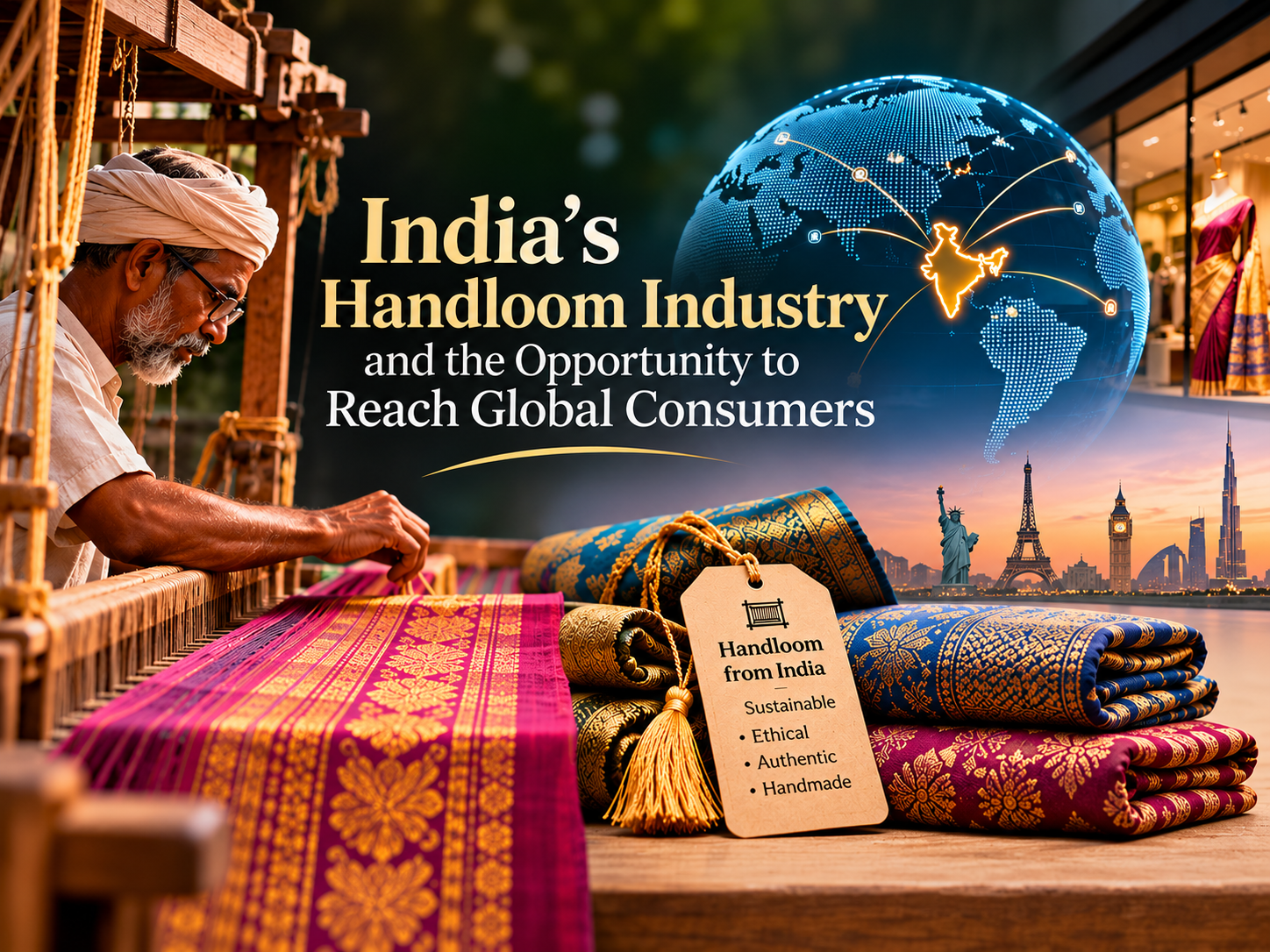
Nov 12: With growing global demand for sustainable, authentic, and ethically sourced products, India’s handloom sector has a unique opportunity to transform its rich craftsmanship into globally competitive brands and high-value businesses.
Beyond its cultural significance, handloom is a powerful economic ecosystem that supports rural livelihoods, generates employment, preserves traditional skills, and creates opportunities for women-led entrepreneurship. As India’s largest cottage industry and second-largest rural employer after agriculture, the sector sustains approximately 35.22 lakh weavers and allied workers across 31.45 lakh households, with women accounting for more than 72% of its workforce.
The industry’s commercial potential is equally compelling. According to recent figures highlighted by the Ministry of Textiles and the India Brand Equity Foundation (IBEF), India’s handloom exports reached approximately ₹1,330.96 crore–₹1,359.14 crore (US$153.8 million) in FY 2025–26, registering around 13% year-on-year growth. Yet, compared with India’s vast production capabilities and the rising international appetite for sustainable products, its global market presence remains relatively underdeveloped.
The opportunity, therefore, extends beyond increasing exports. It lies in transforming handloom from a largely fragmented, production-driven sector into a globally competitive, design-led and commercially sustainable industry. Achieving this transition will require coordinated investments in technology, branding, digital commerce, market intelligence, supply-chain infrastructure, and international business partnerships.
The Global Market Opportunity: Sustainability Meets Consumer Demand
The global handloom products market is projected to grow from US$9.67 billion in 2026 to US$20.39 billion by 2034, representing a compound annual growth rate (CAGR) of 9.78%, according to Fortune Business Insights.
Several emerging consumer and business trends are creating favourable conditions for Indian manufacturers and exporters.
Sustainable and Responsible Consumption: Growing concerns about fast fashion, excessive water consumption, carbon emissions, and textile waste are encouraging consumers to explore environmentally responsible alternatives. Handloom products, particularly those made using natural fibres such as cotton, silk and jute, offer opportunities to position Indian craftsmanship within the global sustainable-fashion movement. However, sustainability claims must be supported by credible production practices, material disclosures and certifications.
Premiumisation and Artisan Storytelling: International luxury consumers increasingly value product authenticity, craftsmanship and provenance. Indian textiles such as Banarasi silk, Sambalpuri Ikat, Pochampally, Chanderi and Kanchipuram possess distinctive regional identities that can command premium positioning when supported by quality assurance and effective branding.
Expansion Beyond Apparel: The international opportunity is not restricted to sarees, scarves and garments. Home furnishings, cushion covers, curtains, table linen, rugs and decorative fabrics offer substantial commercial potential. In FY 2024–25, made-ups accounted for approximately 42.4% of India’s handloom exports, while floor coverings contributed another 40.6%. This demonstrates the importance of developing product categories suited to international home and lifestyle markets.
Export Performance and Emerging International Markets
India’s handloom sector has significant potential to strengthen its position in global textile trade.
1. Export Performance: Key Indicators
- FY 2025–26 exports: Approximately ₹1,331–1,359 crore.
- Annual growth: Around 13%.
- Long-term ambition: US$10 billion export target by 2031.
- Major export destinations: USA, UAE, France, UK and Spain.
- Leading production clusters: Panipat, Karur, Varanasi and Kannur.
2. Emerging International Market Opportunities
- USA: Growing business opportunities in premium home furnishings, lifestyle products and contemporary ethnic fashion.
- Europe (France, UK and Spain): Demand for sustainable textiles, ethically sourced products and artisanal collections.
- UAE: Potential for luxury retail, hospitality textiles and high-end interior design.
- Emerging markets: Scope for expansion through international retailers, distributors and design collaborations.
3. Strategic Priorities for Indian Exporters
- Market diversification: Expand into new international markets and reduce dependence on traditional buyers.
- Product differentiation: Develop premium, contemporary and market-specific collections.
- Global branding: Position Indian handloom as a high-value, sustainable and authentic textile category.
- Strategic partnerships: Build relationships with international retailers, designers and hospitality brands.
- Export competitiveness: Strengthen quality standards, certifications, pricing strategies and supply-chain transparency.
Structural Challenges: What Prevents the Industry from Scaling
Despite its competitive advantages, India’s handloom industry faces structural constraints that restrict profitability and international expansion.
Powerloom Competition and Product Authenticity: Mechanised production frequently replicates traditional designs at lower prices. This creates market confusion, weakens the commercial value of authentic craftsmanship and places downward pressure on weaver incomes. Stronger certification, product labelling and intellectual property protection are essential to differentiate genuine handloom products.
Low Productivity and Limited Weaver Earnings: Fragmented production systems, inconsistent access to raw materials and limited bargaining power affect the financial sustainability of weaving households. Low earnings also discourage younger generations from entering the profession. Businesses must recognise that long-term export competitiveness depends on ensuring fair compensation and reliable production orders.
International Compliance and Quality Standards: Global buyers increasingly demand chemical safety, colour-fastness, durability testing, supply-chain transparency and responsible labour practices. Smaller weaving enterprises often lack the financial resources and technical capabilities to meet these requirements independently. Shared testing facilities, certification support and traceability systems can help bridge this gap.
Tariff and Market-Access Barriers: Import duties and differences in trade agreements can make Indian products less competitive against exports from countries enjoying preferential market access. Effective trade negotiations, export incentives and stronger bilateral commercial relationships can improve India’s position.
Building a Globally Competitive Handloom Business Ecosystem
The next phase of growth requires a multidimensional strategy that connects artisans, manufacturers, exporters, designers, technology providers and international retailers.
Digital Commerce and Direct-to-Consumer Business Models
Digital platforms can fundamentally change how handloom products reach international customers. Government-backed initiatives such as Indiahandmade and the Government e-Marketplace (GeM) are expanding digital market access for artisans and handloom enterprises.
However, the next opportunity lies in building internationally competitive direct-to-consumer (D2C) brands. Exporters can use global e-commerce marketplaces, independent websites and social-commerce channels to reach customers without depending entirely on traditional intermediaries.
Professional product photography, international payment gateways, transparent shipping policies and effective digital marketing will be essential. More importantly, digital storytelling should communicate the product’s origin, weaving technique, artisan contribution and material composition.
GI Protection, Branding and Product Traceability
Geographical Indication (GI) recognition offers an important commercial advantage by protecting products associated with specific geographical origins and traditional production methods. India’s GI-registered handloom products, including Chanderi, Jamdani and Kanchipuram, can be positioned as distinctive premium offerings.
Combining GI recognition with Handloom Mark certification and QR-enabled traceability can strengthen consumer confidence. International buyers should be able to verify authenticity, understand production processes and identify the origin of their purchases.
For exporters, these measures can support brand differentiation, reduce counterfeit risks and create opportunities for premium pricing.
Design Innovation and International Product Development
Traditional craftsmanship must be translated into products that match contemporary consumer preferences. Collaborations involving the National Institute of Fashion Technology (NIFT), the Handloom Export Promotion Council (HEPC), independent designers and international retailers can accelerate this transformation.
Lightweight fabrics, minimalist patterns, contemporary silhouettes and modern colour combinations can make Indian weaves more accessible to international markets.
Businesses should also invest in product diversification, particularly in hospitality textiles, sustainable upholstery, premium table linen, fashion accessories and customised interior products. Developing collections based on international seasonal trends can help exporters secure repeat orders and long-term retail partnerships.
Cluster Modernisation and Investment in Infrastructure
Production clusters need modern infrastructure without compromising traditional weaving techniques. Investments in ergonomic looms, common facility centres, yarn banks, design studios, testing laboratories and improved logistics can increase productivity and product consistency.
Government initiatives under the Union Budget 2026–27, including the Textile Expansion and Employment Scheme and the Mahatma Gandhi Gram Swaraj Initiative, provide opportunities to strengthen traditional textile enterprises. The National Fibre Scheme can further support raw-material availability.
Public-private partnerships can complement these efforts by connecting rural production clusters with export houses, institutional buyers and international design networks.
Women-Led Entrepreneurship and Inclusive Business Growth
With women representing over 72% of the workforce, women’s economic participation must become a central component of the industry’s growth strategy. Access to finance, digital literacy, business training and leadership opportunities can help women move beyond production roles into enterprise ownership and market participation.
Developing producer companies, self-help group enterprises and artisan-led brands can improve income distribution while strengthening the industry’s supply base.
Conclusion: Taking Indian Handloom to Global Markets
India’s handloom industry is sitting on an extraordinary commercial opportunity: a global market increasingly interested in products that combine design, sustainability, authenticity and human craftsmanship. But heritage alone cannot guarantee international success. The real competitive advantage will emerge when traditional skills are supported by modern business practices, reliable infrastructure, strong branding and globally recognised quality standards.
For exporters, the opportunity lies in moving beyond bulk commodity sales towards differentiated, high-value products. For entrepreneurs and investors, it lies in building scalable artisan-led brands, digital marketplaces and transparent supply chains. For policymakers, the priority must be to create an ecosystem where rural craftsmanship can compete confidently in international markets while ensuring fair and sustainable livelihoods.
The future of Indian handloom will not be determined merely by how much the country produces, but by how effectively it connects its artisans to the world’s consumers. By turning every weave into a story of authenticity, every production cluster into a competitive business hub, and every artisan into a valued participant in global commerce, India can transform its centuries-old weaving tradition into a powerful engine of inclusive economic growth and international trade.