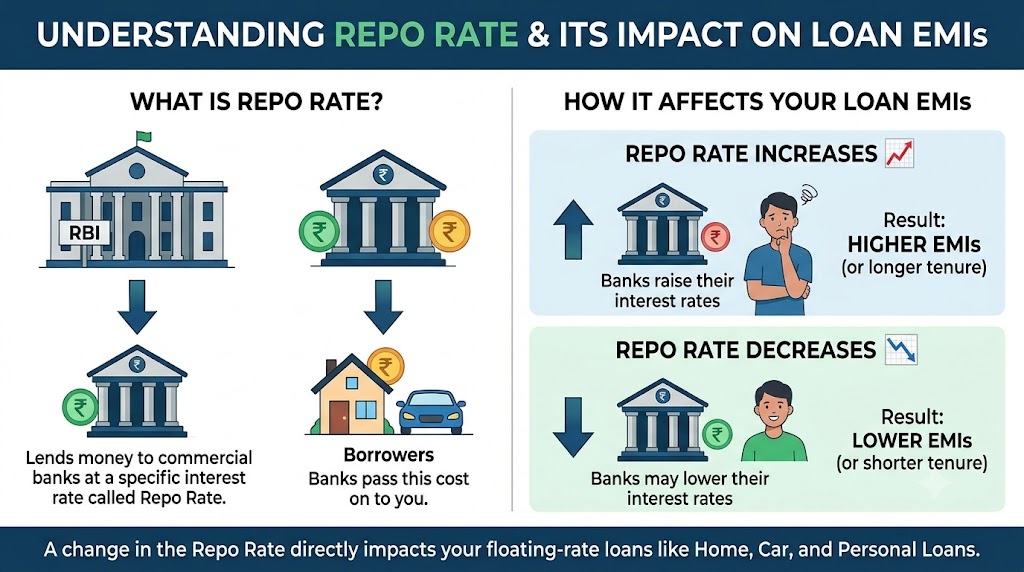
A change in the Reserve Bank of India’s (RBI) repo rate may appear to be a technical financial decision, but its effects can reach almost every corner of the economy. From a family paying a home loan to a small business owner arranging funds for inventory, changes in borrowing costs can influence spending decisions, savings and long-term financial planning.
On October 7, 2026, the RBI raised the repo rate by 25 basis points, taking it from 5.25% to 5.50%. The decision has renewed attention on how monetary policy influences loan interest rates and monthly equated instalments (EMIs). However, the effect on individual borrowers will depend on their loan agreements, interest-rate structures and lenders’ decisions.
Understanding this relationship can help households plan their finances more confidently while enabling businesses to prepare for changes in the cost of credit.
Understanding the Repo Rate
The repo rate is the interest rate at which the RBI lends short-term funds to commercial banks against eligible securities. It is an important monetary policy instrument used to influence inflation, credit availability and economic activity.
When inflationary pressures rise, the central bank may increase the repo rate to make borrowing more expensive and moderate demand. When economic conditions allow, a rate reduction can encourage borrowing, investment and consumption.
These decisions influence the broader financial system, although banks do not necessarily change every lending rate immediately or by the same amount.
For borrowers, the important question is not simply whether the repo rate has increased or decreased, but whether their particular loan is linked to a benchmark that responds to the change.
How a Repo Rate Change Affects Loan EMIs
An EMI consists of the principal repayment and interest charged on the outstanding loan. When the interest rate changes on an eligible floating-rate loan, the monthly instalment, repayment period or both may be affected.
Consider a homebuyer with a ₹30 lakh loan and a remaining tenure of 20 years. At an annual interest rate of 6.90%, the estimated monthly EMI is approximately ₹23,079. If the rate rises to 7.15%, assuming the full 25-basis-point increase is passed on and the repayment period remains unchanged, the EMI increases to around ₹23,530.
The difference is approximately ₹451 per month. Over a year, that amounts to about ₹5,400 in additional payments, assuming the revised EMI remains constant throughout the period.
For some households, this may be manageable. For others, particularly families balancing education costs, healthcare expenses and everyday purchases, the additional payment can require adjustments to the monthly budget.
The calculation is illustrative. Actual repayments depend on the outstanding principal, remaining tenure, applicable interest rate and lender’s repayment policy.
Why Small Rate Changes Can Have a Big Impact
The impact of interest-rate changes becomes more significant when considered over the entire repayment period.
Home loans often extend across 15 to 30 years. Even a modest increase in the lending rate can add to the total interest payable if the loan remains outstanding for a long period. If the lender keeps the EMI unchanged and extends the tenure, the monthly budget may remain stable, but the borrower could pay interest for longer.
A rate reduction can offer the opposite opportunity. Borrowers whose floating rates are revised downward may benefit from a lower EMI or a shorter repayment period. Those who can afford to maintain their existing EMI after a rate reduction may repay the principal faster and potentially save on interest.
This makes it important to examine the overall cost of borrowing rather than focusing exclusively on the monthly instalment.
Fixed-Rate and Floating-Rate Loans: Know the Difference
The effect of RBI policy changes depends largely on the type of loan.
Floating-rate loans can change in line with the applicable benchmark and the terms agreed with the lender. Repo-linked loans are generally more directly responsive to repo rate movements, although the adjustment may occur only at the scheduled reset date.
Fixed-rate loans generally retain the agreed interest rate during the fixed-rate period, subject to the loan contract. Borrowers with such loans are therefore usually less directly affected by policy rate changes during that period.
Before signing a loan agreement, borrowers should understand how interest is calculated, when the rate can change and whether the lender can revise the EMI or extend the repayment tenure.
Beyond Home Loans: The Business Perspective
The repo rate also matters to India’s business community, particularly micro, small and medium enterprises (MSMEs), retailers, manufacturers and service providers that depend on credit to manage day-to-day operations.
For a small retailer, higher borrowing costs can make it more expensive to stock products ahead of a busy sales season. A manufacturer may have to pay more to finance raw materials or purchase machinery, while a service provider may face higher costs when expanding operations or hiring employees.
Businesses operating on thin margins can be especially sensitive to these changes. Higher interest expenses may reduce profits, delay expansion plans and limit the funds available for new investments.
Lower borrowing costs, by contrast, can improve the affordability of working capital and equipment finance. This may encourage businesses to increase production, strengthen distribution networks and explore new markets.
However, interest rates are only one part of the business environment. Customer demand, input prices, cash flow and access to credit also determine whether an enterprise can grow.
Practical Ways to Manage Changing Interest Rates
Borrowers can take several steps to reduce the financial pressure caused by changing lending rates.
Review loan terms regularly. Check the applicable interest rate, outstanding principal, EMI and remaining tenure whenever the lender revises the rate.
Build financial flexibility. An emergency fund can help households continue repayments during periods of unexpected expenses or income disruption.
Evaluate part-prepayments. Borrowers with surplus funds may reduce their outstanding principal through part-prepayment, subject to applicable terms and charges. Essential savings should not be sacrificed to make a large repayment.
Compare refinancing options carefully. A balance transfer may offer savings if another lender provides more favourable terms. Processing fees and other charges must be considered before making a decision.
Strengthen business cash flow. For enterprises, timely collection of customer payments, efficient inventory management and careful budgeting can reduce dependence on expensive short-term borrowing.
The objective is not merely to respond to every interest-rate change, but to maintain a financial position that can withstand uncertainty.
What Lies Ahead for Borrowers?
With the repo rate at 5.50% following the October 7, 2026, decision, borrowers will need to monitor how lenders respond. Future policy decisions will depend on inflation, economic growth, energy prices and other domestic and international developments.
A repo rate hike does not automatically mean that every loan EMI will rise immediately. Similarly, a rate cut does not guarantee instant relief for all borrowers. The actual outcome depends on the loan’s benchmark, contractual terms and rate-reset schedule.
For prospective homebuyers, this makes affordability an important consideration. Instead of calculating repayments only at the current interest rate, they should assess whether their income can support the loan if borrowing costs increase.
Businesses can follow a similar approach by stress-testing their budgets against higher interest expenses before committing to major investments.
Conclusion
The repo rate may be determined by the RBI, but its implications extend well beyond monetary policy meetings. It can influence household budgets, housing affordability, consumer spending, business investment and the overall cost of credit.
As India’s economy continues to evolve, borrowers who understand their loan terms and plan for changing interest rates will be better positioned to manage financial uncertainty. For households, that means balancing repayments with savings and essential expenses. For businesses, it means protecting cash flow while investing carefully in growth.
Ultimately, responsible borrowing is not just about securing the lowest available interest rate. It is about understanding the long-term commitment, preparing for possible changes and ensuring that repayments remain sustainable across different economic conditions.